
Online Dating Tips That Actually Work (2026)
The online dating tips that actually work are simple: pick the app that matches what you want, write a profile with recent photos and specific details someone can reply to, open with a question about their profile, and move from chat to a short video call and a public first date within days, not weeks. Keep every conversation on the app until you have met, and never send money to someone you have not met in person.
This hub turns each of those tips into something you can act on, with numbers from Pew Research and the FTC instead of guesswork, and points you to the rankings and reviews that fit your situation. Every tips guide I publish is listed at the bottom of the page.
The first of the online dating tips: pick the app that fits your goal
Most tip lists skip this, and it is the tip that matters most: the best profile in the world will not work on an app whose crowd wants something else. Decide what you want first, then pick from the matching list.
- You want a relationship: start with Hinge or OkCupid, or a paid site like Match or eHarmony if you want a slower, more committed pool. My serious dating apps ranking compares them.
- You want something casual: Tinder has the biggest pool. The best apps for casual dating and the hookup dating sites pages go further.
- You do not want to pay: the free dating sites hub sorts apps by what the free tier really unlocks.
- You are over 50: see the best dating apps over 50 and the senior dating sites ranking.
- You are LGBTQ+: the LGBTQ+ dating sites page covers apps built for you, not just with a filter.
- You are torn between two big apps: the dating app comparisons put them side by side, starting with Hinge vs Bumble.
Know the real odds before you start
Online dating works for a lot of people, but not as fast as the ads suggest. Here is what Pew Research Center’s survey of 6,034 US adults (July 2022, published February 2023) found:
- Who uses it: 30% of US adults have ever used a dating site or app. The age group that uses dating sites the most is adults under 30 (53%), then 30 to 49 (37%), 50 to 64 (20%) and 65 and older (13%). Among lesbian, gay and bisexual adults it is 51%.
- Does it lead somewhere: 10% of partnered adults met their current partner on a dating site or app, and 20% of partnered adults under 30 did.
- How it feels: users are split, 53% positive and 46% negative. Men are more positive (57%) than women (48%).
- Men and women get opposite problems: 54% of women who used an app in the past year felt overwhelmed by the number of messages, while 64% of men felt insecure about getting too few.
That last point is why generic advice often misses. If you are a man getting few replies, the fix is a sharper profile and better first messages, not more swiping. If you are a woman drowning in messages, the fix is filters, a clear statement of what you want, and permission to ignore low-effort openers.
Build a profile people can answer
A good profile does two jobs: it shows clearly who you are, and it gives the right person an easy way to start talking. The advice that shows up across dating coaches, forums and Google’s own summary is consistent:
- Lead with a recent, clear photo of your face, smiling, without sunglasses or a group. Add a full-body shot and one or two photos doing something you actually enjoy. Skip bathroom mirror selfies and photos of landmarks without you in them.
- Use photos from the last year or two. Showing up looking different from your pictures ends most first dates before they start. The same goes for your age: own it.
- Say what you are looking for, in plain words: a relationship, something casual, marriage, kids or no kids. Most apps have a field or badge for it. Stating it costs you a few matches who wanted something else, and saves you weeks.
- Write specifics, not adjectives. “Loves travel” gives nobody anything to reply to. “Still trying to recreate the cacio e pepe from a trip to Rome” does.
- Keep it positive. A list of what you do not want reads as bitterness, even when it is fair.
If your profile is the bottleneck, the completely free dating apps are a cheap place to test a new version before paying anywhere.
Write first messages that get answers
“Hey” is the most common opener and the easiest to ignore. A first message that works does three things: it shows you read their profile, it asks one question, and it is short enough to answer in a few seconds. Comment on a specific photo or prompt, ask about it, and stop. On apps like Hinge you can reply to one prompt directly, which does most of the work for you.
If the conversation goes well, keep matching their energy: similar message length, a question back now and then, no walls of text. If they answer in one word twice in a row, move on without taking it personally.
Move off the chat at the right speed
Dating coaches call it pen pal syndrome: weeks of great texting with someone you have never met, followed by zero chemistry in person. The fix is to suggest a short phone or video call after a few good exchanges, then a first date soon after. A video call also does safety work, because it proves the person is who their photos say, and someone who keeps refusing one is a person to unmatch.
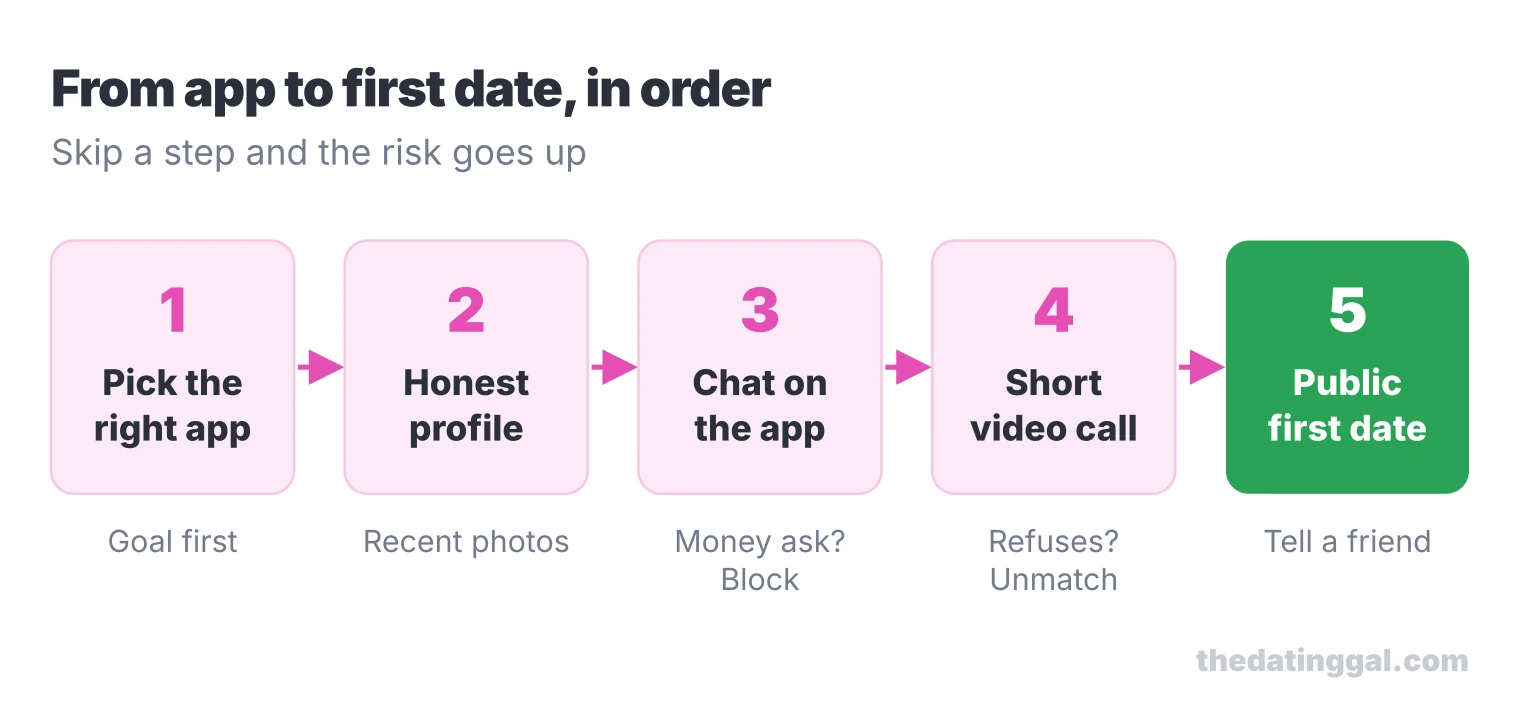
The order matters. Keep chatting inside the app until after you have met: the apps’ reporting and blocking tools only work there, and moving to text or WhatsApp too early is exactly what scammers ask for (more on that below).
Plan a short, low-stakes first date
A first date is a check, not an audition. Coffee, a walk, a single drink or a daytime breakfast works better than a long dinner: it is cheap, easy to leave, and it leaves room for a second date if it goes well. Pick a busy place you do not visit regularly, get there on your own, and keep the first meeting to an hour or so.
On the date, be curious rather than impressive. Ask about their life, leave the exes out of it, and if you are not feeling it, say so kindly afterward instead of ghosting.
Online dating safety tips that apps themselves give
The big apps publish their own safety advice, and it lines up with the tips women share on forums. Tinder’s safety tips and Bumble’s safety page boil down to:
- Keep your home address, workplace, daily routine and details about your children to yourself until you know the person.
- Talk on the app, then on a phone or video call, before meeting.
- Meet in a public place and stay there. Tell a friend who you are meeting, where and when, and check in when you get home.
- Control your own transportation, and have a backup ride.
- Do not leave your drink unattended, and take drinks directly from the staff.
- Leave if you feel uncomfortable, and ask a bartender or server for help if you feel unsafe.
- Never send money or share financial information, and report anyone who asks.
Use the safety tools the apps already give you
None of the top-ranking tip lists mention them, but the apps have built-in tools that do part of the vetting for you. Bumble’s safety page names Photo Verification (it suggests asking a match to complete it before meeting), in-app video and voice calls so you do not have to share your number, Private Detector, which blurs lewd images, Snooze mode for breaks, and unmatch, block and report. Tinder tells users to block and report fake profiles, harassment and spam from inside the app.
A verified badge is not a background check: it shows the person matches their photos, not that they are safe. Use it as one step, alongside the video call and a public first meeting. Each app’s safety tools are covered in its review, such as the Bumble review and the Tinder review.
Spot a scam before it costs you
Romance scams are common enough to plan for. In the same Pew survey, 52% of online daters said they think they have come across someone trying to scam them. The FTC’s data on romance scams shows how they work: about 70,000 people reported one in 2022, with $1.3 billion in reported losses and a median loss of $4,400. Gift cards were the payment method named most often (24% of loss reports), while cryptocurrency and bank wires made up more than 60% of the money lost. About 40% of detailed reports mentioned WhatsApp, Google Chat or Telegram, which is why the first move is usually to get you off the dating app.
The FTC’s romance scam warning signs are worth memorizing:
- They want to move off the app quickly.
- They say it is love fast, but live far away, often “in the military” or “on an oil rig”, and can never meet or video call.
- They ask for money, gift cards, crypto or help with an “investment”, usually with an emergency attached.
- Their photos show up under another name in a reverse image search.
If it happens: stop replying, report the profile in the app, and report it to the FTC at ReportFraud.ftc.gov. If you already paid, contact your bank or the gift card company right away.
Red flags and boundaries
Leaving early is not being too picky. Common red flags: pressure to meet somewhere private, pushing past a no on anything (photos, personal details, plans), a profile that does not match what they tell you, and anyone who mocks or tests you to get a reaction. Pew found that 30% of online daters had someone keep contacting them after they said they were not interested, and 38% received sexually explicit messages or images they did not ask for. Block and report both; that is what the tools are for.
Decide your boundaries before you start, such as what you share, how soon you meet, what you will not compromise on, so you are not deciding them under pressure.
Protect your time and energy
Online dating is a numbers game, and burnout is the most common reason people quit. A few habits help:
- Set a time limit, such as 20 minutes in the evening, and turn off notifications the rest of the day.
- Use one or two apps well instead of five badly.
- Give it a few months before judging, and take a break the moment it starts hurting your mood.
- Keep meeting people offline too. The dating app alternatives hub has ways to meet that do not involve swiping.
What about the 3-3-3 rule, the 72-hour rule and the 5 P’s?
These come up constantly in searches, and they are social media rules of thumb, not research. Their definitions change from one creator to the next. In the versions that circulate most, the 3-3-3 rule is about pacing (checking in with yourself at around three dates, three weeks and three months), the 72-hour rule suggests waiting about three days before a big step such as sleeping together or deciding how you feel, and the 5 P’s are lists of behaviors or types of people to avoid. The useful idea behind all of them is the same: slow down, notice how the person treats you, and do not let a rule override your own judgment. As for how soon to become exclusive, there is no standard timeline; the honest answer is to ask once you know you want it.
Online Dating Tips That Actually Work: sections
- Online Dating Safety: Scams, Red Flags and Safe Apps (2026) How to verify a match, spot romance and sugar scams, choose apps that verify users and report a scam in the US.