
Do Dating Apps Actually Work? What the Research Says (2026)
Yes, dating apps do work, but for a minority of users at any given moment, and much better for some people than others. In Pew Research Center’s 2023 survey, 10% of partnered US adults met their current partner on a dating app or site, rising to 20% of those under 30 and 24% of lesbian, gay and bisexual adults. They work best when you pick an app whose users want what you want, use it actively, and move to a real date quickly.
The rest of this page is what the research actually says, why so many people feel the apps fail them, and what separates the people they work for from the ones who give up.
Do dating apps actually work? What the numbers say
The best US data comes from Pew Research Center’s key findings on online dating, a survey of 6,034 US adults run in July 2022 and published in February 2023:
- 30% of US adults have ever used a dating site or app: 53% of adults under 30, 37% of those 30 to 49, 20% of those 50 to 64 and 13% of those 65 and older.
- 10% of partnered adults met their current partner on a dating site or app. That is 20% among partnered adults under 30 and 24% among partnered LGB adults.
- 42% of users say the apps made finding a partner easier, 22% say harder, and 32% say they made no difference.
- 53% of users describe their experience as positive and 46% as negative. Men are more positive (57%) than women (48%).
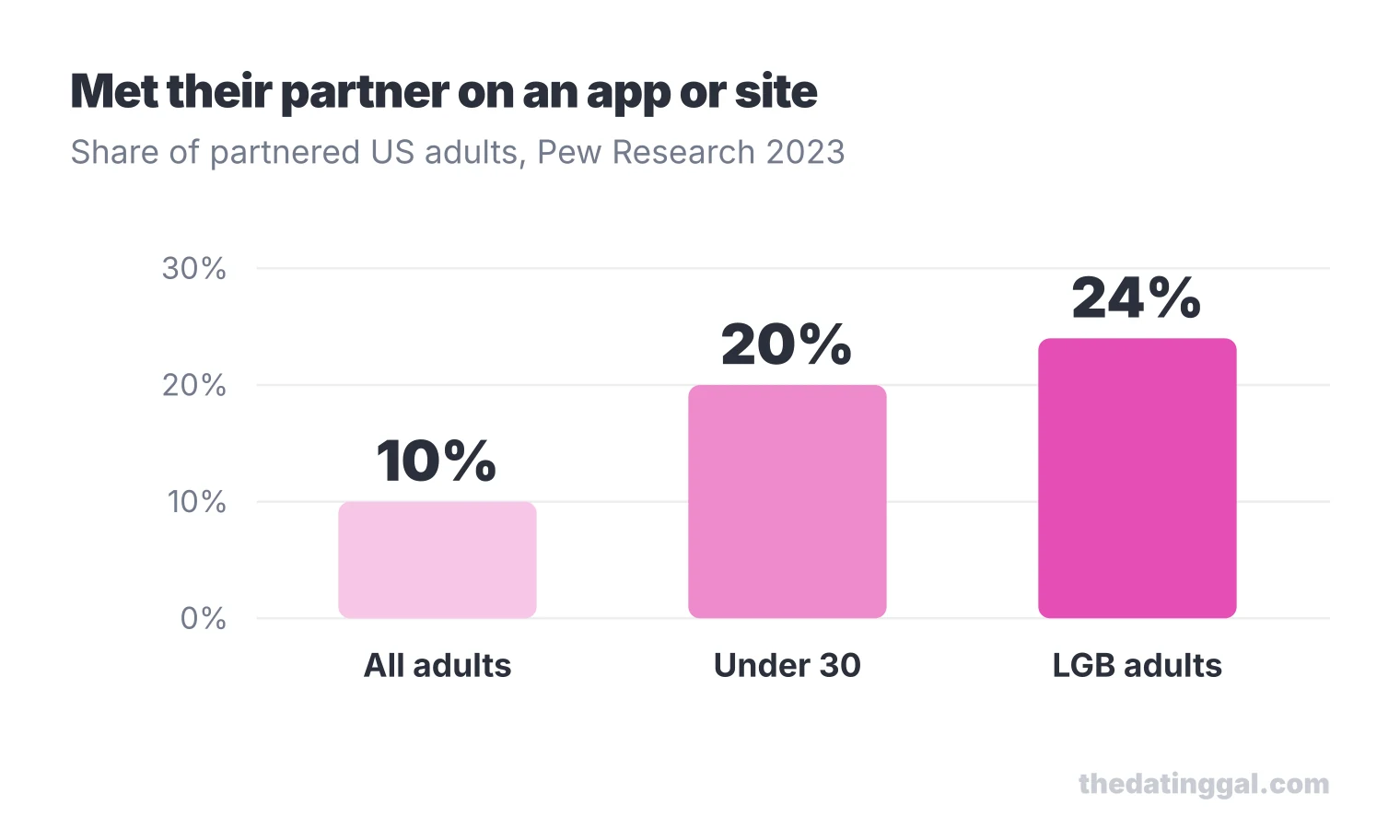
An earlier Pew report, The Virtues and Downsides of Online Dating (survey of 4,860 adults, October 2019), found that 12% of all US adults have married or been in a committed relationship with someone they first met on a dating site or app, about 20% of adults under 30 and of LGB adults. It also found that 71% of online daters found it at least somewhat easy to find people they were physically attracted to. Finding attractive people is not the hard part. Turning them into a relationship is.
“Most couples meet online”: which number is right?
You will see two very different numbers quoted, and Google’s own AI summary mixes them up when it says 40 to 50% of modern couples met online. Both come from solid research. They just measure different things.
- About 10% is Pew’s share of all partnered adults who met their current partner online. It includes couples who got together in the 1980s, long before apps existed.
- About 39% is the share of heterosexual couples who met in 2017 and met online, from Stanford sociologist Michael Rosenfeld’s How Couples Meet and Stay Together survey, published in PNAS in 2019 as “Disintermediating your friends”. For same-sex couples who met in 2017 it was about 65%. The study found that meeting online overtook meeting through friends as the most common way heterosexual couples meet around 2013.
So the honest summary is this: among couples forming now, meeting online is the single most common route, but it is still well under half for straight couples, and no primary source I could open supports figures like “less than 24% find a long-term partner” or “34% never get a date” that circulate in AI answers. Treat those as unsourced.
Do relationships that start on an app last?
This is the fear behind a lot of “do dating apps work” searches: maybe you meet someone, but is it real? The Rosenfeld paper addresses it directly. Using follow-up data on the same couples over time, the researchers found that how couples met had no significant effect on breakup rates or relationship quality. The one difference they did find: heterosexual couples who met online moved to marriage faster.
In other words, an app is an introduction, not a type of relationship. Once two people are together, the way they met stops mattering.
Who dating apps work best for
The data and the essays in Google’s top results agree on who gets the most out of apps:
- LGBTQ+ daters. 51% of LGB adults have used a dating app, against 28% of straight adults, and LGB users are more positive about it (61% vs 53%). In a small or conservative town, an app may be the only place people are openly out and looking. My LGBTQ+ dating sites ranking covers the apps built for that.
- People under 30. Twice as likely as the average adult to have met their partner online, because that is where their peers are.
- People whose social circle is tapped out: new in town, working long hours, rural, recently divorced, or simply past the age when friends set you up. Apps put you in front of people you would never cross paths with.
- People who know what they want. Pew found 44% of recent users were looking for a long-term partner and 40% for casual dating. When your goal matches the app’s crowd, the odds go up sharply.
Apps work less well for people who want chemistry to happen first and conversation second, and for anyone using them mostly when lonely or bored, which is when rejection lands hardest.
Why it feels like dating apps don’t work
If the numbers are decent, why are so many people tired of them? The research points to a few specific problems, and they hit men and women differently.
Men and women get opposite problems
Among people who used an app in the past year, 64% of men felt insecure about getting too few messages, while 54% of women felt overwhelmed by getting too many. Men tend to experience the apps as silence. Women tend to experience them as noise they have to filter, which is part of why women’s overall view is more negative.
Bad behavior is common
According to Pew, 38% of online daters have received sexually explicit messages or images they did not ask for, and 30% had someone keep contacting them after saying they were not interested. Among women under 50, the share who received unsolicited explicit content is 56%. That wears people down even when they do get dates.
Scams and fake profiles
52% of online daters believe they have come across someone trying to scam them. Profiles that turn out not to match the person, from old photos to outright catfishing, come up in almost every personal story in the top results.
Too much choice, slow conversations
37% of users say the apps offer too many options. Endless choice makes every match feel replaceable, which is how you get the pattern the PureWow piece describes: match, take days to reply, forget why you liked each other. Ghosting is not new, but apps make it effortless.
How dating app algorithms decide who sees you
People often suspect the apps hide them on purpose. The only first-hand explanation most apps give is general, but Tinder has published one. In “Powering Tinder: The Method Behind Our Matching”, it says:
- Activity matters most. Tinder prioritizes people who are active, especially active at the same time as you. Its own advice for better matches is simply to use the app.
- Distance and your settings (age range, gender, location) set the pool.
- Your profile and behavior refine it: the interests you add, cues from photos you like, and how your profile and others nearby get liked or passed.
- No more Elo. Tinder says it no longer uses the old Elo “desirability score”, and that it does not track social status, religion or ethnicity.
The practical takeaway works on most apps: open the app regularly for short sessions rather than in rare binges, fill in your profile, and be selective with likes instead of liking everyone.
Does paying make dating apps work better?
Google’s AI summary raises the obvious suspicion: an app that finds you a partner loses a customer, and free tiers are limited to push upgrades. Pew’s data gives part of an answer. 35% of users have paid for a dating platform, and 58% of paying users describe a positive experience against about half of those who never paid.
That is a correlation, not proof that paying works: people who pay may simply be more committed or older. My view is to start free, fix your profile and your messages first, and pay for one month only if a specific paid feature solves a problem you actually have, such as seeing who already liked you. The free dating sites hub sorts apps by what the free tier really includes.
Which dating app works for which goal
There is no public data showing one app produces the most relationships, so “the most successful dating app” really means the one where people with your goal are. Pew’s survey shows where users are: 46% of US online daters have used Tinder, 31% Match and 28% Bumble, with OkCupid, eharmony and Hinge each around 20%. Among users 50 and older, 50% have used Match and only 11% Tinder.
- If you want a relationship and you are under 40: start with Hinge or Bumble. The Tinder vs Hinge comparison covers the difference in crowd.
- If you want a relationship and do not mind paying for a slower pool: Match or eHarmony. My serious dating apps ranking compares them.
- If you want something casual: Tinder has the biggest pool, and the best apps for casual dating list goes further.
- If you are over 50: go where your age group is, which per Pew is Match far more than Tinder. See the best dating apps over 50.
- If you want detailed matching questions: OkCupid still leans on long profiles and questions.
How to make dating apps work for you
The advice in the top results comes down to honesty and timing, and Tinder’s own explanation of its algorithm backs up the timing part. Put together:
- Pick one or two apps that match your goal, not five. Spreading thin means being inactive everywhere, and activity is what the algorithm rewards.
- Be honest in your profile. Recent photos and your real age. A date that starts with “you look nothing like your photos” is over before it begins, and that story shows up in the top results for a reason.
- Say what you are looking for in plain words. It costs you matches who wanted something else and saves you weeks.
- Write first messages that reference their profile and ask one question. “Hey” is easy to ignore.
- Move to a short call, then a short public date, within a week or two. Long chats that never turn into a meeting are where most matches die.
- Use short sessions and take breaks. Log off when it starts to feel personal. An app cannot measure your worth, only your patience.
The online dating tips hub turns each of these into specific steps, from profile photos to first-date plans.
Red flags and scams to watch for
A big part of making apps work is not wasting time, or money, on people who are not real. The FTC’s guide to romance scams lists the classic signs:
- They want to move the conversation off the app quickly, to text, email or another messaging app.
- They always have a reason they cannot meet in person, often that they live abroad or are in the military.
- They ask for money, for medical bills, travel or fees, and push you to pay by wire transfer, gift card, payment app or cryptocurrency.
The FTC’s rule is simple: never send money or gifts to someone you have not met in person. Stop replying, report the profile in the app, and report it to the FTC at ReportFraud.ftc.gov. Beyond scams, treat pressure to meet somewhere private or anyone who pushes past a no as reasons to unmatch. The online dating safety hub covers the rest.
When to put the apps down
Apps are one way to meet people, not the only one. In the PureWow poll of 60 singles in the top results, set-ups through friends and meeting at bars still came up often, and Rosenfeld’s data shows meeting through friends was the most common route for decades. If the apps have made you feel worse about yourself for weeks, a break is a strategy, not a failure. Tell friends you are open to set-ups, join a recurring activity where you see the same people each week, and come back to the apps later with a fresh profile.
Frequently asked questions
Are dating apps worth it?
For many people, yes: in Pew’s 2023 survey 53% of users called their experience positive and 42% said apps made finding a partner easier. They are most worth it if you are under 30, LGBTQ+, or your social circle no longer introduces you to new people. Start on a free tier and only pay if a specific feature solves a real problem.
Do dating apps work for men?
They can, but men face a tougher start: 64% of men who used an app in the past year felt insecure about getting too few messages. Men are still more positive about apps overall than women (57% vs 48%). A clear, recent photo set, an honest profile and first messages that reference the other person’s profile make the biggest difference.
What is statistically the most successful dating app?
No app publishes comparable success rates, so nobody can say for sure. Pew’s data shows where US online daters are: 46% have used Tinder, 31% Match and 28% Bumble. The most successful app for you is the one where people want the same thing you do.
What is the 3-3-3 rule in dating?
It is an informal rule of thumb with no single definition. The most common version says to check in with yourself after 3 dates, 3 weeks and 3 months to decide whether the relationship is worth continuing. It is a pacing tool, not a rule any app or study sets.
Does dating include kissing?
Not necessarily. Dating simply means spending time together to see if there is romantic interest, and when or whether to kiss is up to the two people involved. On a first date from an app, take your cue from the other person and ask if you are unsure.
What is a red flag on a dating app?
The FTC’s classic signs are someone who wants to move off the app quickly, always has a reason not to meet, and then asks for money by wire, gift card, payment app or crypto. Pushing past a no or pressing to meet somewhere private are red flags too. Unmatch, report the profile in the app and report scams at ReportFraud.ftc.gov.