
Online Dating Safety: Scams, Red Flags and Safe Apps (2026)
Online dating safety comes down to three rules: never send money or gift cards to someone you have not met, verify that a match is a real person (a verified badge plus a short video call) before you meet, and keep the first date public with your own way home. Most of the harm on dating apps is financial, not physical, so the fastest win is learning how romance scams start and where to report one.
This hub is my safety section: how to check a match, the red flags that mean stop, which apps verify users and what that check really proves, how to report a scam in the US, and the extra rules for hookup, affair and sugar sites. Numbers below come from the FBI, the FTC and Pew Research, each linked.
Online dating safety: how common the problems are
Scams are the risk most daters meet. In Pew Research Center’s key findings about online dating (February 2023), 52% of US adults who have used a dating site or app say they came across someone they think was trying to scam them. Harassment is the second problem: 38% of users received sexually explicit messages or images they did not ask for, 30% were contacted again after saying they were not interested, and 6% were threatened with physical harm. Among women under 50 who have used the apps, those numbers rise to 56%, 43% and 11%. Only 48% of Americans now call online dating very or somewhat safe.
The money side keeps growing. The FBI’s 2025 IC3 annual report counts 23,159 confidence and romance fraud complaints with $929,287,469 in reported losses, up from $672,009,052 in 2024. That category also covers family impersonation schemes, so it is not dating alone, but it is the clearest current US figure. And most fraud never gets reported: a study cited by the FTC found only 4.8% of mass-market fraud victims complained to a government agency or the Better Business Bureau, so the real numbers are higher.
Before you match: protect your profile
Every safety guide that ranks for this topic starts with the same thing: give strangers as little as possible to work with.
- Use your first name only. Leave out your last name, employer, school, neighborhood and anything about your daily routine (the gym you go to every Monday is a routine).
- Use photos that are not on your social media. A reverse image search on a public Instagram photo can lead a stranger to your real name. Skip photos that show your street, your car plate or your office.
- Keep your accounts separate. Do not link Instagram or Spotify until you trust someone, and use a strong, unique password with two-factor login where the app offers it.
- Stay in the app’s chat. Tinder’s safety tips explain why: messages inside the app go through its trust and safety detection, which is exactly why people with bad intentions push to move you to text, WhatsApp or Telegram right away. If you want to talk by phone, a free second number (Google Voice or a texting app) is easy to drop later.
- Traveling as an LGBTQ+ dater? Tinder’s Traveler Alert warns you in countries with laws that target LGBTQ+ people and lets you hide your profile there.
Red flags that mean stop
A red flag in online dating is any behavior that pushes you to trust faster than the facts allow. One alone can be innocent. Two or more together, especially with a story about money, is the pattern scammers follow. The FTC’s romance scam page and the police and campus guides that rank for this search agree on these:
- They want to leave the app for email, text or a messaging app almost immediately.
- They say it is love within days, message you many times a day, and pile on compliments (love bombing).
- They live or work far away: overseas, on an oil rig, on a military base, with an international charity. Meeting is always next month.
- They refuse a video call, or the camera is always “broken”.
- Their answers stay vague, the story changes, or they call you by the wrong name (scammers work several victims at once).
- They ask for your home or work address “to send flowers”.
- They ask for intimate photos. These are used for sextortion: pay, or the pictures go to your friends.
- Any request for money, gift cards, crypto, an investment tip, or a favor like receiving a payment and forwarding it. That last one makes you the middle of a money laundering chain.
Two words you will see in safety advice: a catfish is someone using a fake identity, usually someone else’s photos, and kittenfishing is the mild version, a real person whose photos are years old or whose height and job are “rounded up”. Kittenfishing is dishonest; catfishing is how most scams begin.
How to verify a match before you meet
Work through these in order and stop at the first one that fails:
- Reverse image search their photos (Google Lens or TinEye). If the face shows up under another name, on a stock site or in scam reports, you are done. The FTC also suggests searching their claimed job plus the word “scammer”.
- Look for a verified badge on their profile (see the table below for what it proves).
- Check that the story holds up: a LinkedIn or Instagram that matches what they told you, ideally a mutual friend.
- Do a short video call. A real person who wants to meet you will do five minutes on camera. Strong resistance is a stop sign.
Dating apps do not run criminal background checks on members, so this checklist is on you, whichever app you use.
Which apps verify users, and what the badge proves
A verification badge on the big apps confirms one thing: the person holding the phone matches the photos. It does not check a criminal record, marital status, age beyond the selfie, or intentions. It is still the single best filter against catfish. Features checked on each app’s own safety page, October 2026:
| App | Identity check | Other safety tools | Source |
|---|---|---|---|
| Tinder | Photo Verification: a short video selfie compared to your photos with facial recognition. Photo Verified Chat lets you accept messages only from verified profiles. | Are You Sure and Does This Bother You message prompts, Block Contacts, contact exchange alerts, Traveler Alert, Safety Center | Tinder safety features |
| Bumble | Photo Verification to confirm a match is who they say they are | In-app video and voice calls without sharing a number, Private Detector (blurs lewd images), block and report, ban on weapons in photos and on hate speech | Bumble safety |
If you are choosing an app with safety in mind, large mainstream apps that publish their verification and moderation tools, like the two above, are a safer start than small sites you found through an ad. Fake dating sites exist, filled with paid chat profiles; before you pay any site you do not know, look it up in my dating site reviews A to Z, where many of the international chat sites are checked for exactly that.
Romance scams: how they work
The script rarely changes. Someone attractive matches with you, moves the chat off the app, talks to you every day for weeks, and builds a future together. Then a crisis arrives: a medical bill, a frozen bank account, customs fees, a plane ticket to finally meet, or a “sure thing” crypto investment they want to share with you. The FTC lists those exact lies, and its romance scam data spotlight found that claiming to be on a faraway military base is the most popular excuse for never meeting.
In that FTC data, nearly 70,000 people reported a romance scam in 2022, with $1.3 billion lost and a median loss of $4,400. Contact started on social media for 40% of those who lost money, and on a dating website or app for 19%. The rule that stops nearly all of it is the FTC’s own: never send money or gifts to a sweetheart you have not met in person.
How you pay matters
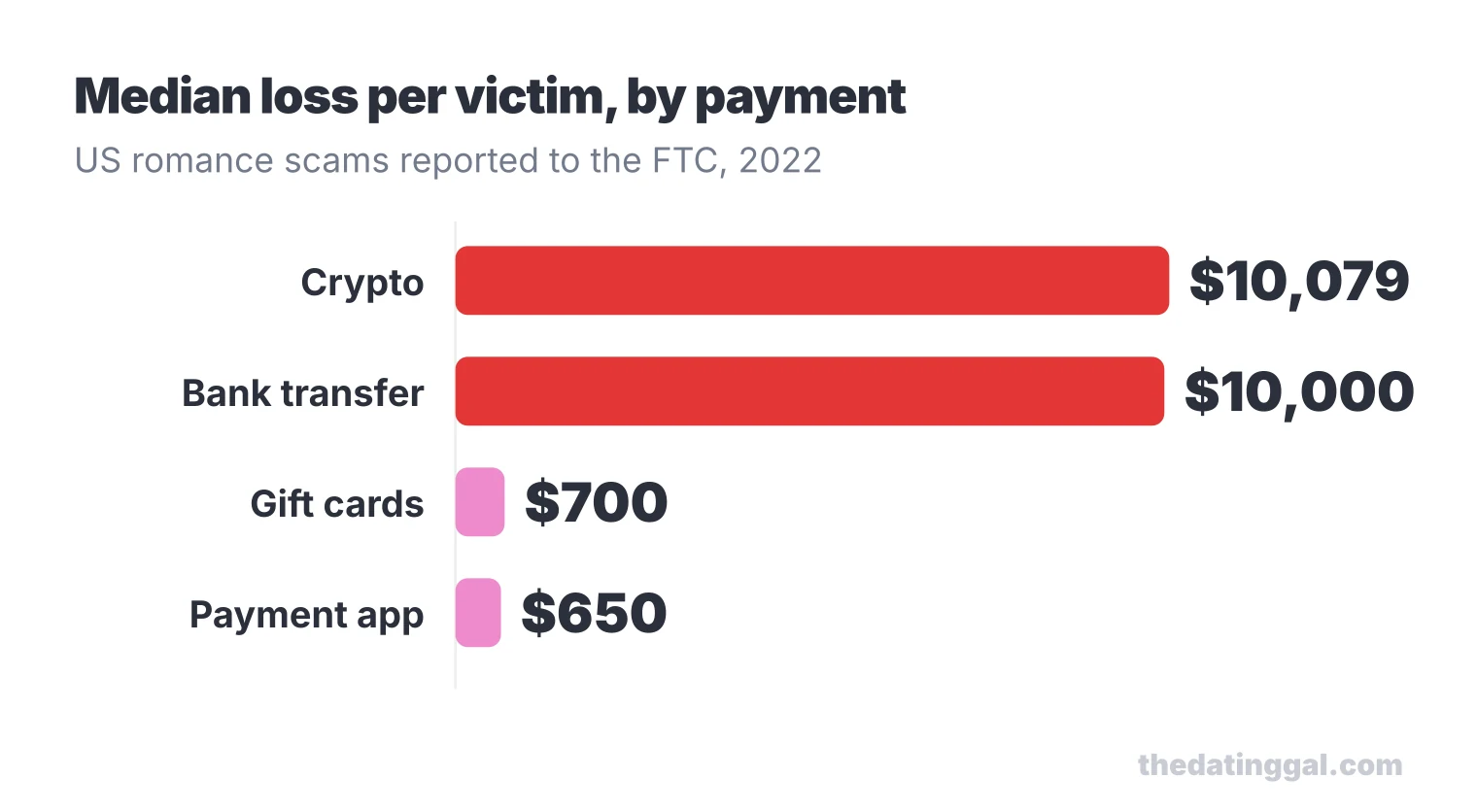
Scammers ask for payment methods that are fast and almost impossible to reverse: wire transfers, gift cards (with the PIN on the back), payment apps and cryptocurrency. Gift cards were the most common method in the FTC data, used by 24% of people who lost money, but crypto and bank transfers did the most damage, together more than 60% of all reported losses. The typical victim who paid in crypto lost $10,079 and by bank transfer $10,000, against $700 for gift cards and $650 for payment apps.
A request to pay by gift card is a scam every time: no real person, sugar daddy or soldier needs Google Play or Apple cards. And a request to “just receive” money for someone is not safer, because the money is usually stolen and the account that moved it is yours.
How to report a dating scam or a bad match
Report even if you lost nothing: scammers run many profiles, and your report can get the next one removed. If money already moved, the order changes, because speed decides whether a bank can stop a transfer.
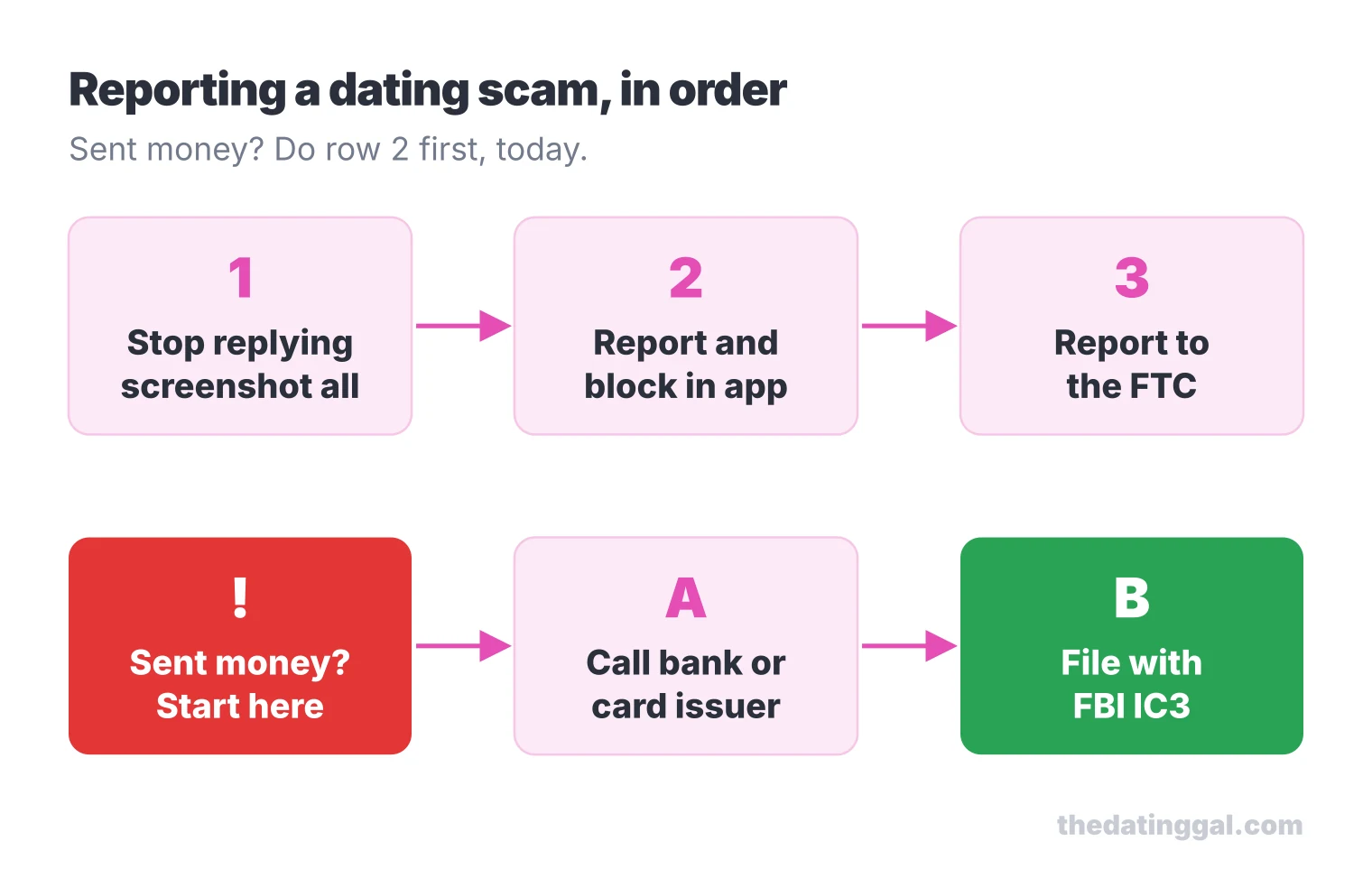
- Stop replying and save everything: screenshots of the profile, the username, the chat, phone numbers, and payment receipts.
- Report and block in the app. On Tinder you can report from the profile or the chat window, and unmatching does not stop you from reporting later. Report requests for money, threats, harassment, fake profiles and anyone who appears to be under 18.
- Report to the FTC at ReportFraud.ftc.gov.
- If you sent money: call your bank, card issuer, the gift card company or the payment app the same day and ask for a reversal, then file a complaint with the FBI’s Internet Crime Complaint Center (IC3).
- If you are threatened, followed or hurt, call 911 or your local police. What happened is not your fault.
First date safety
- Meet in public and stay in public. A busy café, bar or restaurant, not a park, not a home. If your date pushes for a private place, end the date.
- Get yourself there and back. Drive, take transit or a rideshare. Do not let a first date pick you up at your home.
- Tell a friend. Send them a screenshot of the profile, where you are going and when you expect to be home, and share your live location from your phone.
- Watch your drink and know your limits. Only accept drinks from the bartender or server.
- Have an exit. A charged phone, a backup rideshare app, and the staff: bartenders and servers can help you leave quietly.
- Trust your instincts. You do not owe anyone politeness at the cost of your safety. Leave, then block and report.
- Talk about consent and sexual health before things get physical, and remember consent can be withdrawn at any time.
Hookup, affair and sugar sites: extra rules
These niches carry more risk, because people share less about themselves and money is often part of the deal. The rules above all apply, plus these:
- Hookup apps (see my hookup dating sites and best free hookup apps): meet in public first even if the plan is casual, tell a friend the address, and be wary of sites where every message costs credits and the most eager profiles never agree to meet. Pay-to-chat profiles are a business model, not a match.
- Affair and discreet sites (my affair dating sites hub): secrecy makes people easy blackmail targets. Never send identifiable photos, use a separate email, and treat anyone who threatens to “tell your spouse” as an extortion attempt to report, not negotiate with.
- Sugar dating (my sugar daddy sites page, and reviews like Seeking): the classic scam is a “sugar daddy” who promises an allowance, then asks you to pay a fee, buy gift cards or forward part of a deposit before the money arrives. Real allowances never require you to pay first. Exchanging sex for money is illegal in most of the US, and the sites themselves ban it.
- International dating (my international dating sites hub): long distance is the home ground of romance scams. Never pay for a visa, a ticket or a translator for someone you have not met.