
How to Start a Conversation on a Dating App (With Examples)
To start a conversation on a dating app, pick one specific detail from their profile (a photo, a prompt answer, a hobby), say one short thing about yourself that connects to it, and end with an easy, open question. Keep it to two or three sentences. That beats “hey” on every app, and on Hinge it is built into how matching works.
Below: the three-part formula, more than 20 example openers sorted by what is on their profile, the rules each big app sets for the first message, what to do when nobody answers, and the red flags that can show up in the very first chat.
A simple formula for how to start a conversation on a dating app
Almost every good opener in Google’s top results, from dating coaches to eharmony’s question lists, follows the same pattern. Here it is as three steps you can reuse on any profile:
- Notice something specific. A photo with a story behind it, a prompt answer, a dog, a place, a book. This proves you read the profile, not just the first photo.
- Add a little of yourself. One line that connects: “I tried that trail last spring,” “I’m firmly team pineapple too.” It gives them something to reply to besides a question, and it stops the chat from feeling like an interview.
- Ask one easy, open question. Something they can answer in a sentence or two without thinking hard, and that cannot end in yes or no.
Put together: “That photo at the Grand Canyon looks unreal. I’ve only seen it from the rim. Did you actually hike down?” Short, specific, about them, with a door left open.
There is real data behind this. Hinge says likes sent with a comment are twice as likely to lead to a date, and that 72% of daters in its research are more likely to consider someone when a like includes a message. Hinge’s Lead Relationship Scientist, Logan Ury, puts the rule plainly in the same announcement: skip the generic “hey” or surface-level compliment, and say what caught your eye or how their prompt connects to your own life.
Example openers, sorted by what is on their profile
Use these as shapes, not scripts. Swap in the real detail from the person you are writing to. A line that obviously came from a list reads like one.
They have a travel photo
- “Okay, that view in your third photo: where is that, and was it worth the trip?”
- “Is that Lisbon in your second photo? I need your best food recommendation from there.”
- “You look very at home on that mountain. Are you a summit person or a scenic-lunch-halfway person?”
They have a pet
- “Your dog looks like he runs the household. What’s his name, and what’s his worst habit?”
- “Full honesty: your cat is half the reason this is a match. Is she as unimpressed in real life as in that photo?”
They answered a prompt
- “You said your most irrational fear is geese. I need the full story.”
- “Your ideal Sunday sounds like mine, minus the 7 a.m. run. What gets you out of bed that early?”
- “Bold claim that you make the best lasagna in town. What’s the secret ingredient you’ll admit to?”
They list a hobby or interest
- “Fellow climber! Indoor gym or outside? I’m still terrified of anything taller than a bouldering wall.”
- “You read a lot of sci-fi, it looks like. What’s the last book you couldn’t put down?”
- “A home cook who lists ‘sourdough’ as a personality trait. How old is your starter?”
Their profile is almost empty
Thin profiles are hard. Use the one thing there is, or fall back on a light, specific question that is fun to answer:
- “Your profile is a mystery, so I’ll ask the important question: what’s the best taco place near you?”
- “Quick vote: beach weekend or mountain cabin?”
- “Road trip question: are you the driver, the DJ or the one asleep in the back?”
Playful openers, for when the profile is playful too
- “A pilot with this many plant photos? Who waters them when you’re flying?”
- “Important question before we go further: pineapple on pizza, dealbreaker or green flag?”
- “What’s the worst opener you’ve gotten on here so far? I want to make sure I beat it.”
Match the tone of their profile. A funny, chaotic profile invites banter. A warm, earnest one usually wants a sincere question. Dry sarcasm is the one style that rarely survives text from a stranger, so save it for when they know you.
Five openers that work almost anywhere
If you want five conversation starters to keep in your back pocket, these are the most reusable because they ask about the person, not about small talk:
- “What’s the story behind [specific photo]?”
- “Your profile says you love [interest]. How did you get into it?”
- “What’s been the best part of your week so far?”
- “This or that: [two options that fit their profile]?”
- “What’s one thing on your profile you’re hoping someone asks you about?”
What to avoid in a first message
- “Hey,” “hi,” “what’s up.” They are not rude, but they hand all the work to the other person, who probably has several of them waiting.
- Comments only about their body or looks. A compliment on their smile in a specific photo is fine. “You’re hot” reads as shallow at best, and at worst as the start of something they will want to report.
- Copy-paste pickup lines. People recognize them, and they say nothing about you.
- A wall of text. Two or three sentences. Long first messages feel like homework to answer.
- Interview mode. Five questions in a row is a form, not a conversation. One question, plus a little about you.
- Heavy topics too early. If their profile says they are divorced or widowed, leave that for when they bring it up or for an in-person date.
- Asking for their number in the first message. It feels pushy, and as you will see below, rushing off the app is also a classic scam pattern.
- Double and triple messages before they answer. One message, then wait.
How each app handles the first message
The same opener lands differently depending on the app’s rules, and none of the top results mention them. Here is what each of the three biggest apps says in its own materials (checked October 2026):
| App | Who can message first | Time limit | Built-in help |
|---|---|---|---|
| Hinge | Anyone. A match starts when someone likes or comments on a specific part of your profile | None to start, but Your Turn Limits pauses new likes if too many people are waiting on your reply | Convo Starters: personalized ideas based on their prompts and photos (US and UK) |
| Bumble | In man-woman matches, the woman sends the first message or sets an Opening Move for him to answer; in same-gender and non-binary matches, either person | The woman has 24 hours to respond to an answered Opening Move before the match expires; Premium can extend matches by 24 hours | Opening Moves: up to three questions on your profile that matches answer |
| Tinder | Either person, once you match | No time limit advertised | Photo Verified Chat: verified users can choose to receive messages only from other verified users |
Sources: Hinge’s App Store listing and its announcement of Your Turn Limits; Bumble’s guide to Opening Moves and its Google Play listing; Tinder’s safety features page. Checked October 2026.
Hinge: comment on one thing
Hinge is the easiest app for openers because the structure does half the job: you like a specific photo or prompt and can add a comment to it. Treat that comment as your first message and use the formula above on that exact photo or prompt. A bare like with no comment is the Hinge version of “hey.”
Bumble: write an Opening Move worth answering, or answer one well
If you are a woman on Bumble, an Opening Move saves you writing a fresh opener for every match. Choose a question people can answer with a story (“What’s your ideal first date?” beats “How are you?”). If you are a man answering one, treat it like any first message: answer the question properly, add one detail about you, and ask something back. The match can disappear if the conversation does not start in time, so reply while it is fresh.
Tinder: you have the profile and the prompts
Tinder profiles can be thinner, so use whatever is there: a photo, an interest, an answered prompt. If your message will not send and the app asks you to verify, the other person has likely turned on Photo Verified Chat. Getting verified is a short video selfie, and it also tells matches you are real.
Still deciding where to spend your time? My Hinge vs Bumble and Tinder vs Hinge comparisons cover who uses each app and what the free tiers include.
Does it change if you are messaging a man or a woman?
The formula is the same for everyone. What changes is how a message from a stranger can read. Writing to a woman, anything that sounds pushy, sexual or overly familiar is the fastest way to get ignored or reported, so specific and friendly wins: comment on what she chose to share, not on her body.
Writing to a man, do not wait for him to go first if you like his profile. A confident, specific opener or a light compliment on something he chose to share (his cooking, his dog, his terrible pun in a prompt) is a good start. On Bumble, women start man-woman matches anyway, so it is worth getting comfortable with it.
Keep it going after the first reply
- Answer, then ask. Respond to what they said, add something of your own, and pass the ball back with a question. That rhythm is the whole game.
- Follow their energy. Similar message length, similar pace. If they write two lines, do not send ten.
- Pivot when it flattens. One-word answers on a topic mean change the topic, not push harder. “Okay, completely different question...” is fine.
- Do not leave them waiting for a day. Slow replies end plenty of promising chats. Hinge built Your Turn Limits because unanswered messages were one of the biggest obstacles to getting dates.
- Move toward a date within days. Once you have a good back-and-forth going, suggest a short call or a coffee. Weeks of texting builds an imaginary person who may not match the real one.
If you are wondering whether all this effort pays off, the research on whether dating apps actually work is clear that the people who succeed move from chat to meeting fairly quickly.
No reply? What to do next
Silence after a first message is normal and usually has nothing to do with your opener: people get busy, stop opening the app, or have too many chats going. Here is a simple way to handle it:
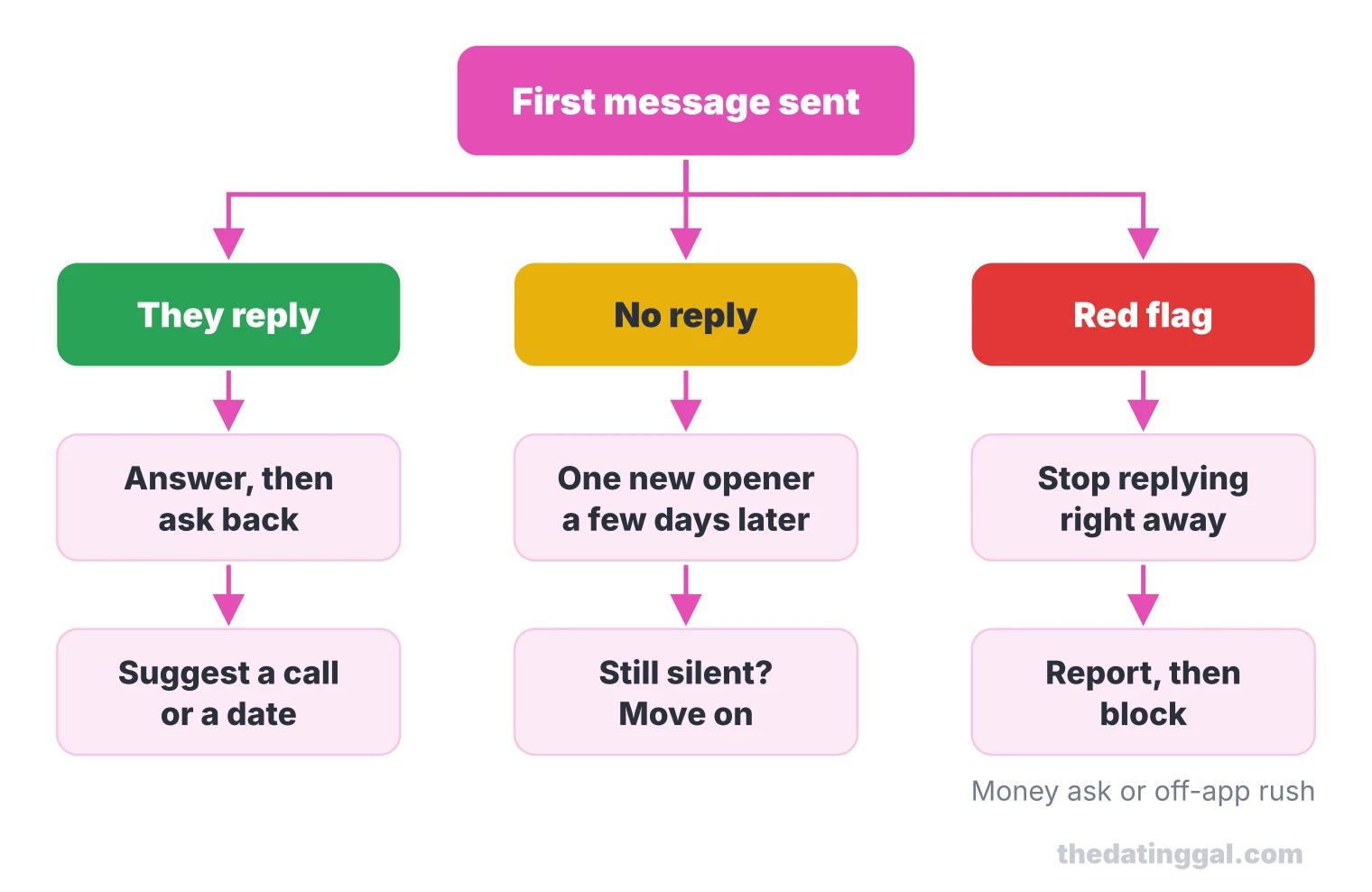
- Send one follow-up, a few days later, and make it a new, easy opener rather than “hello??” Something like “Okay, new question: best pizza in town, go.”
- If that gets nothing, move on. Unmatch if you like, without a message. Two unanswered messages is enough.
- If you are the one going quiet, a short “I’ve enjoyed chatting, but I don’t think we’re a match. Good luck out there!” is kinder than ghosting, and on Hinge, ending conversations you will not continue keeps Your Turn Limits from pausing your new likes.
Red flags in the first few messages
The opening chat is also where scams start, and none of the top-ranking guides mention it. The FTC’s romance scam guidance and Tinder’s safety tips agree on the signs:
- They want to move off the app right away to WhatsApp, Telegram, text or email. Tinder notes that people with bad intentions often try this because messages on the app are subject to its safety checks.
- They cannot meet because they are overseas, on an oil rig, in the military or working abroad, and they will not do a video call either.
- Money comes up, in any form: an emergency, a plane ticket, a fee, or a “great” crypto investment. The FTC’s bottom line is to never send money or gifts to someone you have not met in person.
- The chat gets serious very fast, with big feelings before you have even met.
If you see these, stop replying and report the profile in the app. The same goes for messages that are sexual or abusive from the start; on Tinder, the Does This Bother You prompt lets you report a flagged message right from the chat. My guide to online dating scams walks through how these play out, and the safest dating apps ranking compares verification tools.
Abbreviations you will see in openers
Some messages and profiles use shorthand that is not obvious. A few that come up in searches:
- GGG: “good, giving and game,” a phrase from sex-advice columnist Dan Savage about being a generous, open partner. On a profile it signals a sexual attitude, not a hobby.
- SWT: usually just “sweet” in texting. On a Muslim profile, it is often the honorific “subhanahu wa ta’ala” after the word Allah.
- NMNK: there is no settled meaning. If someone uses an abbreviation you do not know, asking is a perfectly good conversation starter.
For everything that comes before and after the first message, from picking the right app to planning a first date, see my full list of online dating tips.
Frequently asked questions
What are some good openers for a dating app conversation?
The best openers mention one specific thing from their profile, add a line about you, and end with an easy open question, such as “That view in your third photo is unreal. Where is it, and was it worth the trip?” Openers about a photo, a prompt answer or a shared interest beat generic greetings because they give the other person something to answer.
Is it okay to just say hi on a dating app?
It is not rude, but it rarely works well, because it leaves all the work to the other person. Hinge’s own advice is to skip the generic “hey” and say what caught your eye instead. If you want to keep it simple, “Hi! Your dog looks hilarious, what’s his name?” is still short and gives them something to reply to.
What are 5 conversation starters for a dating app?
Five that work on almost any profile: ask the story behind a specific photo, ask how they got into an interest they list, ask about the best part of their week, offer a this-or-that choice that fits their profile, and ask what on their profile they hope someone asks about. Swap in their real details so it does not read like a script.
What is the 333 rule in dating apps?
It is not a rule from any dating app, and the versions shared on social media disagree. Most are about pacing, such as checking in with yourself after about three dates, three weeks and three months. For first messages, the useful takeaway is simply not to let a chat drag on for weeks before suggesting a call or a date.
How long should you wait to follow up if they do not reply?
Wait a few days and send one new, easy opener rather than “hello??”. If that also gets no answer, move on without taking it personally. Two unanswered messages is enough.