
Hinge vs Bumble: Which Is Better in 2026?
Hinge vs Bumble comes down to this: pick Hinge if you want a relationship and a free tier that still works, pick Bumble if you want a bigger, swipe-style pool with stronger default verification in the US. The old tiebreaker is gone: since August 2026 Bumble lets either person send the first message, so “women message first” is no longer a reason to choose it. Hinge is my pick for most people looking for something serious; Bumble is the better second app, not the worse one.
Hinge vs Bumble at a glance
Here is how the two apps compare on the points that decide the choice, from each company’s help center and app store listings.
| Hinge | Bumble | |
|---|---|---|
| Best for | Serious relationships, people who like reading profiles | Volume with intent filters, people who want verified profiles by default |
| How you browse | Scroll full profiles, like one photo or prompt | Swipe cards, right to like |
| Who messages first | Either person; a like can carry a comment | Either person since August 2026, one opener each, then the chat unlocks |
| Match timer | None, but Your Turn Limits pauses new likes if too many people wait on you | 72 hours to send an opener, 72 hours to reply |
| Free tier | Limited daily likes, see incoming likes one at a time, 1 free Rose a week | Swiping, matching, chatting, 1 free Extend a day |
| Paid tiers | Hinge+ and HingeX | Boost, Premium and Premium+ |
| See everyone who liked you | Hinge+ and up | Premium and up |
| Verification | Voluntary Selfie Verification badge in the US | Photo verification mandatory in the US, optional ID check |
| App Store rating | 4.4 (1.1M ratings) | 4.3 (1.8M ratings) |
| Google Play rating | 3.5 (490K reviews) | 3.8 (1.63M reviews) |
Ratings from the Hinge App Store listing, Bumble App Store listing, Hinge on Google Play and Bumble on Google Play, checked October 2026.
The big 2026 change: Bumble dropped “women message first”
Almost every Hinge vs Bumble article still says women must message first on Bumble within 24 hours. That stopped being true this year. Bumble announced on August 11, 2026 that anyone in a match can send the first message, and the reply window went from 24 to 72 hours, as TechCrunch reported. Opening Moves, the canned profile questions Bumble added in 2024, are gone too.
Bumble’s help article on how conversations start describes the new flow: you both get one opening message, either of you has 72 hours from the match to send it, and once one person writes, the other has 72 hours to reply before the chat fully opens. If you type a bare “hi” or “hey,” the app nudges you to write something more personal, but it does not block the message.
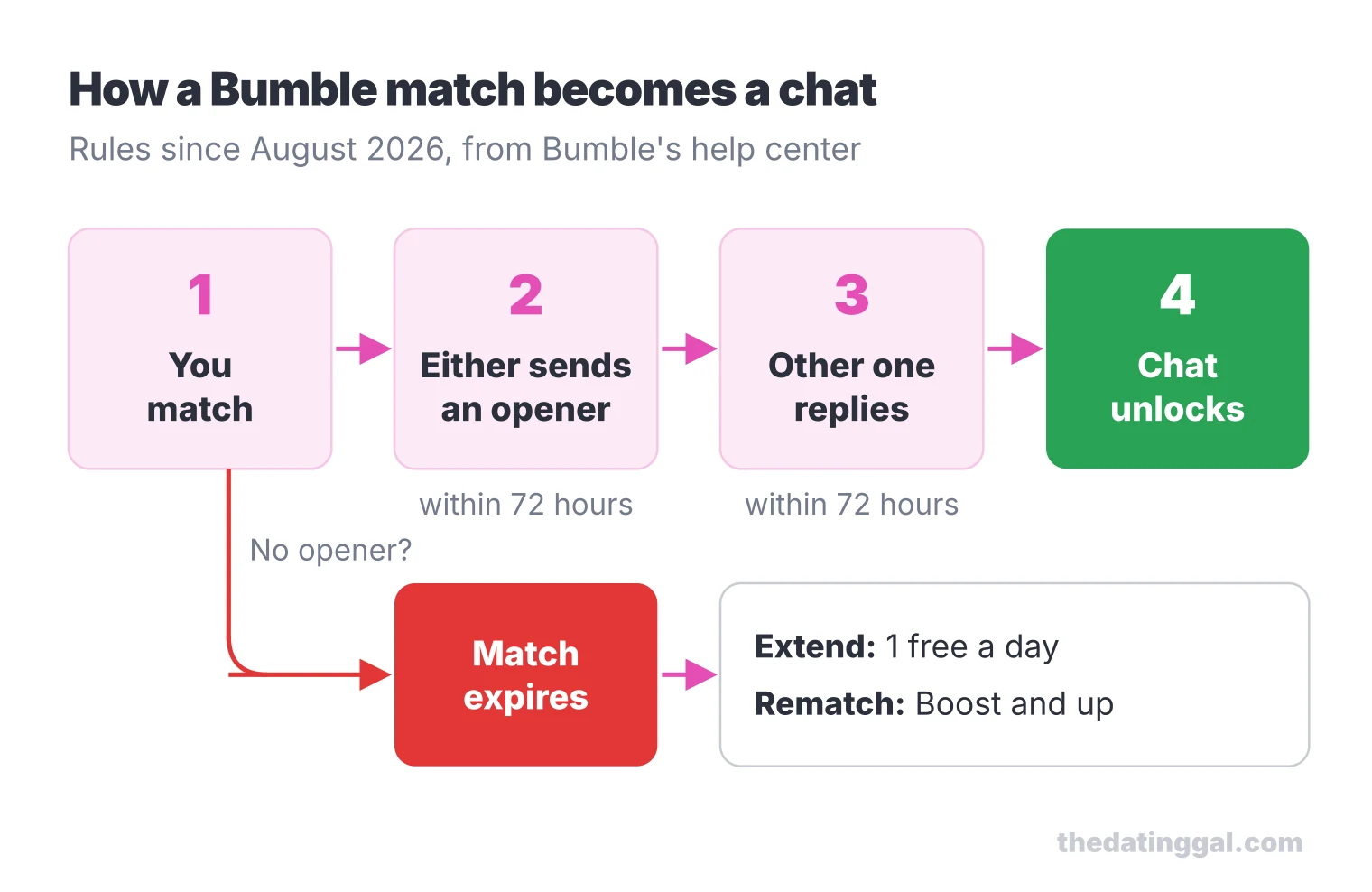
If nobody writes in time, the match expires. Bumble’s expired matches page says everyone gets one free Extend a day (72 more hours), while paid members get unlimited Extends and can Rematch with an expired connection.
What this means for the comparison:
- For men, the main complaint about Bumble (sitting and waiting for her to write) is gone. Hinge’s edge for men is now its format, not its messaging rule.
- For women, Bumble no longer guarantees that only you can start a chat. What remains is the one-opener-each structure, which still filters out people who send a dozen “hey”s, because each person gets one shot before a reply.
- Bumble BFF is also moving out. Bumble says BFF Mode is closing in the US, Canada and Mexico in favor of a separate BFF app, so “Bumble does friends too” is no longer a reason to pick it for dating.
My Bumble review describes the old women-first rule and predates this change: read it for the feel of the app, not for the messaging rule.
How matching works on each
Hinge: full profiles and a like on something specific
Hinge profiles are built from photos and written prompts. In Discover you see one profile at a time and tap the heart on a specific photo or prompt; adding a comment turns that like into your opening line. Hinge’s help center says liked profiles leave your feed until the other person responds, and a match happens when they like you back. Roses are the stronger signal: everyone gets one free Rose a week, and a Rose sits at the top of the other person’s likes.
Two features change how Hinge feels in practice. Your Turn Limits stops you from sending or receiving new likes when too many matches are waiting on your reply, which applies to paying members too. And Convo Starters suggests openers from a person’s prompts and photos; Hinge says it sends that public profile content to OpenAI to generate the tips, and that it never sends a message for you.
Bumble: swipe cards with filters on intent
Bumble is a swipe app: right to like, left to pass, a match when it is mutual. Profiles carry a bio, prompts, interest badges and a “Looking for” setting, where you can pick up to two dating intentions per Bumble’s help center. Paid extras such as SuperSwipes, Spotlight and Notes (formerly Compliments, a message before matching) help you stand out. It is quicker to browse than Hinge, and it shows you more people per minute, which is good for volume and worse for attention.
Free vs paid: what each free tier really gets you
Both apps are free to download and use. Hinge says so plainly, and Bumble’s paid features page says the app “works great even without them.” The difference is where each one draws the line.
- Hinge free: a limited number of likes per day, incoming likes shown one at a time (you can still match with each), one free Rose a week and one Undo Skip a week. Hinge’s help center only says free users get “a select number” of likes; in my Hinge review I found the free tier capped me at eight likes a day, which is the “8 rule” people search for.
- Bumble free: swiping, matching and chatting, one free Extend a day, but you cannot see who already liked you: Bumble’s Liked You page says you need Premium to see everyone who liked you, and lower plans get a blurred stack.
So Hinge’s free tier rations what you send, and Bumble’s free tier hides who is interested in you. If you are in a smaller town, Hinge’s cap matters less (you run out of profiles anyway). If you are in a big city with a long Liked You queue, Bumble’s blur is the more annoying limit.
What you pay: Hinge+ and HingeX vs Bumble Boost, Premium and Premium+
Neither company publishes a US price list on the web: prices appear on the subscribe screen inside the app and vary with plan length, and my Hinge review also found Hinge prices varying by age and location. Here is what each tier adds, from the help centers, and the in-app purchase prices the app stores list.
| Tier | What it adds | Prices listed on the US App Store |
|---|---|---|
| Hinge+ | Unlimited likes, see everyone who liked you, unlimited Undo Skips, advanced filters (height, children, family plans, education, politics, drinking, smoking, marijuana, drugs) | Hinge+ $16.99 and $19.99; “Hinge Subscription” $14.99, $29.99 and $34.99 (plan length not shown) |
| HingeX | Everything in Hinge+, plus See Compatible People Sooner, an always-on visibility boost and Priority Likes that stay at the top of someone’s list for 7 days | |
| Hinge add-ons | Roses (packs of 3, 12 or 50), Boost (1 hour), Superboost (24 hours) | 3 Roses $9.99, 12 Roses $29.99, Boost $9.99 and $19.99 |
| Bumble Boost | Unlimited likes, 5 SuperSwipes and 1 Spotlight a week, unlimited Extends, Rematch, unlimited Backtrack | $2.99 to $12.99 |
| Bumble Premium | Everything in Boost, plus Liked You, advanced filters, Incognito Mode, Travel Mode | $17.99 to $32.99 |
| Bumble Premium+ | Everything in Premium, plus photo insights, faster delivery of your likes, priority in feeds, 2 Notes, 10 SuperSwipes and 2 Spotlights a week | Not in the App Store’s top purchases list |
Prices checked October 2026. Tiers from Hinge’s subscription benefits page and Bumble’s paid features page; prices from the App Store listings linked above, which show amounts without plan lengths. On Google Play, Hinge lists in-app items from $0.49 to $284.99 and Bumble from $0.49 to $259.99.
The useful comparison is not the sticker price but what you are paying to fix. On Hinge, you pay to stop rationing likes and to see your whole likes list at once. On Bumble, Boost (the cheapest tier) mostly fixes the timer and like limits, and you need Premium to see who liked you. If seeing your admirers is the whole point, Bumble Premium and Hinge+ are the tiers to compare.
Why the Bumble and Hinge prices you read online disagree
The top Google results for this question quote very different numbers: one puts Bumble Boost at about $15 a month, another at $39.99, and Bumble Premium anywhere from $29.99 to $69.99. They are not all wrong. Prices differ by plan length (Hinge sells weekly, monthly, three-month and six-month plans), by where you pay, and by the profile the app is pricing for. The only price that counts is the one on your own subscribe screen, so check it before you trust any article, this one included.
Three billing details matter more than the sticker:
- Auto-renewal: Hinge subscriptions renew automatically, and you must turn off auto-renew at least 24 hours before the next billing period. Bumble plans also renew until you cancel; cancelling stops the next renewal and you keep your perks until the paid period ends.
- Where you pay: on iPhone, Hinge lets you pay through the App Store or through Hinge’s own checkout (powered by Stripe). Where you paid decides where you cancel and who handles a refund.
- Refunds: Hinge says most purchases are nonrefundable and Roses or Boosts never are, but residents of Arizona, California, Colorado, Connecticut, Illinois, Iowa, Minnesota, New York, North Carolina, Ohio, Rhode Island and Wisconsin can request a full refund within 3 business days of subscribing. Bumble sends App Store and Google Play refund requests to Apple and Google, and handles card, PayPal and web payments itself, per its refund page.
Who uses each app
Bumble is the bigger app by any public measure you can check. It shows 100M+ downloads on Google Play against Hinge’s 10M+, and more ratings on both stores. Pew Research Center’s survey of 6,034 US adults (July 2022) found 28% of online daters had ever used Bumble, against about a fifth for Hinge; Tinder led at 46%, so yes, Tinder is still very much a thing (see my Tinder review).
The user counts, gender splits and age shares quoted elsewhere (“60% male,” “72% under 35”) do not come from a source either company publishes, so treat them as estimates. Pew’s public summary does not split Hinge and Bumble users by gender either, so the honest answer to “do women use Bumble or Hinge more?” is that nobody has published reliable numbers. What you can check is your own area: open both apps with the same filters and see which one runs out of profiles first.
On age, both apps are for adults 18+, and neither help center mentions an upper age limit. At 45 or 55 you are not too old for either; what matters is how many people in your range live nearby. Hinge’s prompt format gives you more to go on per profile, which helps when the pool is smaller. If most of your matches are much younger, our senior dating sites list covers apps built for that age group.
One Hinge quirk: in select regions, new members may land on a waitlist that Hinge uses to balance the dating pool, lasting from hours to months. A complete profile and Selfie Verification can shorten it.
Hinge vs Bumble for serious relationships (and for casual)
For a serious relationship, Hinge has more built in: daily like limits push you to choose, prompts give you something to talk about, Your Turn Limits stops people hoarding matches, and the app asks how your date went after you exchange numbers. Its pitch is literally that it is designed to be deleted. Both apps appear in our serious dating apps list, with Hinge the stronger fit.
Bumble can work for serious dating too, especially if you set your “Looking for” to a long-term option so the people you match with know it. It is the better of the two for casual dating, because swiping is faster and the pool is bigger. Intent still comes down to the person: plenty of people use Hinge casually, so read profiles rather than trusting the logo.
If both apps feel like a second job, you are not alone, and the companies know it. TechCrunch’s report on the Bumble change notes that Bumble is exploring a swipe-free future with more in-person events, aimed especially at Gen Z, and that its Q2 2026 revenue fell 15.2% year over year to $210.5 million. Hinge’s answer is Your Turn Limits and its follow-up after dates. Using one app at a time, for a few short sessions a week, usually beats running both all day.
Safety and verification: Bumble is stricter by default
This is the one area where Bumble clearly leads in the US.
- Bumble: photo verification is mandatory in the USA, checked by automated and human review. You can add an ID verification badge with a government ID and a live selfie. Its safety features include in-app video calls, Private Detector (blurs likely explicit images), and Deception Detector (an AI scam filter backed by human moderators). Its App Store listing adds Share Date, which sends your date plans to a group chat.
- Hinge: Selfie Verification is voluntary in the US (a video selfie compared with your photos, then a badge); a mandatory Face Check scan applies only in certain regions. Hinge itself warns the badge does not guarantee anyone’s safety.
Neither app runs background checks. The everyday risk on both is less a criminal than kittenfishing: someone using old, flattering or heavily edited photos and stretching their height or job. A verification badge helps with that, a short video call before meeting helps more. Report anyone who asks for money or pushes you off the app fast: on Bumble from the bottom of their profile (reporting is anonymous), on Hinge from the three dots on their profile, or through Hinge’s impersonation report form if someone is using your photos.
How to cancel and delete each app
Deleting either app from your phone does not cancel a subscription or delete your profile. Cancel first, then delete.
- Hinge: if you paid through Apple, cancel in iPhone Settings, then your name, then Subscriptions; on Android, in Google Play. If you paid with Hinge’s own checkout, use Manage subscription in Hinge’s account settings (Hinge’s cancel guide). To delete: profile photo, gear icon, scroll down, Delete Account (Hinge’s delete page).
- Bumble: Apple and Google subscriptions are cancelled in the store; card, PayPal or Apple Pay plans in the app under Subscription details, then Manage your subscription (Bumble’s cancel guide). To delete: profile icon, gear icon, Delete account. Bumble keeps a deleted account restorable for up to 28 days (Bumble’s delete page).
Which should you pick? A decision list
- You want a relationship and will put effort into a profile: Hinge.
- You want the most people to swipe through, or something more casual: Bumble.
- You are a man who disliked waiting on Bumble: try Bumble again, the rule changed; still start with Hinge if prompts suit you.
- You are a woman who wants fewer low-effort openers: both now filter them (Hinge through comments on likes, Bumble through one opener each). Pick the one with more people you like nearby.
- Verification matters most to you: Bumble, for mandatory US photo verification and an ID badge.
- You will not pay anything: Hinge, whose free tier lets you see incoming likes, even if one at a time.
- You are LGBTQ+: both work for same-gender matches; Hinge is in our LGBTQ+ dating apps picks.
Still deciding between the big apps? Our dating app comparisons hub puts the major apps side by side.
How I compared them
This comparison is based on Hinge’s and Bumble’s help centers, their App Store and Google Play listings, Pew Research data and the current top Google results, all checked in October 2026, plus my original hands-on Hinge and Bumble reviews, whose ratings (4.5 and 4 out of 5) this page reuses. I did not use either app again for this page, and I left out user counts and gender ratios that neither company publishes.
Frequently asked questions
Is Hinge or Bumble better?
Hinge is better for most people who want a serious relationship: prompts, limited free likes and a free tier that shows incoming likes push you toward real conversations. Bumble is better if you want a bigger pool to swipe through or mandatory photo verification in the US. Since August 2026 either person can message first on Bumble, so that rule no longer decides it.
What is the 8 rule on Hinge?
The 8 rule refers to Hinge's free tier, which caps how many likes you can send per day; the original Dating Gal Hinge review found that cap at eight. Hinge's help center only says free users get a select number of likes. Hinge+ and HingeX remove the cap.
Do women still have to message first on Bumble?
No. Bumble announced on August 11, 2026 that anyone in a match can send the first message. Each person gets one opening message, there are 72 hours to send it, and the other person has 72 hours to reply before the chat opens.
Is Hinge or Bumble cheaper?
Neither publishes a US price list on the web, and prices vary by plan length. On the US App Store, Bumble Boost purchases are listed from $2.99 to $12.99 and Bumble Premium from $17.99 to $32.99, while Hinge+ is listed at $16.99 and $19.99. Check the subscribe screen in each app for your own price.
Is 45 too old for Hinge or Bumble?
No. Both apps are for adults 18 and over and neither help center mentions an upper age limit. What matters at 45 is how many people in your age range use the app near you, so try both free tiers with the same filters and keep the one with more matches.
Why is Gen Z ditching dating apps?
Burnout from endless swiping and matches that never turn into dates is the common reason. Bumble is exploring a swipe-free future with more in-person events aimed at Gen Z, and Hinge limits how many unanswered chats you can hold with Your Turn Limits.