
Online Dating Scams: How They Work and How to Spot One (2026)
An online dating scam (also called a romance scam) is when a criminal sets up a fake profile on a dating app or social media, builds what feels like a real relationship, then asks you for money, gift cards, crypto or personal information. The giveaways almost never change: they move you off the app fast, they always have a reason not to meet or video call, and sooner or later there is an emergency or an “investment” only you can help with. The rule that stops nearly all of it comes from the FTC: never send money or gifts to someone you have not met in person.
Below I walk through how the scam unfolds stage by stage, the stories scammers use, how to check whether a match is real, and exactly who to call if money already left your account. Everything comes from the FTC, the FBI’s Internet Crime Complaint Center (IC3), the Secret Service and Congress.gov, all linked, checked October 2026.
How big the online dating scam problem is in 2026
The FBI’s 2025 Internet Crime Report counts 23,159 confidence and romance fraud complaints with $929,287,469 in reported losses, up from 17,910 complaints and $672,009,052 in 2024. That FBI category also includes “grandparent” schemes where someone poses as a family member, so it is not dating alone, but it is the most recent full-year US figure. The same report breaks out three numbers worth knowing:
- People 60 and over filed 10,188 of those complaints and reported $584,032,745 in losses, more than half the total.
- Crypto was involved in 5,925 romance complaints, with $394,787,515 lost.
- AI: the FBI says scammers now use fake profiles and scripts from AI chat generators, and victims lost over $19 million in 2025 to romance scams with a likely AI link.
The FTC sees the same trend from its side. Its May 2026 alert on new trends in imposter scams says reported romance scam losses rose 22% in 2025, which “comes to a staggering $2,020 per person,” and that imposter scams were the number one scam reported to the FTC for the ninth year in a row. Most victims never report, so the real figures are higher.
It is not only older daters. Anyone lonely, recently divorced or widowed, or simply busy and trusting can be a target, which is why the scripts are built to feel normal for weeks before anything is asked.
How an online dating scam unfolds, stage by stage
The FTC and FBI describe the same five stages, and knowing where you are in them is the best protection. The first three cost you nothing. Everything you lose happens from stage four on.
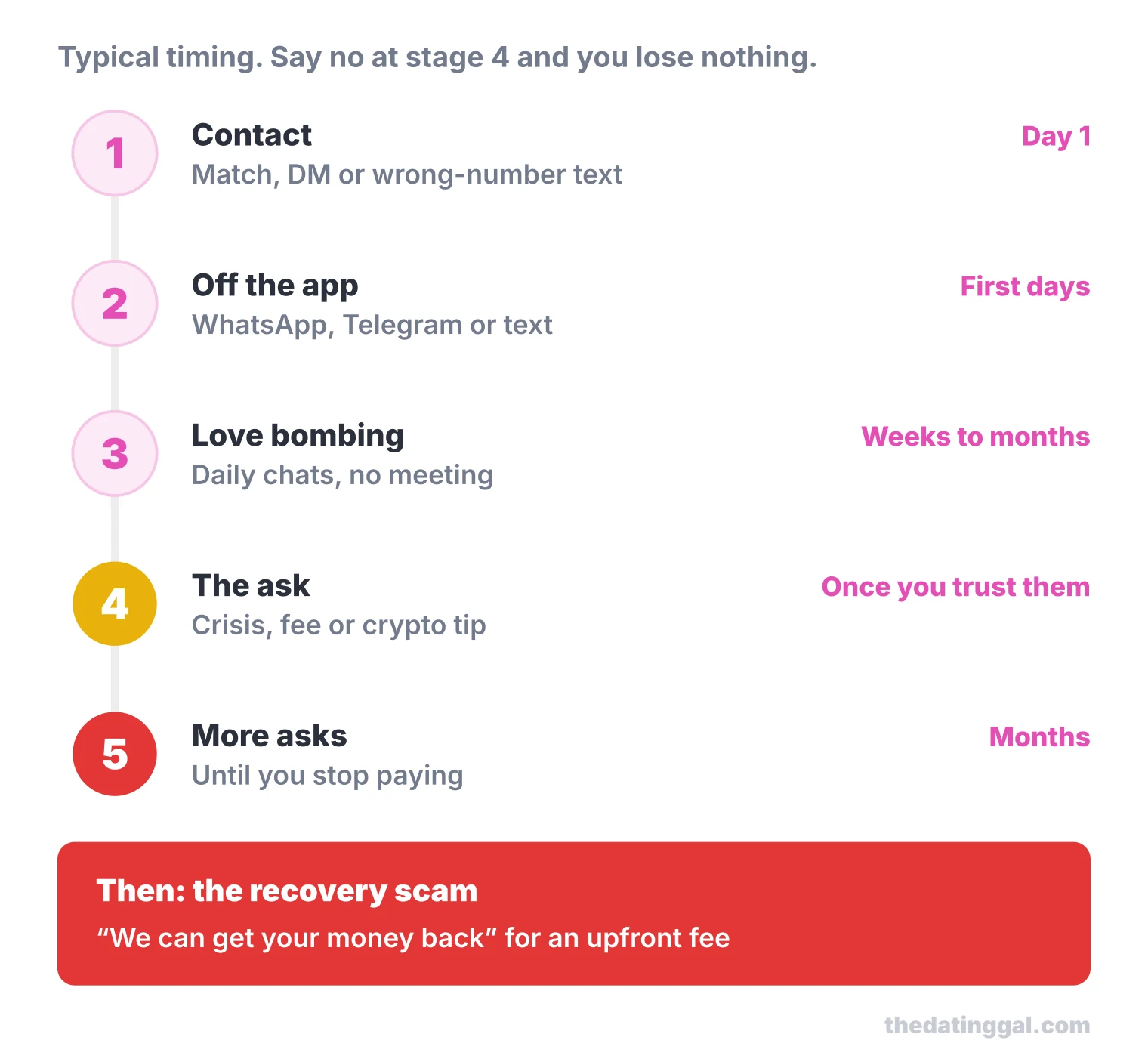
- Contact. A match on a dating app, a DM on Instagram or Facebook, or a “wrong number” text that turns into a friendly chat. The photos are stolen from a real person or generated by AI. In the FTC’s romance scam data spotlight, 40% of people who lost money said it started on social media and 19% on a dating website or app.
- Off the app. Within days they ask for your number or suggest WhatsApp, Telegram or Google Chat. Dating apps scan messages and ban scam accounts; private messengers do not. About 40% of the 2022 loss reports with detailed stories in that FTC data mentioned WhatsApp, Google Chat or Telegram.
- Love bombing. Messages morning and night, pet names, talk of a future together, and a steady stream of reasons they cannot meet or turn on a camera. This stage lasts weeks or months on purpose: the scammer is building enough trust that the request in stage four feels like helping a partner, not paying a stranger.
- The ask. A crisis (hospital bill, frozen account, customs fee, plane ticket to finally meet you) or an opportunity (“my uncle taught me crypto trading, let me show you”). It is urgent, and it comes with instructions on how to pay.
- More asks. If you pay once, there is always a next fee, a new emergency, or a bigger investment. It ends when you stop paying, at which point they vanish or turn to threats.
Then, often, a second wave arrives. I cover that “recovery” scam further down, because it hits people right when they are most desperate.
The stories romance scammers tell
The FTC’s guide What To Know About Romance Scams lists the same lies again and again: they live or travel abroad, work on an oil rig, serve in the military or work for an international organization, and they need money for medical bills, a plane ticket, visa costs, legal trouble or getting started in crypto. Its data spotlight found the faraway military base is the single most popular excuse for not meeting. Here is how the main versions work.
| The story | How it works | The tell |
|---|---|---|
| The deployed soldier | Stolen photos of a real service member; can’t meet or call from “the base”, needs money for leave, a phone or shipping | Any request for money to visit, call or come home |
| Oil rig, ship or overseas contractor | Remote job explains bad internet and no video; needs cash for a stuck payment, equipment or a flight | A great job but no access to their own money |
| The crypto “investment” (pig butchering) | Weeks of romance, then a trading app or site showing big fake profits; withdrawals need “taxes” or “fees” | Any love interest who wants to teach you investing |
| Medical or legal emergency | Sudden surgery, accident, arrest or detention abroad; you are “the only one” who can help | An emergency that only money from you can fix |
| The gift or package | They mailed you jewelry, cash or a parcel; customs or the courier needs a fee to release it | A gift that costs you money to receive |
| The inheritance | A fortune or gold is stuck; they need fees, taxes or even a marriage license to unlock it | Wealth that needs your cash first |
| The money mule | They send money to you and ask you to forward it, open an account or reship phones and laptops | Any request to receive or move money for them |
| Sextortion | Intimate photos or a video call get recorded, then they threaten to send them to your family unless you pay | A push for explicit photos early on |
Two of these deserve extra caution. The money mule version feels safe because you are not losing money, but the Secret Service’s romance scam page warns that victims who launder funds can end up liable, financially and potentially criminally. And sextortion does not stop when you pay: paying tells them you will pay again. If someone is threatening you, stop replying, keep the evidence and report it (steps below).
Sugar dating has its own variants, from the fake check to the gift card “loyalty test”. I break those down in my guide to sugar daddy scams.
Red flags: how to tell you are chatting with a scammer
One red flag can be innocent. Three together, especially with a money request, is a scam. Watch for:
- They rush you off the app in the first few messages.
- Strong feelings very fast: “soulmate”, “I’ve never felt this way” within days, before you have met.
- Every plan to meet falls through at the last minute, and the camera is always “broken” or the connection too bad for video.
- They ask lots of questions but share little you could check: no last name you can find, no friends who exist online, a job you cannot verify.
- They want the relationship kept secret, or get upset when you mention telling friends or family.
- Their story drifts: the age, hometown, children’s names or job details change from week to week. Scam operations often rotate several people on one profile.
- Any talk of money: an emergency, a fee, a sure-thing investment, or an offer to send money to you.
- They tell you how to pay: gift cards, wire transfer, crypto, a payment app, or cash in the mail.
- They ask for codes sent to your phone “to verify you”. That code is the key to your account.
A dating site that asks for your Social Security number or bank details just to sign up is a red flag too. My online dating safety hub has the full checklist for profiles, first messages and first dates.
How to check if a match is real
You do not need to be a detective. Five checks, in this order, catch most fake profiles before any money comes up:
- Reverse image search their photos (Google Lens or TinEye). The FTC says a photo tied to another name, or to details that don’t match, is a sign of a scam.
- Search their name or job plus “scammer”. The FTC suggests searches like “oil rig scammer” or “US Army scammer” to see whether others report the same story.
- Ask for a live video call, and ask them to do something simple on camera, like wave or say your name. A real person can do five minutes. Keep in mind the Secret Service warns that video calls and messaging apps are not enough proof of identity on their own, and AI face and voice tools are improving.
- Keep the chat on the app until you have met. Apps can see and ban scam accounts; WhatsApp cannot. Verification badges help too: the safest dating apps compares which apps check photos or IDs and what the badge really proves.
- Tell a friend. The FTC says to talk to someone you trust, especially if friends or family are already worried about the relationship. A match who asks you to keep the relationship secret is a red flag in itself.
On your side, keep your profile and social media light on the details scammers use: your employer, your recent loss or divorce, your finances. And if you are over 50 and back on the apps, the platforms I recommend in my list of the best dating apps over 50 are the ones with real verification and reporting tools.
How scammers want to be paid, and why it matters
The FTC names the methods: wire transfers through Western Union or MoneyGram, gift cards (Amazon, Google Play, Apple, Steam) with the PIN read out or photographed, money transfer apps, and cryptocurrency. They all have one thing in common: the money moves fast and is hard to get back. In the FTC’s 2022 data, gift cards were the most common method (24% of people who lost money), but crypto and bank wires did the most damage, together more than 60% of all reported losses.
So the rule is simple: a request to pay with a gift card is a scam every time. A request to “invest” on a platform your match recommends is a scam every time. No real partner needs either.
Already sent money? Who to call first
Being taken in by a scammer is not a judgment on you. These scripts are written by groups who do this full time. What matters now is speed: the FBI’s 2025 report says its Recovery Asset Team froze $679,013,183 in 2025 with a 58% success rate, and it tells victims to contact their bank immediately and to file at IC3 “regardless of the amount lost.”
The FTC’s What To Do if You Were Scammed (updated June 2026) says who to call depending on how you paid. Checked October 2026:
| How you paid | Call first | What to ask |
|---|---|---|
| Credit card | The card issuer (number on the back) | Report the charge, request a refund |
| Debit card, bank transfer or Zelle | Your bank or credit union | Reverse the payment, return the money |
| Venmo, Cash App, PayPal | The app, in-app support | Reverse the payment and refund it |
| Western Union, MoneyGram | The wire transfer company | Say a scammer tricked you, ask for a refund |
| Gift card | The card issuer (number on the back) | Say a scammer got the number and PIN; keep the card and receipt |
| Cryptocurrency | The exchange or crypto ATM operator | Report the transaction as fraud, ask for a reversal |
| Cash by US mail | US Postal Inspection Service, 1-877-876-2455 | Intercept the package if not yet delivered (fee applies) |
Then, in this order:
- Stop all contact. Don’t argue or explain; it only hands them a new story. Block them everywhere.
- Save the evidence: profile screenshots, usernames, phone numbers, chats, receipts, wallet addresses and transaction IDs.
- Report the profile on the app or social network where you met.
- Report to the FTC at ReportFraud.ftc.gov and to the FBI at IC3.gov, with full transaction details.
- If you shared your Social Security number, go to IdentityTheft.gov for a recovery plan. If you shared passwords or codes, change them and turn on two-factor login.
The second scam: “we can get your money back”
Most guides skip this part, and it is costly. Right after a romance scam, victims get contacted by a “recovery firm”, a “law firm”, a crypto tracing service or someone posing as a government agent, promising to get the money back for an upfront fee. The FBI’s 2025 report logged 10,516 recovery scam complaints with $1.4 billion in losses (a figure that can include the earlier scam), and it flagged fake law firms targeting crypto scam victims and criminals impersonating the IC3 itself.
The FTC’s page on refund and recovery scams is clear: scammers buy lists of past victims, and real government agencies and consumer groups never charge to help you get a refund. Never pay a retainer, processing fee or “tax” to recover money. Work only with your bank, the payment company and the official reports above, and look up any phone number yourself instead of using the one you were given.
What is changing for dating apps
The Romance Scam Prevention Act (H.R. 2481) is close to becoming law, though some guides still say it only passed the House. As of October 19, 2026, Congress.gov shows it passed the House by voice vote on June 23, 2025, passed the Senate without amendment by unanimous consent on September 23, 2026, and was presented to the President on October 14, 2026. The enrolled bill text says:
- When a dating app or site bans a member for fraud, it must notify every member who received a message from that account, by email or text, normally within 24 hours (3 days at most, longer only if law enforcement asks for a delay).
- The notice must give the banned username, say the person may have used a false identity or tried to defraud members, warn you not to send money or financial information, and include anti-fraud tips and a customer service contact.
- The FTC and state attorneys general enforce it, and it takes effect one year after it is signed.
That helps, but only for scammers the app has already caught. The checks above still matter, and so does reporting: every report is how apps catch the next fake profile.
Frequently asked questions
How can you tell an online dating scammer?
Scammers move you off the dating app quickly, declare strong feelings within days, always have a reason not to meet or video call, and eventually bring up money: an emergency, a fee, a gift that needs customs paid or a crypto investment. One of these alone can be innocent, but several together, especially with any money request, point to a scam.
How can you tell if someone is real on a dating site?
Reverse image search their photos, search their name or job plus the word scammer, and ask for a live video call where they do something simple like say your name. Prefer apps with photo or ID verification, and remember a badge proves the face matches the photos, not that the person is honest.
How long will a scammer keep talking to you?
Often weeks or months. Romance scammers deliberately spend a long time building trust before the first money request, and once you pay they keep going with new emergencies or fees until you stop. When you refuse, they usually vanish or switch to threats.
Why is my husband getting spam from dating sites?
Dating site spam on its own does not mean someone signed up. Email addresses are bought, guessed and harvested for marketing and phishing campaigns, and many of these emails are scams themselves. Check whether the emails are addressed to an actual account, and avoid clicking unsubscribe or login links in messages you did not expect.
Should I try to trick or bait an online scammer?
No. Scam operations are organized, and keeping the conversation going gives them more chances to manipulate you or collect your details, and some turn to threats. Stop replying, save the evidence, report the profile to the app, and file reports at ReportFraud.ftc.gov and IC3.gov.
Can you get money back after a romance scam?
Sometimes, if you act fast. Call your bank, card issuer, payment app, wire company, gift card issuer or crypto exchange right away and ask for a reversal, then file at IC3.gov with full transaction details. Never pay a recovery firm or anyone who asks for an upfront fee to get your money back.