
How to Spot a Fake Sugar Daddy: 9 Red Flags (2026)
To spot a fake sugar daddy, watch what he asks for, not what he promises. A fake one messages you first, offers a big allowance for almost nothing, rushes you off the app, dodges a live video call and, sooner or later, needs you to pay, buy a gift card or hand over a login before any money arrives. A real one can pass a reverse image search and a five-minute video call, and he never asks you to send money.
Below are the 9 red flags in the order they usually show up, a verification routine you can run in about ten minutes, a real-vs-fake comparison, and what the main sugar sites actually check. If you want the mechanics of each con (fake checks, “loyalty tests”, money mule setups), my guide to sugar daddy scams and how they work walks through all seven.
How to spot a fake sugar daddy: the 9 red flags
One flag on its own can be innocent: plenty of real people write clumsy messages. Two or three together, or any request for money, is a pattern. These flags come from the FTC’s romance scam guide, the safety pages of the sugar sites themselves and the security guides that rank for this search.
1. He found you, in your DMs
Most fake sugar daddies cold-message people on Instagram, TikTok, Snapchat, Facebook or Discord: a comment like “beautiful, be my baby”, then a DM with an offer. Real people looking for an arrangement usually go where arrangements are listed, on sugar dating sites, rather than writing to strangers who never asked.
The FTC’s data backs this up. In its report Romance scammers’ favorite lies exposed, 40% of people who lost money to a romance scam in 2022 said it started on social media, against 19% on a dating website or app. Among those who named the platform, 29% said Instagram and 28% Facebook. An unsolicited sugar offer in your inbox is already the biggest red flag on this list.
2. The profile sells wealth, not a person
Fake profiles are built fast and look it. Watch for:
- Photos that are all props: yachts, watches, sports cars, first-class seats, and almost no ordinary life. Overly polished or slightly cartoonish faces can be AI-generated.
- A new account with few posts, few followers, or thousands of followers who never comment (bought followers).
- Almost no specifics: no city, no real job, no friends tagged, a bio that could fit anyone.
- A name that does not match the handle, or a profile that exists on one platform only.
A real wealthy man’s profile tends to be boring: a few normal photos, a short bio, some detail about where he lives and what he does.
3. The offer is too big for too little
“$1,500 a week, I only want to chat, nothing sexual.” “$7,000 weekly allowance via PayPal, no meeting needed.” The script always promises a lot of money for almost nothing, often before he knows your name. Real arrangements are negotiated slowly between two people who have met, and nobody serious pays a stranger thousands a week for texts. If the number came before the conversation, it is bait.
4. He love-bombs you, then asks for photos
Pet names in the second message, “you are the one I have been looking for”, constant good-morning texts: this is love bombing, and it is designed to make you feel special enough to ignore the other flags. It often turns into requests for pictures, first harmless, then intimate. Never send intimate images to someone you have not met and verified: they are the raw material for sextortion, which the FTC report says people aged 18 to 29 were over six times as likely to report as people 30 and over.
5. He wants to move to WhatsApp, Telegram or text, fast
“I’m rarely on this app, text me on Telegram.” Moving off the platform takes you away from its moderators, its report button and its spam filters. The FTC found that about 40% of detailed romance scam loss reports mentioned WhatsApp, Google Chat or Telegram. Sugarbook’s own safety tips page warns that users with bad intent frequently try to shift conversations off-platform. Stay where you met until he has passed the checks below.
6. He will not do a live video call
The camera is broken, he is traveling, he is shy, the connection is bad, he will call “next week”. A man with real money and a real face can spare five minutes on camera. Refusing, or offering only a voice call, is one of the strongest signs that the person behind the profile is not the man in the photos.
7. His story does not hold together
Scammers run many conversations at once from a script, so details slip. Last week he was a widowed surgeon in Houston, today he is an engineer on an oil rig. The FTC lists the favorite excuses for never meeting: a faraway military base, an offshore rig, being sick, hurt or in jail. Add messages that read like a copy-paste (generic, overly formal, odd grammar, questions answered with more flattery) and you are talking to an operation, not a man. Keep a few notes on what he tells you: age, city, job, family. Inconsistencies show up fast on paper.
8. He sends “proof” instead of money
A screenshot of a pending PayPal or Cash App payment. A bank alert in an email. Photos of other “sugar babies” holding signs that say he paid them. A promise that the money is “held by the bank” until you do something. None of this is money. Proof of payment is your own balance, checked inside your own banking or payment app, never a picture he sends you.
9. He asks you to pay, buy or share anything first
This is the one that ends the conversation. A “verification fee”, a gift card to “prove your loyalty”, your online banking login “to send the allowance”, your card login so he can pay off your balance, a request to forward part of a check or transfer: every version means the money flows from you or through you. People search “why do sugar daddies ask for money first” because it happens so often. The answer is simple: real ones do not. The FTC’s bottom line is “Never send money or gifts to a sweetheart you haven’t met in person”, and it notes that scammers ask for gift cards, wires, payment apps or crypto precisely because those payments are hard to reverse. In the FTC’s 2022 data, the median loss was $700 for gift cards and $650 for payment apps.
Personal data counts too: your Social Security number, a photo of your ID, your home address or your bank account and routing numbers are all things a stranger has no reason to hold. Each scam built on these requests is broken down in my sugar daddy scam guide.
How to verify a sugar daddy is real
Run these checks in order and stop at the first one he fails. Together they take about ten minutes, and none of them costs you anything or exposes your personal details.
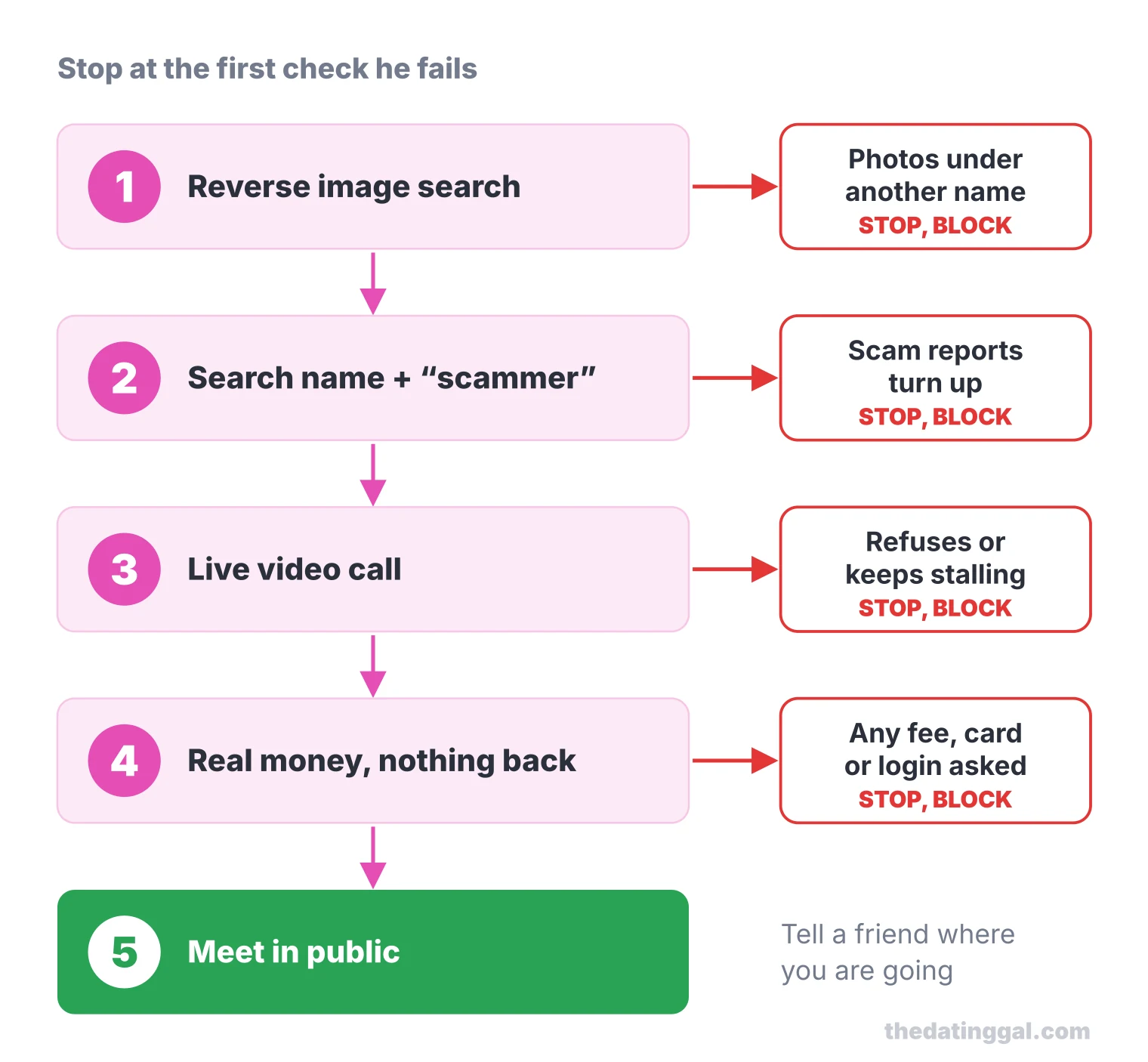
- Reverse image search his photos. On a computer, go to google.com, click Search by image, then Upload a file and choose a saved profile photo (steps from Google’s help page on searching with an image). On a phone, the Google app’s Lens camera does the same. The FTC’s test: is the photo associated with another name, or with details that do not match? Stolen photos of models, businessmen and soldiers turn up this way in seconds.
- Search his name, phone number or job plus “scammer”. This is the FTC’s own suggestion. Copied scripts and recycled numbers often have a trail of reports.
- Ask for a live video call, and a live action. Five minutes is enough. Ask him to wave, say your name or turn his head: a prerecorded clip or a stolen video cannot do that on request. Stalling, a frozen “bad connection” or a voice-only offer means stop.
- Let real money come first, with nothing asked back. If he wants to send an allowance, it should arrive with no fee, no gift card, no login and no request to forward any of it. Check the balance inside your own app. Money from a check can bounce weeks later, so wait before spending it, and never send any part of it on.
- Ask a friend. The FTC also asks: do your friends or family say they are worried? Show someone you trust the profile and the chat. Outsiders spot scripts faster than the person being flattered.
- Meet in public, on your own terms. A busy place, your own transport, a friend who knows where you are, and no home address, workplace or bank details shared until you are sure.
For the profile and chat itself, protect yourself while you check: use a separate email or number at first, and keep your account private if strangers flood your DMs.
Real vs fake sugar daddy: side by side
People ask how to know if a sugar daddy offer is real. These are the differences that matter, drawn from the FTC guidance and the sugar sites’ safety pages above.
| What you see | Real sugar daddy | Fake sugar daddy |
|---|---|---|
| First contact | On a sugar or dating site, often after you both set up profiles | Cold DM on Instagram, TikTok, Snapchat or Discord |
| The offer | Discussed after you talk and meet, tied to real plans | A big weekly number in the first messages, “no meeting needed” |
| Pace | Patient, respects your boundaries | Love bombing, pet names, pressure to decide now |
| Where you talk | Happy to stay on the platform at first | Pushes to WhatsApp, Telegram or text right away |
| Video call | Says yes, shows his face live | Broken camera, traveling, voice only, always “later” |
| Money | Sends it, asks for nothing back | Sends screenshots, then asks for a fee, a gift card or a login |
| Your data | Does not need your bank login, SSN or ID | Needs them “to set up payment” or “for verification” |
| His story | Consistent over weeks | Job, city and family change between chats |
What sugar dating sites actually verify
A common tip is “use a reputable sugar site instead of social media”. It helps, because sites have report buttons, moderators and some form of identity check. But a badge is not a background check, and the big sites verify different things. Here is what each one’s own pages say, checked October 2026.
| Site | Identity check | Background check | Rules on money | Report |
|---|---|---|---|---|
| Seeking | Optional ID verification, badge on the profile; video chat available | Optional, opt-in; no mandatory screening | Never send money; sugar dating and allowances are banned | Report a Member on every profile, 24/7 support |
| Secret Benefits | Video verification | None: no criminal background checks or security screening | Bans attempts to defraud members | Report button on each profile |
| Sugarbook | Profile checks and face verification, per its blog | Not described | Never share banking details or transfer money; does not handle payments between members | In-app Report button, anonymous |
Sources: Seeking’s Dating Safely page, the Secret Benefits FAQ (which also says it cannot guarantee members look the same in person as in their photos), Sugarbook’s safety tips and its post on how to tell if a sugar daddy is real online. Checked October 2026.
Two things stand out. First, Seeking now bans sugar dating outright: its Dating Safely page says compensated companionship, “sugar daddy” language and allowance talk get profiles denied and accounts suspended. A Seeking member pitching you an allowance is breaking the rules from the first message, which is a flag in itself. My Seeking review covers what the site is for now. Second, a verified face only proves the person matches the photos. It says nothing about intentions, so the money rules above still apply on every platform. The sugar daddy sites roundup and the reviews of Secret Benefits and Sugarbook compare the rest of their features.
One more rule worth knowing: these sites ban paying for sex, and exchanging sex for money is illegal in most of the US. A “sugar daddy” who frames the allowance that way is either a scammer or someone you do not want to meet.
If you are the one paying: how to spot a fake sugar baby
The same tricks run the other way. Fake sugar babies target older men with a beautiful profile, warm attention, then an emergency: rent, a broken phone, a sick relative, or “travel money” to come and meet you. The meeting never happens. The checks are the same: reverse image search the photos, insist on a live video call, and send nothing before a real, in-person meeting. Seeking tells members to report anyone who asks for money before meeting, including sob stories and requests to cover bills.
Spotted a fake? Block, report, move on
Do not argue or try to “scam the scammer”: replying tells the account your profile is active, and more messages follow. Instead:
- Take screenshots of the profile, the username and the chat.
- Report the account on the platform where it contacted you, then block it.
- Report it to the FTC at ReportFraud.ftc.gov, as the FTC’s romance scam guide recommends, even if you lost nothing.
If you already sent money, a gift card or a login, speed matters: the steps to take today, by payment method, are in the recovery section of my sugar daddy scams guide. For red flags beyond sugar dating, and the apps with the strongest verification tools, see the online dating safety hub and my list of the safest dating apps.
Frequently asked questions
How do you verify a sugar daddy is real?
Run a reverse image search on his photos, search his name or number plus the word scammer, and ask for a short live video call where he waves or says your name. Then let real money arrive with nothing asked back before you meet in a public place. Stop at the first check he fails.
Do real sugar daddies ask for money first?
No. A real sugar daddy never asks you for a fee, a gift card, a loyalty test, a bank login or part of a check back. Any request that makes money flow from you or through you is a scam, whatever the reason given.
Are sugar daddies on Instagram and TikTok real?
Almost never. Unsolicited allowance offers in your DMs are the classic opening of the scam, and the FTC found that 40% of people who lost money to romance scams in 2022 were first contacted on social media. Block and report them.
What do most sugar daddies want?
Genuine ones want companionship, discretion and clear expectations with someone they have met. They do not want money, logins or personal documents from you. Sugar sites also ban paying for sex, which is illegal in most of the US.
How do you know if someone has a sugar daddy?
From the outside, you usually cannot. Lifestyle posts showing gifts and trips cannot be verified, and some accounts that flaunt a sugar daddy are fronts used to make the offer look normal. Judge the person messaging you by the checks on this page, not by what others post.
Are sugar daddies legal?
A relationship between consenting adults that includes gifts or financial support is legal, but exchanging sex for money is illegal in most of the US and banned by the sugar sites. Seeking now bans sugar dating and allowance talk altogether in its rules.