
Sugar Daddy Scams: The 7 Patterns and How to Avoid Them
A sugar daddy scam is a con where someone poses as a wealthy man offering an allowance, then gets you to send money, gift cards, bank logins or intimate photos before any “allowance” is real. Almost every version runs on one of seven patterns, from the fake check to the “loyalty test” gift card, and they all share one tell: a real sugar daddy sends money, he never asks you to send any back, pay a fee or move money for him.
Below I break down how each scam works step by step, where the scammers find you, what you stand to lose with each one and who to call first if it already happened. Everything here comes from the FTC, the FBI’s Internet Crime Complaint Center, the National Consumers League’s Fraud.org, Cash App’s own scam guides and the safety pages of the sugar sites themselves, all linked.
How every sugar daddy scam runs
The details change, the script does not. Scammers create a profile with stolen or AI-made photos of a well-dressed older man, yachts and watches included, and message dozens of people at once on Instagram, TikTok, Snapchat, Grindr, Telegram or a sugar dating site. They promise a weekly allowance for very little: chatting, being “loyal”, sometimes nothing at all. They flatter you, talk fast about money, and push you off the app to WhatsApp, Telegram or text, where no trust and safety team reads the chat.
Then comes the turn. Before the allowance can start, there is a step: deposit this check, give me your card login so I can pay off your balance, pay a small fee, buy a gift card to prove you are serious, send a photo. Each step costs you something real, while everything you receive is fake, stolen or later reversed. Once they have what they wanted, or once you push back, they vanish or switch to threats.
It is not a niche problem. The FBI’s 2025 IC3 annual report counts 23,159 confidence and romance fraud complaints with $929,287,469 in reported losses, up from $672,009,052 in 2024. The same report lists 2,194 overpayment complaints ($22,898,075 lost) and more than 75,000 sextortion submissions, with people aged 20 to 29 filing the most (22,061). Those categories are not sugar dating alone, but the sugar daddy scam uses exactly those three mechanics.
The 7 sugar daddy scam patterns
1. The fake check (overpayment) scam
This is the classic. Your “sugar daddy” mails or mobile-deposits a check, often a few thousand dollars, tells you to keep part as your first allowance and send the rest to his “assistant”, a bill, a charity or a friend, usually by Zelle, Cash App, wire or gift cards. The money appears in your balance, so it feels safe.
It is not. The FTC’s fake check scam guide explains that banks must make deposited funds available quickly, but it can take weeks for a bank to figure out a check is fake. By then your transfer is gone, and you are the one stuck paying the bank back. Seeing the money in your account does not mean the check is good.
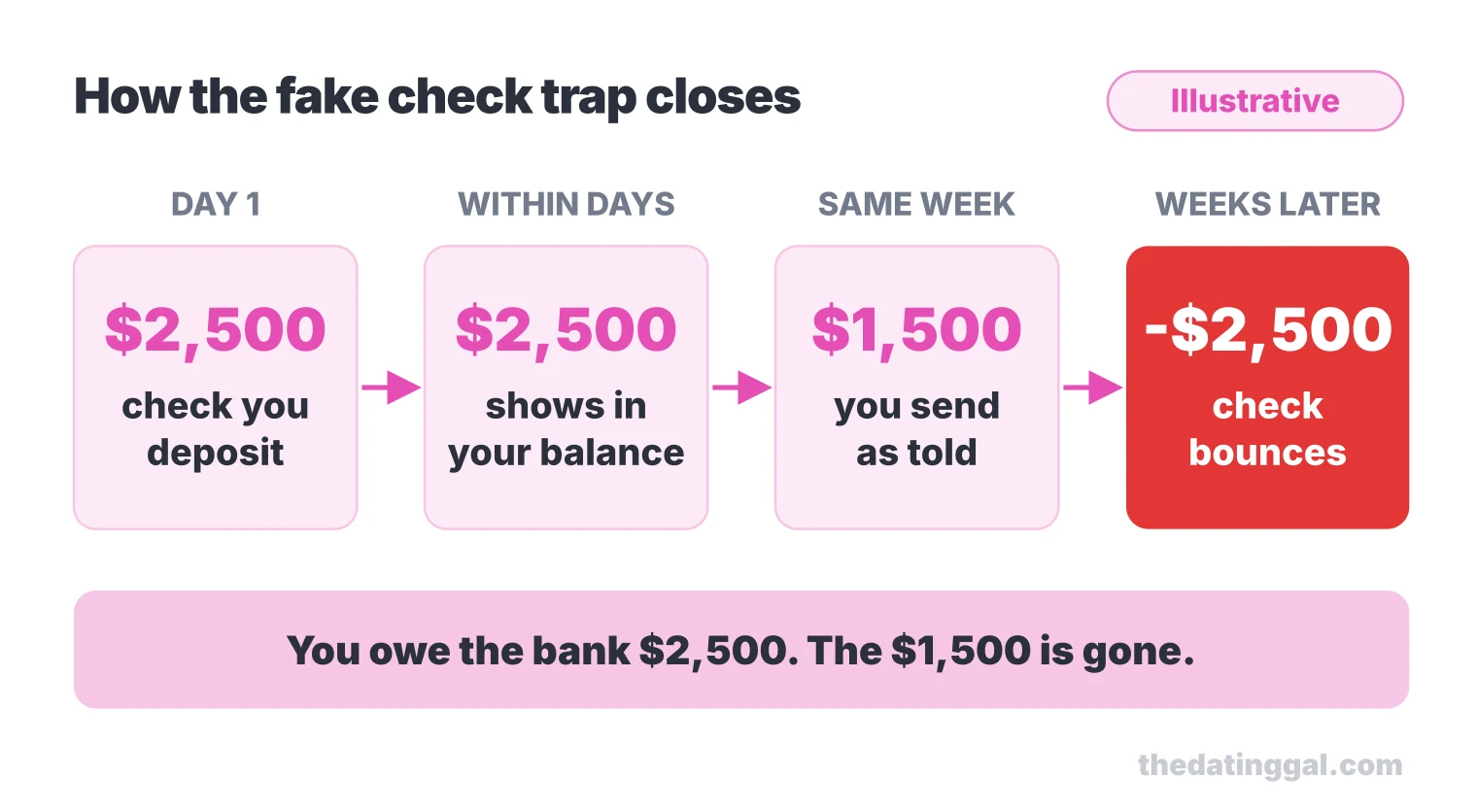
The same trick runs on payment apps. Cash App’s guide to the most common scams warns that a payment you did not expect, followed by a request to send some back, was often made with stolen funds or a compromised account.
2. The “I’ll pay off your credit card” scam
Here the scammer offers to clear your credit card or student loan. You hand over your card account login, he makes a payment that makes the balance look paid, and then asks for a thank-you: Apple, Google Play or Steam gift cards. Fraud.org’s sugar daddy alert describes the ending: the payment came from stolen money, the card company reverses it, and you owe the original balance plus the gift cards you bought. Victims who refuse to buy the cards get abusive or blackmailing messages. Fraud.org said complaints about this scam grew by more than 250% in 2019.
3. The upfront fee
The allowance is “ready” but stuck. You need to pay a verification fee, a clearance fee, a tax, an account upgrade on Cash App or PayPal, or a fee to a fake “bank” email. Sometimes a screenshot of a pending payment comes with it. Cash App’s guide notes that fake screenshots of payment confirmations are a staple of these pitches. No real payment needs you to pay first to receive it. Check your balance inside the app itself, never in a screenshot or an email.
4. The gift card “loyalty test”
A softer version of the fee: before he spoils you, prove you are not using him. Buy a $100 Apple or Google Play card and send a photo of the code. The FTC is blunt in its gift card scam guide: anyone who asks you to pay with a gift card is a scammer, and the code alone is enough for them to drain it. A “test” that runs in only one direction, from you to him, is the scam.
5. The bank login and money mule scam
This one feels like free money and is the most dangerous legally. He asks for your online banking login, or your account and routing numbers, “to send the allowance”. Stolen money lands in your account, and he asks you to forward part of it, buy crypto or gift cards, or receive packages. You have just moved stolen money for a criminal.
The FTC’s money mule alert names online dating as a recruiting ground, tells you never to send money back to an online love interest who sent you money, and warns you could get into legal trouble for helping a scammer move stolen money. The FBI’s definition of romance fraud in its IC3 report covers exactly this: people tricked into laundering money for the perpetrator. When the bank traces the transfers, they lead to your name, not his. Expect a frozen or closed account at the very least.
6. Sextortion
The “sugar daddy” asks for photos, first harmless, then intimate, sometimes after sending some of his own. Once he has them, the tone flips: pay, or the pictures go to your family, your employer or your followers. On Grindr and other LGBTQ+ apps, the threat can include outing you. The FBI’s IC3 report describes the same cycle: sextortion often starts with someone offering something of value, and once the criminals have images they threaten to publish them to force more pictures or payments, while shame keeps victims from asking for help. My advice: do not pay, because paying never guarantees the images are deleted and tells them you will pay again. Stop replying, keep the evidence and report it (steps below). If the photos were posted, report them to the platform for removal.
7. The fake sugar baby (when you are the one paying)
The scam also runs the other way. Security guides describe fake sugar babies who target older, wealthier men: a beautiful profile, warm messages, then requests for “travel money” to meet, rent, a phone bill or “self-care”, and no date ever happens. Seeking’s Dating Safely page tells members to report anyone who asks for money before meeting in person, including sob stories and phone bill requests. If you are the generous one, the rule is simply: no money before a real, in-person meeting.
What each scam costs you, and who to call first
Speed decides whether any money comes back, and the right first call depends on how you paid. Here is the pattern-by-pattern view, from the FTC, Cash App and Fraud.org pages linked above.
| Scam pattern | What you lose | Call first | Chance of getting it back |
|---|---|---|---|
| Fake check | Everything you sent on, plus the full check amount the bank takes back | Your bank, before you send anything (ask it to hold the check) | Good if you have not sent money yet, poor after |
| Credit card payoff | The original balance (reversed) plus the gift cards | Card issuer, then the gift card company | Low for gift cards unless reported fast |
| Upfront fee | The fee, often repeated | The payment app or bank you used | Low: payment app transfers are usually final |
| Gift card test | The card value | The gift card company, with the card and receipt | Some issuers refund if you report quickly |
| Bank login / money mule | Account access, possible account closure, legal exposure | Your bank, today; change passwords | Depends on the bank; stop moving money now |
| Sextortion | Money if you pay, privacy | Do not pay; report to the platform and the FBI’s IC3 | Paying does not end it |
| Fake sugar baby | Whatever you sent | Your bank or payment app | Low once sent |
Where sugar daddy scammers find you
Most of these scams do not start on a sugar site. The top guides list Instagram (comments, then a DM), Facebook groups about money or luxury, TikTok, Snapchat, Discord servers, Telegram, and Grindr. A stranger sliding into your DMs with an allowance offer you never asked for is the purest form of this scam: real people looking for an arrangement go where arrangements are listed, they do not cold-message students on TikTok.
Sugar dating sites are not scam-free either, because a fake profile blends in where everyone talks about allowances. Two things are worth knowing about the big platforms in October 2026:
- Seeking now bans sugar dating. Its Dating Safely page says sugar dating and compensated companionship are prohibited under its Terms of Use, and talk of allowances can get a profile denied or an account suspended. Someone on Seeking pitching you an allowance is already breaking the rules, which is a red flag in itself. My Seeking review covers what the site is now for.
- Sites built for arrangements verify less than you think. Secret Benefits’ FAQ offers video verification, but its terms say it does not run criminal background checks on members. A verified badge means the face matches the photos, not that the person is honest. My Secret Benefits review and the sugar daddy sites roundup explain which tools each site actually has.
Whatever the platform, the sites ban paying for sex, and exchanging sex for money is illegal in most of the US. A “sugar daddy” who frames the allowance that way is either a scammer or someone you do not want to meet.
Lines that give a sugar daddy scam away
Scammers work from scripts, so the same phrases come up again and again. If you see any of these, you are reading a script, not a person:
- “I just want to spoil someone, no meeting, no calls, nothing expected.”
- “I’ll pay $1,000 a week, I just need your bank login to send it.”
- “Deposit this check, keep $500 and send the rest to my accountant.”
- “My bank needs a small clearance fee before your allowance can go through.”
- “Buy a gift card to show me you are loyal, I will pay you back double.”
- “Let’s move to Telegram/WhatsApp, I am rarely on this app.”
- “My camera is broken, but here is a photo of me on my boat.”
- “Don’t tell your friends about us, they won’t understand.”
Most of these are about money moving from you or through you, which is the whole point. For a full checklist of profile and conversation warning signs, my online dating safety hub has the red flags and the verification steps in order.
The one test that beats every pattern
People ask how to “test” a scammer. You do not need tricks. Two rules catch all seven patterns:
- Money only flows to you, and only real money. No fees, no gift cards, no forwarding, no “send back the extra”, no logins. If any step requires you to pay or move money first, stop. A real allowance sent by a payment app with no strings attached and no request to send anything back is the only kind that counts, and even then, wait before you spend money that came from a check.
- A live video call before anything else. A real person with real money can do five minutes on camera. The FTC’s romance scam guide adds a reverse image search on the profile photo and a search of the claimed name or job plus the word “scammer”. If the photos belong to someone else, you are done.
And if you do move forward with a real arrangement: meet in a public place the first time, get there and home on your own, tell a friend where you are, and never share your home address, Social Security number or bank details. Seeking’s safety page gives the same advice and says to never give bank or financial information to anyone you meet on the platform.
Already caught in a sugar daddy scam? Do this now
Being scammed is not a judgment on you: these scripts are written by people who do this all day. The sunk cost feeling (“if I stop now, I lose what I already sent”) is what keeps people paying, so cut it off now.
- Stop sending money and stop replying. Do not confront them; it only gives them a new story. Block them everywhere they can reach you.
- Save the evidence: screenshots of the profile, username, chats, phone numbers, the check, payment receipts, gift card numbers and receipts.
- Call the money first. Your bank or card issuer for checks, transfers and card payments (ask them to stop or reverse, and to watch your account). The gift card company for gift cards. The payment app’s in-app support for Cash App, Zelle or PayPal; Cash App’s guide on what to do if you get scammed says a pending payment can sometimes be canceled, but a completed one is usually final, so do this today.
- If you gave a login or your SSN, change your passwords, turn on two-factor login, and consider a credit freeze with the three credit bureaus.
- Report it: on the app or site where you met (Seeking, for example, has a Report a Member button on every profile), to the FTC at ReportFraud.ftc.gov, and to the FBI at IC3.gov. If you are being threatened, call your local police.
- Be wary of “recovery” services. The FTC’s page on refund and recovery scams warns that scammers contact past victims promising to recover their losses for an upfront fee, and says never to pay upfront for help getting a refund. Work with your bank and the official reports above.
Reporting matters even if you lost nothing: these accounts message dozens of people, and a report is how platforms and the FBI connect them.
Frequently asked questions
How do I know if my sugar daddy is scamming me?
If he asks you to send anything, it is a scam: a fee, a gift card, part of a check, your bank login or intimate photos. A real sugar daddy sends money and never needs money back. Refusing a live video call is the other strong sign.
Can I be scammed if someone sends me money on Cash App?
Yes. Cash App warns that an unexpected payment followed by a request to send some back is often made with stolen funds or a compromised account. If the original payment is reversed, the money you sent back is gone, and payment app transfers are usually final.
What are common sugar daddy scammer phrases?
Watch for offers to spoil you with no meeting and no calls, requests for your bank login to send an allowance, a check to deposit with part to forward, a clearance fee before payment, and a gift card to prove your loyalty. Pressure to move to Telegram or WhatsApp right away is part of the same script.
How do you test a sugar daddy scammer?
Ask for a short live video call and do a reverse image search on his photos. Then refuse any step that needs you to pay or move money first. A scammer will make excuses or disappear, a real person will not mind.
What should you never say or send to a scammer?
Never share your bank login, account and routing numbers, Social Security number, home address, gift card codes or intimate photos. Do not argue or warn them you are reporting them; just stop replying, save the evidence and report the account.
Can you get in trouble for a sugar daddy scam?
You can if your account was used to move stolen money. The FTC warns that people who forward money for a scammer can get into legal trouble, and banks often freeze or close accounts used this way. Stop moving money and call your bank as soon as you suspect it.