
Dating App Safety: 12 Rules Before You Meet (2026)
Dating app safety comes down to a short checklist: share less on your profile, keep the chat inside the app, never send money or intimate photos, check that a match is real with a badge, a quick search and a video call, and keep the first date public with your own ride home and a friend who knows where you are. If anything feels off, leave, block and report. The apps do part of the work, but none of the big ones runs a criminal background check on every user, so the rest is on you.
Below are my 12 rules in the order you need them, the settings worth switching on in Tinder, Bumble and Hinge, and what each app’s own safety policy says it does and does not check. Every feature and number comes from the apps’ help centers, the FTC and Pew Research, linked and checked October 2026.
Why dating app safety needs a checklist
Most of the harm on dating apps is scams and harassment, not the true crime scenario everyone pictures. In Pew Research Center’s key findings about online dating, 52% of US adults who have used a dating site or app say they came across someone they think was trying to scam them. Among all users, 38% received sexually explicit messages or images they did not ask for, 30% were contacted again after saying they were not interested, and 6% were threatened with physical harm. For women under 50 who use the apps, those numbers rise to 56%, 43% and 11%. Only 48% of Americans now call online dating a very or somewhat safe way to meet people, down from 53% in 2019.
None of that means you should delete the apps. It means a few habits, done every time, remove most of the risk. Here they are at a glance.
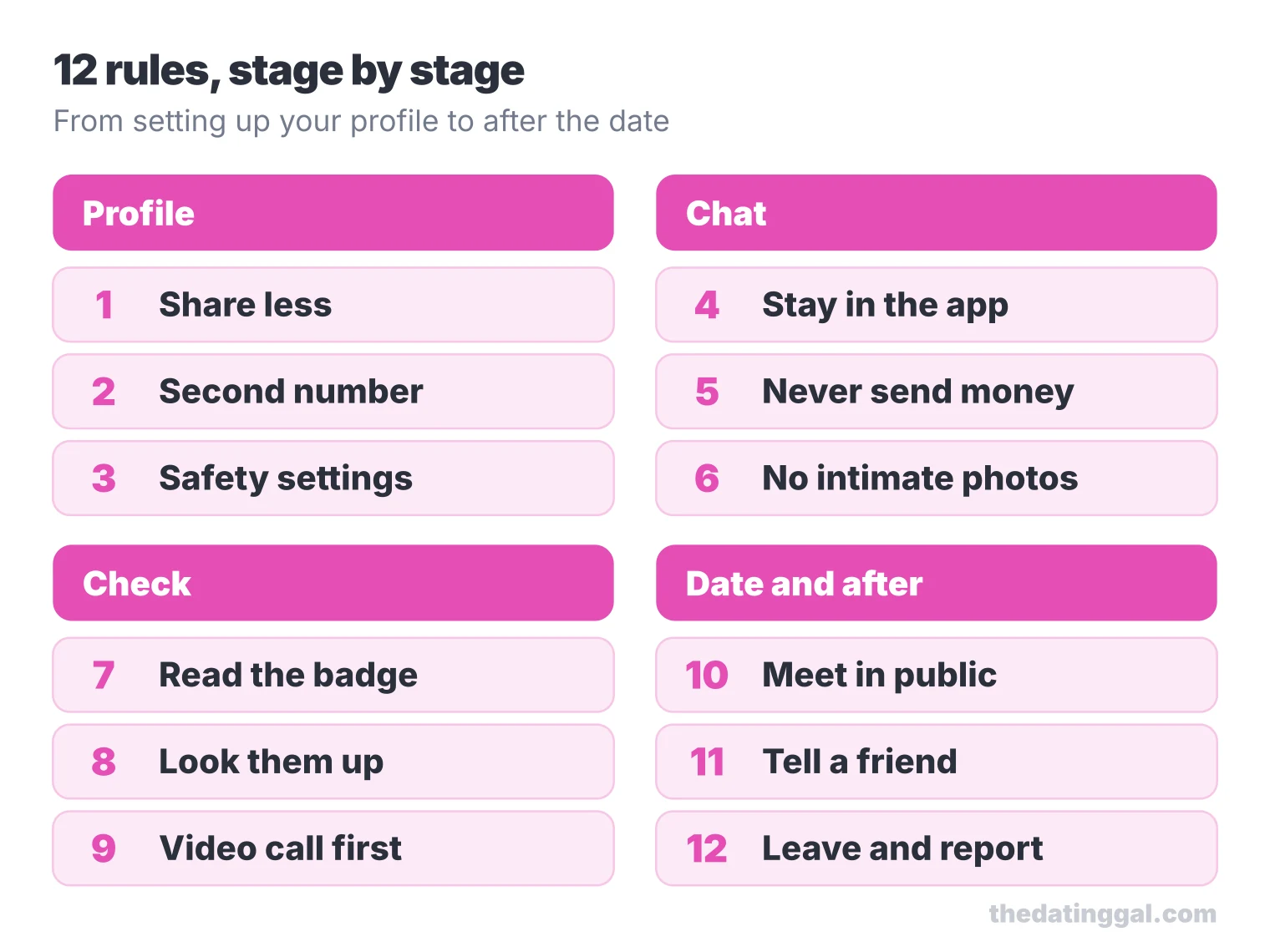
Before you match: set up your profile
1. Share less than you think you need to
A stranger should not be able to go from your profile to your front door. Use your first name only and leave out your last name, employer, school, neighborhood and anything about your routine. Hinge’s Safe Dating Advice gives the perfect example of a routine detail to skip: that you go to a certain gym every Monday. If you are a parent, Hinge also suggests leaving out your children’s names, ages and school.
Watch your photos too. A photo you also posted on a public Instagram can lead someone to your full name with one reverse image search, and a photo in front of your building, your car plate or your office badge gives away more than you meant to. Tinder now blocks screenshots of profiles, but its screenshot protection page says it only applies in select regions and that no technology can stop someone photographing the screen with another device. Treat every profile photo as public.
2. Use a second number and a separate email
Your real phone number is linked to your name in more places than you would guess. Before you give a match any number, get a free second one: Google Voice’s setup guide says US users can pick their own number by city or area code, and calls within the US and Canada are almost always free. If a match turns unpleasant, you drop the number, not your life. Do the same with email, and use a strong, unique password on the dating account so no one can get in through a guess.
3. Turn on your app’s safety settings
Every big app hides useful safety tools in its settings. These are the ones worth switching on before you start swiping:
| App | Setting | What it does | Where to find it |
|---|---|---|---|
| Tinder | Block Contacts | Hides you from people you know, like an ex or a coworker. They are not notified, and you can type in a number instead of sharing your whole contact list. | Profile, Settings, Block Contacts |
| Tinder | Photo Verified Chat | Only Photo Verified people can message you. You must be verified yourself to turn it on. | Match List, Safety Shield, Update Message Settings |
| Tinder (US) | Noonlight | Logs who, where and when you are meeting, and lets you silently alert police: hold the button, release, and do not enter your PIN. | Open the chat, tap the blue Noonlight icon |
| Bumble | Private Detector | Blurs images that may be explicit so you choose whether to open them. | Automatic |
| Bumble | Voice and video calls | Call a match without sharing your number. | Phone and video icons, top right of a chat |
| Hinge | Selfie Verification | Adds a badge showing your face matches your photos, and lets you see who else is verified. | Photo icon, gray check mark under your name |
Features checked on each app’s help center, October 2026. Get verified yourself on whichever app you use: Bumble makes photo verification mandatory in the USA, while Tinder’s is optional and Hinge’s is voluntary except in the regions where it requires a Face Check. For a full side-by-side of verification on each app, see my guide to the safest dating apps.
While you chat: keep control
4. Keep the conversation in the app
Messages inside the app are scanned. Hinge says its chats go through Safe Message Filters, and that is exactly why people with bad intentions try to move you to text, WhatsApp, Telegram or email right away. Tinder shows a contact exchange alert when it spots you sharing contact details, and its safety tips say the same thing: stay on the platform while you get to know someone. A match who gets annoyed that you will not hand over your number or Snapchat on day one has told you what you need to know.
5. Never send money, gift cards or crypto
This is the rule that stops nearly every dating scam, and the FTC words it plainly on its romance scams page: never send money or gifts to a sweetheart you have not met in person. The stories vary (a medical bill, a plane ticket, a visa, customs fees, a stuck inheritance) but the payment request does not: wire transfers, gift cards with the PIN, payment apps or cryptocurrency, all fast and hard to reverse. Hinge adds a rule I like for its bluntness on its scam page: never send or receive money by wire, money order, currency exchange, gift card or investment, “not for any reason. Ever.” A date who gives you crypto or stock tips is not a date. Report it.
The full playbook, stage by stage, is in my guide to how online dating scams work.
6. Don’t send intimate photos to someone you haven’t met
Intimate photos sent early are the raw material for sextortion: pay, or the pictures go to your friends and family. Keep that kind of trust for someone you know offline. If it has already happened, you have options:
- Do not pay. Paying does not guarantee anything gets deleted. Stop replying, screenshot everything, block, and report the account.
- Use StopNCII. StopNCII.org is a free tool from the Revenge Porn Helpline for adults over 18. It creates a digital fingerprint (a hash) of your image on your own device, so the image itself never leaves your phone, and shares only that fingerprint with participating platforms so they can block copies. It also works when you have only been threatened.
- Report to the app. Tinder has a dedicated form for intimate images shared without consent, including AI deepfakes, and bans accounts responsible across all Match Group apps.
Before you meet: check they are real
7. Read the badge, and know what it doesn’t prove
A verified badge is worth looking for. On Tinder, Photo Verification compares a short video selfie with the profile photos using facial recognition. On Bumble you can also add ID verification with a government ID and a live selfie. But the badge proves one thing: the person holding the phone looks like the photos. Hinge says it outright: its badge “does not confirm their name, age, or other identity details.” Tinder calls its blue check “a signal,” not a guarantee. No badge on a profile? Ask them to verify before you meet.
8. Look them up
Ten minutes of homework catches most fakes:
- Reverse image search their photos with Google Lens or TinEye. If the face shows up under another name or on a model’s page, you are done.
- Search their name, plus their claimed job and city. A LinkedIn or Instagram that matches the story is a good sign. Nothing at all is not proof of a scam, but it raises the bar for the video call.
- Ask for their last name before the date. Someone with nothing to hide shares it, and it gives your friend something to search if needed.
9. Do a short video call first, outside the app if you must
Every safety guide says “video chat before meeting,” and they are right: five minutes on camera rules out most catfish, and a match who always has a broken camera is a stop sign. What they don’t tell you is that the apps changed. Hinge removed its voice and video calling, and Tinder deprecated Face to Face video chat, so on those two apps the call has to happen somewhere else. Bumble still has in-app calls. On Tinder or Hinge, use your Google Voice number or a video app that only needs an email you don’t mind sharing, so the call does not hand over your real number.
What your app does and does not check
Colorado law requires dating apps to publish their safety policies, and those pages are the most honest description of what “safe” means on an app. Tinder’s safety policy and Hinge’s say almost the same thing:
- They do not run criminal background or identity checks on all users.
- They may check users against state sex offender registries when they have enough information to do so, and they ban accounts that match.
- Their terms ban anyone convicted of, or who pled no contest to, a felony or a crime involving sexual misconduct or violence, but they act when they “become aware” of it, not through a check at signup.
- Serious violations like violence or sexual misconduct lead to a ban on that app and across the Match Group portfolio, the company that owns both apps.
- Both say plainly that no online photo verification or background screening is foolproof.
That gap is why the checklist matters. Pew found six in ten Americans think apps should require background checks before a profile goes live, but that is not how any of these apps work today. Paid background check sites exist, as some guides suggest, but they need a full name you may not have yet. Rules 7 to 9 cost nothing.
Red flags that mean stop
A red flag is any behavior that pushes you to trust faster than the facts allow. One can be innocent. Two or more together, especially with money in the story, is the pattern:
- Pushes to leave the app for text or another messaging app right away.
- Says it is love or fate within days and messages constantly (love bombing).
- Lives far away or overseas: the military, an oil rig, an international charity, the reasons the FTC lists. Meeting is always next month.
- Refuses a video call or the camera never works.
- Asks for your home or work address, or asks for intimate photos.
- Gets angry at your safety steps, or pushes to meet at their place or yours for a first date.
- Any request for money, gift cards, crypto or an investment, or to “just receive” a payment for them.
- Answers stay vague, the story changes, or messages read like a script.
If you’re looking at a sugar dating profile, my red flags for fake sugar daddies covers the patterns specific to that world.
On the date: stay in charge of the exits
10. Meet in public, get there yourself, keep it short
- Public and busy: a café, a bar, a restaurant. Not a park, not a home, not a remote “romantic” spot. And stay in public: move to a second place only if it is also public, and in your own car or rideshare.
- Your own transport, both ways. Do not let a first date pick you up at home. If you travel to meet someone in another city, book your own hotel and don’t tell them where it is.
- Keep it short: coffee or one drink, with an end time you mention up front. A date who keeps pushing past it is showing you how they handle boundaries.
- Watch your drink and your limits. Take drinks from the server or bartender, don’t leave your glass, and drink little enough that you could drive.
- Pay your own share on the first dates if you’d rather nobody “expect” anything. Some daters pay cash so their full name on a card never ends up on the table.
11. Tell a friend and share your location
Send a friend a screenshot of the profile, the name, where you are going and when you expect to be home. Then share your live location: Find My on iPhone or Google Location Sharing on Android, both easy to stop afterward. Agree on a code word that means “call me with an emergency,” and a check-in time. On Tinder in the US, Noonlight (in the table above) adds a silent alarm. Bumble’s Share Date card would be ideal, but its help page says the feature is currently unavailable, so share the details by text instead.
After the date: leave, block and report
12. Leave when your gut says so, then report
You never owe anyone politeness at the cost of your safety. If something feels wrong, go to the restroom, tell the staff, and leave. If you are in danger, call 911. Then report, even if nothing “happened.” Reports are confidential on all three apps, and on Tinder and Bumble you can still report someone after you unmatch:
- Tinder: tap the three dots on the profile or chat, then Report. For anything that happened in person, pick “Something that happened off Tinder or in person”. Without the profile, Tinder’s reporting page asks for the name, age, bio and screenshots by email.
- Bumble: open the profile, scroll to the bottom, tap Report. The person is not told. If you already unmatched, Bumble’s reporting guide says to contact support with their name and screenshots, and you can track your report in the Help Hub.
- Hinge: three dots on the profile or chat, Report, pick a reason; the profile disappears from your view. Outside the app, use Hinge’s report form and choose Safety and Reporting.
- Money lost? Call your bank or the gift card company the same day, then report at ReportFraud.ftc.gov.
If you were hurt, it is not your fault. Tinder’s in-person harm page links to RAINN and to ThroughLine for local crisis support, and Hinge’s support resources connect you with local helplines and a scam recovery guide. For the bigger picture on scams, reporting and safety on hookup and sugar sites, my online dating safety hub brings it all together.
Which dating app is the most secure?
None is risk free, but the large apps publish real tools. Bumble requires photo verification for everyone in the US and still offers in-app video calls, which makes rules 7 and 9 easier there. Tinder has the deepest settings (Photo Verified Chat, Block Contacts, Noonlight). Hinge requires a Face Check in some regions and filters messages. My reviews go deeper on each: Bumble, Tinder and Hinge. The bigger risk is a small site you found through an ad, where paid chat profiles and no verification are common. Whatever you pick, the 12 rules above are what keep you safe, not the logo.
Frequently asked questions
How do you stay safe on a first date from a dating app?
Meet in a busy public place, get there and back on your own, and keep it short with an end time. Tell a friend who you are meeting and where, share your live location, and watch your drink. If anything feels off, leave and report the person in the app.
What's the most secure dating app?
No app is risk free. Bumble requires photo verification for everyone in the US and still has in-app video calls, Tinder has the most safety settings, and Hinge filters messages and requires a Face Check in some regions. None runs a criminal background check on every user, so your own checks still matter.
What is the 3-3-3 rule in dating?
It is a rule of thumb, not a study, and people use it in different ways, usually to pace a new connection over its first days, weeks and months. For safety, the useful version is simple: don't rush. Verify the person, video call, and meet in public a few times before you go somewhere private.
Are dating apps healthy?
They can be, if you set limits. Pew Research found 38% of users received sexually explicit messages they did not ask for and 30% were contacted again after saying no, so block and report freely and take breaks. Bumble, for example, has a Snooze mode for time away.
What is a red flag on a dating app?
Any behavior that pushes you to trust faster than the facts allow: moving you off the app right away, love bombing, always being overseas, refusing video calls, asking for your address or intimate photos, and above all any request for money, gift cards or crypto.
What is the male to female ratio on Hinge?
Hinge does not publish a male to female ratio in its help center, and figures you see online are third-party estimates. It is not a safety question either way: whatever the ratio, the same verification and first-date rules apply.