
Tinder vs POF: Which Is Better in 2026?
Tinder vs POF comes down to speed versus control: pick Tinder if you want the biggest pool, a quick photo-first swipe and an app that works almost anywhere; pick Plenty of Fish (POF) if you want to search by age, distance and other details, read longer profiles and send one free message a day to someone you have not matched with yet. Both are free to start, both are owned by Match Group, and neither is worth paying for until the free version shows you people you would actually meet.
Tinder vs POF at a glance
Here is how the two line up on the points that decide the choice, from each company’s help center and app store listings.
| Tinder | POF (Plenty of Fish) | |
|---|---|---|
| Best for | Volume, under-35s, casual dating, small towns, travel | Searching by criteria, 30-plus daters, longer profiles |
| How you find people | Swipe only | Swipe (Meet Me) plus a free Search with filters |
| Message before a match | No (Platinum can add a note before matching) | Yes, 1 free First Contact a day |
| Free version | Match, chat, limited likes, ads | Search, Meet Me, chat with mutual matches, ads |
| See who liked you | Gold and Platinum | Premium and Prestige |
| Paid tiers | Plus, Gold, Platinum | Plus, Premium, Prestige |
| Cheapest listed App Store subscription | Tinder Plus $9.99 | $19.99 (1 week) |
| Photo verification | Optional video selfie (Face Check where required) | Optional selfie, Face Check rolling out by region |
| Date-sharing tool | Noonlight (US) | Share My Date |
| Where it works | 190+ countries | Mostly local search by distance |
| App Store rating | 4.2 (1.8M ratings) | 4.3 (1.8M ratings) |
| Google Play rating | 3.9 (9.26M reviews, 500M+ downloads) | 3.7 (1.67M reviews, 50M+ downloads) |
Ratings and prices from the Tinder App Store listing, the POF App Store listing, Tinder on Google Play and POF on Google Play. Prices checked October 2026.
How matching and messaging work
This is the biggest practical difference between the two, and the one most comparisons get only half right.
Tinder: match first, then talk
Tinder has one way in. You swipe right to like, left to pass, and when two people like each other it is a match. Its help center is blunt about the rest: only once you’ve matched can you start to chat. Either of you can write first, and nobody can message you unless you liked them back. The one exception is paid: the Google Play listing says Tinder Platinum lets you “send a compliment before matching.”
POF: swipe, search, or write first
POF gives you two routes. Meet Me is its swipe deck: a mutual like is a match, and a match means unlimited messages with that person. Then there is Search, which POF says is available on all membership levels, including free, with filters such as gender, location, age, distance and religion.
When you find someone through Search you have not matched with, you send a First Contact. That is where the AI answers and several top-ranking pages overstate things: POF does not let free members message anyone they like. Its Google Play listing says you get one First Contact a day. You need a main profile photo to send it, more are sold à la carte, and unlimited First Contacts come only with the Prestige tier. Then the other person decides: per POF’s messaging page, if they don’t reply or like you back, you can’t send follow-ups. In my Plenty of Fish review I found the same limit: one first contact a day on a free account.
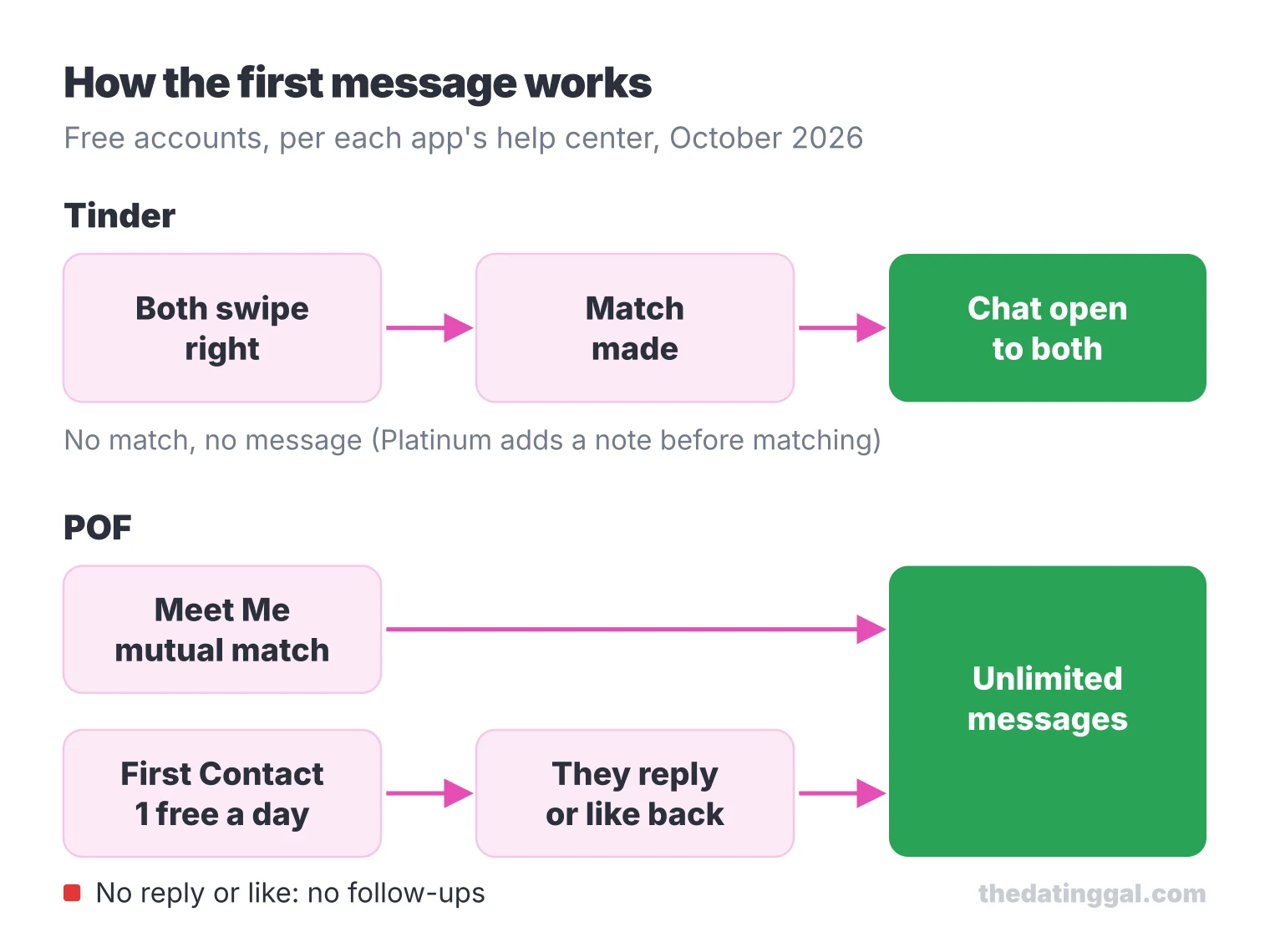
What this means: on POF, one well-chosen message a day to someone you searched for can beat a hundred swipes. On Tinder, you can’t reach anyone who hasn’t already said yes, which keeps your inbox clean but makes your photos do all the work.
Profiles and how much effort each asks
Tinder profiles are photo-led: pictures, a short bio, interests and optional prompts. The swipe is fast, and the first impression is almost entirely visual. POF asks for much more at sign-up. In my POF review the sign-up covered relationship intent, education, income, marital status, kids, pets, appearance, personality, a headline and prompts, so plan on a cup of coffee. Paying members also see extended profile details such as whether someone has or wants children and their lifestyle habits, per POF’s upgrade benefits page.
Both apps reward being active. POF says it outright: its recommendations page says the algorithm favors people who are online or were recently, and that subscribers and Boost buyers can “pay to skip the line.” One quirk to know: POF’s Search automatically widens your distance and age range when results run thin, and there is no setting to stop it, so in a small town you will see people far away.
What you get free on each app
Both apps are free to download, and both free versions are usable. The difference is what the paywall blocks.
- Tinder free: its overview page says the free version lets you “match, chat, and connect,” with limited likes and ads. Seeing who already liked you is reserved for Gold and Platinum, per the Likes page.
- POF free: full Search with filters, Meet Me, unlimited messaging with mutual matches and one First Contact a day. Unlimited likes, no ads and the extended profile details start with POF Plus; the full list of who liked you (Interested in Me) and read receipts need POF Premium.
Neither company publishes its free daily like limit, so any number you see quoted online is a guess. For most people the free POF account goes further: you can search and you can make the first move, which Tinder only sells.
What each costs in 2026
Neither app publishes a fixed US price list on the web. Prices show up in the app and change with plan length, location and promotions. The most reliable public numbers are the in-app purchase prices on each App Store listing.
| Tier | What it adds | App Store price points |
|---|---|---|
| Tinder Plus | Unlimited likes, Rewinds, Passport, no ads, incognito | $9.99 |
| Tinder Gold | Plus features, weekly Super Likes, 1 Boost a month, see who likes you | $13.99, $14.99, $18.99, $24.99 |
| Tinder Platinum | Gold features, Prioritized Likes, a note before matching | Not among the listed App Store items |
| POF Plus | Unlimited likes, extended profiles, first look at new members, up to 16 photos, no ads | Listed by length, not tier: $19.99 (1 week), $29.99 (1 month), $29.99 (“POF Premium Membership”), “Upgrade” at $19.99 and $38.99 |
| POF Premium | Plus features, Interested in Me, read receipts | |
| POF Prestige | Premium features, unlimited First Contacts, unlimited priority likes, messages seen first (some US iOS members only) |
Features from Tinder’s subscriptions page and POF’s membership tiers page; prices from each app’s App Store listing. Prices checked October 2026.
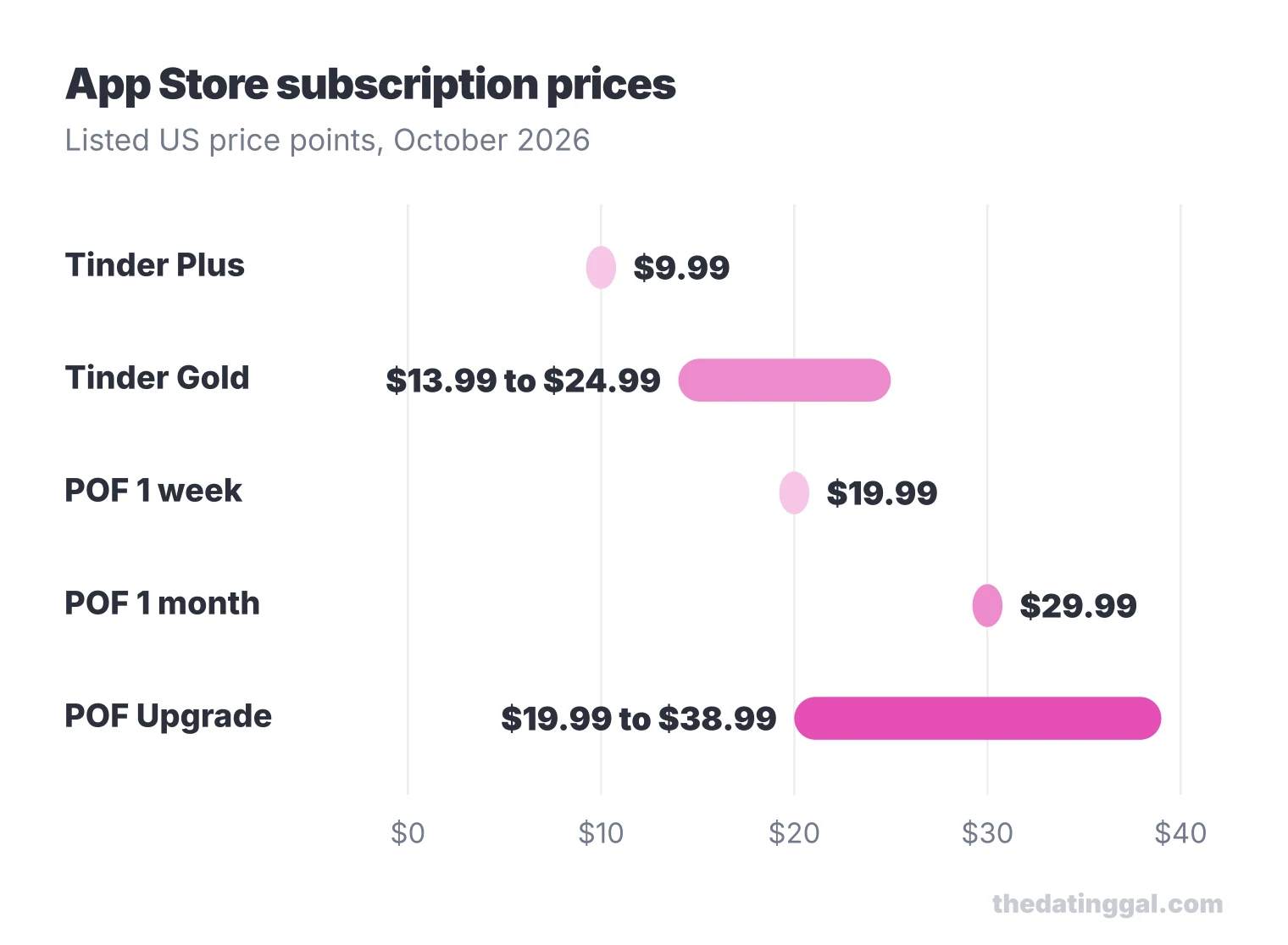
On these numbers, Tinder’s entry tier is cheaper than any listed POF subscription. But compare like with like: a POF week at $19.99 is steep, while POF’s free tier already includes Search and a daily First Contact that Tinder doesn’t sell below Platinum. On Google Play, single items range from $0.49 to $299.99 on Tinder and from $0.99 to $399.99 on POF, which covers long plans and bundles. Extras cost money on both: Tinder lists a Boost at $3.99 to $7.99 and 5 Super Likes at $4.99, and POF sells Boosts and Super Likes as à la carte packs plus tokens from $1.99 for 1 to $17.99 for 10.
POF charges the whole plan up front and offers 1-week, 1, 2, 3 and 6-month memberships, per its renewal page. A week is the cheapest way to test whether paid features change anything.
What older comparisons get wrong
Some pages still quote Tinder Plus at $9.99 under 30 and $19.99 over 30, and POF features like the Chemistry Predictor, group chats and “goldfish credits.” Tinder’s age-based pricing was the subject of a California class action, and Match Group’s quarterly filing says the parties agreed on September 10, 2025 to settle it for $60.5 million. POF’s current help center describes Plus, Premium and Prestige and says you no longer need tokens to unlock membership features; the old features above don’t appear in it. Trust the price in the app over any blog table.
Who uses each app
Tinder is the bigger app by a wide margin. In Pew Research Center’s survey of 6,034 US adults (July 2022), 46% of people who had used online dating had used Tinder, more than any other platform, and 79% of online daters under 30 had used it. Pew does not report POF separately. On Google Play, Tinder shows 500M+ downloads against POF’s 50M+, while on the US App Store both have about 1.8 million ratings, a sign POF still has a large American following.
What age group uses POF most? POF doesn’t publish an age or gender split, and Tinder doesn’t publish a US gender split either, so treat the confident percentages on other sites as estimates. Pew’s numbers confirm that Tinder skews young. Third-party pages consistently describe POF as drawing more people in their 30s, 40s and 50s, which fits its longer profiles, but no POF source confirms it. POF does say in its search help that the vast majority of its members are looking for people near them, so it works best as a local app.
The companies’ own numbers show direction rather than size. In its second-quarter 2026 results, Match Group says Tinder’s year-over-year decline in daily active users narrowed to 4%, its best result in 10 quarters. POF sits in the group it calls Everyone Everywhere with Match, Meetic and OkCupid, and gets no separate figures.
Safety, verification and fake profiles
The most common complaint about POF, in the AI answer and in the alternatives pages that rank, is bots, fake profiles and a spammy inbox. That reputation comes partly from the open-inbox model: anyone can send you one First Contact. Here is what each app actually gives you.
- POF: optional Selfie Verification earns a badge (change your main photo and you verify again). From a chat you can ask the other person to verify, and the Safety Toolbox (the shield icon) puts verification, Share My Date, the Crisis Text Line, reporting and blocking in one place. Share My Date sends a link with when, where and who to friends, and it expires 7 days after the date. POF is also rolling out a mandatory Face Check video selfie region by region.
- Tinder: Photo Verification is an optional video selfie that earns a badge, ID + Photo Verification exists only in select test markets, and a Face Check scan is mandatory in some regions, per its age checks page. In the US you can connect Noonlight to share who and where you are meeting and discreetly call emergency services. The match-first rule means strangers can’t message you at all.
- Video before meeting: neither app has in-chat video calls right now. Tinder deprecated Face to Face video chat; POF unlocks voice messages and photo sharing once you are in a real conversation (its Conversation Powers) and says voice calling is coming. Ask for a video call on another app before you meet.
Both companies say a badge is not a guarantee. On either app, look for the badge, ask anyone without one to verify, and walk away from anyone who asks for money, gift cards or crypto. POF’s online safety guide warns against moving off the app too fast and against people who won’t meet or video call, the same signs the FTC lists for romance scams. One POF-specific scam: POF has no phone support, so any “POF support” number you find on Google is fake. To report someone, tap the shield icon on POF (POF reporting guide) or the three dots on Tinder (Tinder reporting page). For more, see my guide to online dating scams.
Same company, so what?
Tinder and POF are sister apps. Match Group bought POF in July 2015 for $575 million, per its Wikipedia entry, and POF’s Google Play listing names Tinder, Match.com, Hinge and OkCupid in the same portfolio. Two things follow that no comparison mentions:
- Your POF profile can show up elsewhere. POF’s Expanded Discovery & Interaction setting, where it is offered, lets your profile appear in discovery and search on other Match Group services. Turn it off under Settings, Your Privacy Choices, Match Group Data Sharing if you want to stay on POF only.
- Bans and verification travel. POF says it shares information across Match Group companies to ban fake accounts and fraud across its services and can carry a verified status from one app to another. Getting banned on one can follow you to the other.
It also means switching between them is not escaping a company you dislike. If you want a different owner, Bumble is the big independent: see my Tinder vs Bumble comparison.
Serious or casual: is POF a waste of time?
Tinder carries the hookup reputation, and it is the app most people think of for casual dating, though you can set relationship goals on your profile and plenty of couples meet there. POF has a more traditional, relationship-minded feel, with long profiles and intent fields, which is why it tends to suit people over 30 who want to date seriously.
Why do some people call POF a waste of time? The complaints come down to three things: an older-looking app, more junk in the inbox than on match-only apps, and a free First Contact that can go unanswered. Two of those are fixable. Verify yourself and ask matches to verify, and use Search to send your one daily message to someone whose profile you have read. If what you want is a curated, serious feed, Hinge does that better: see my Tinder vs Hinge comparison or the shortlist of serious dating apps. If casual is the goal, my ranking of the best dating apps for casual dating goes beyond these two.
Cancelling, refunds and deleting your account
Both apps auto-renew, and deleting the app from your phone cancels nothing. How you cancel depends on where you paid.
- POF: cancel in your iPhone’s Subscriptions settings, in Google Play under Payments & subscriptions, or on POF.com under Manage Account, Account Type, per POF’s cancellation page. Do it at least 24 hours before renewal. The same page says POF subscriptions are “final and non-refundable,” so the one-week plan is the safe way to try it.
- Tinder: the same Apple and Google routes, or Manage Payment Account on tinder.com for card and PayPal purchases, per Tinder’s cancellation page. Its refund page says most purchases are nonrefundable but it can help with direct purchases made in the last 14 days; Apple and Google decide refunds on their stores.
- Deleting: cancel first. POF deleted accounts can’t be reactivated, upgrades don’t transfer to a new account, and on Android you delete through POF.com in your phone’s browser, not in the app. Tinder deletes from Settings and keeps profile data for 90 days before purging it.
Which one should you pick?
- You are under 30: Tinder. That is where most people your age are.
- You are 35 or older and want a relationship: POF, and filter by what matters to you; my list of the best dating apps for over 40 has more options.
- You are a man with average photos: POF’s daily First Contact lets a good message do the work. On Tinder, your photos have to carry you.
- You are a woman who hates unsolicited messages: Tinder’s match-first rule keeps strangers out; on POF, use the Safety Toolbox and report freely.
- You want it free: POF’s free tier does more (Search and a daily First Contact).
- You want to pay the least for unlimited likes: Tinder Plus at $9.99 on the App Store.
- You travel: Tinder, with Passport as a standalone purchase or on any paid tier.
- Bumble or POF? Bumble if you want mandatory photo verification in the US and a slower pace (4/5 in my Bumble review); POF if you want to search and message first for free.
- Still unsure: use the same photos on both for two weeks, count the conversations that turn into plans, and keep the winner.
Comparing other big apps? All my head-to-heads are in dating app comparisons.
Frequently asked questions
Is Bumble or POF better?
Bumble is better if you want mandatory photo verification in the US and a slower, more curated feed. POF is better if you want to search by criteria and send a free first message to someone you have not matched with. Both are free to try, so test both for two weeks.
Is Tinder the most popular dating app?
In the US, yes by usage. In Pew Research Center's 2022 survey, 46% of online daters had used Tinder, more than any other platform, and Tinder shows 500M+ downloads on Google Play against 50M+ for POF.
Who uses Plenty of Fish?
POF is used by adults looking mostly for local dates, and its long profiles and intent fields draw a more relationship-minded crowd than Tinder. POF does not publish an age or gender breakdown, so exact percentages quoted online are estimates.
What age group uses POF most?
POF does not publish it. Third-party pages consistently describe its users as older than Tinder's, with many people in their 30s to 50s, while Pew's data shows Tinder is strongest with adults under 30.
Why is Plenty of Fish a waste of time for some people?
The usual complaints are an older-feeling app, more spam than match-only apps, and a single free First Contact a day that can go unanswered. Verifying yourself, asking matches to verify, and spending that daily message on a profile you have actually read makes POF far more useful.
Can you message someone on POF without matching?
Yes, with a First Contact. POF's Google Play listing says free members get one a day, a main photo is required, and the other person must reply or like you back before you can send more. Unlimited First Contacts come with the Prestige tier.