
Tinder vs Hinge: Which Is Better in 2026?
Tinder vs Hinge comes down to what you want: pick Hinge if you want a relationship and like reading a profile before you say hello; pick Tinder if you want the biggest pool, fast casual matching, or a dating app that works almost anywhere in the world. If you live outside a big city and want something serious, run both on their free tiers for two weeks and keep the one that has more of your people nearby.
Tinder vs Hinge at a glance
Here is how the two apps line up on the points that decide the choice, from each company’s help center and app store listings.
| Tinder | Hinge | |
|---|---|---|
| Best for | Volume, casual dating, small towns, travel | Serious relationships, people who like detailed profiles |
| How you browse | Swipe cards: right to like, left to pass | Scroll a full profile, like one photo or prompt |
| Message before matching? | No, chat opens after a mutual match | Yes, in effect: a like can carry a comment |
| Free version | Match, chat, limited likes, ads | Match, chat, limited daily likes, see incoming likes one at a time |
| See who liked you | Tinder Gold and Platinum | Free one at a time; all at once on Hinge+ and HingeX |
| Paid tiers | Tinder Plus, Gold, Platinum | Hinge+ and HingeX |
| Cheapest listed App Store subscription | Tinder Plus $9.99 | Hinge subscription $14.99 |
| Change location | Passport: paid tiers or standalone purchase | Edit your location in your profile, free |
| Verification | Optional Photo Verification badge, Photo Verified Chat | Optional Selfie Verification badge |
| Where it works | 190+ countries | Select countries only |
| App Store rating | 4.2 (1.8M ratings) | 4.4 (1.1M ratings) |
| Google Play rating | 3.9 (9.25M reviews) | 3.5 (490K reviews) |
Ratings and prices from the Tinder App Store listing, Hinge App Store listing, Tinder on Google Play and Hinge on Google Play. Prices checked October 2026.
How matching and messaging differ
This is the real difference between the two apps, and it shapes everything else.
Tinder: swipe first, talk later
Tinder shows you one profile card at a time. You swipe right to like and left to pass, and if the other person also swiped right, it is a match. Tinder’s help center is plain about the rule: you can only chat once you have matched. Profiles are photo-led, with an optional bio, prompts and interests. Decisions are fast and mostly visual, which is why Tinder feels like a numbers game.
Hinge: like a detail, open with a comment
Hinge shows you a whole profile: photos plus written, voice or video prompts. Instead of liking the person in one swipe, you tap the heart on a specific photo or prompt and can add a comment. That comment is what the other person sees when they decide whether to match, so your opener is sent before the match exists. Hinge says adding a comment makes a reply more likely.
The effect: Tinder gives you more matches and more dead “hey” chats; Hinge gives you fewer matches that start with something to talk about. If you hate writing openers from nothing, Hinge does half the work for you. If you hate filling in a long profile, Tinder is the easier app to start on.
Chatting after the match
Both apps let free users message matches. Many comparisons still say Tinder has in-app video chat and Hinge has voice and video calls. Neither is true anymore: Tinder says Face to Face video chat has been deprecated, and Hinge removed its voice and video calling feature, keeping voice notes. If you want a quick video call before a first date, which is a good scam filter, you now do it on FaceTime, WhatsApp or similar once you trust the person enough to share a number.
The algorithms: who you get shown
Neither company publishes its ranking code, so treat anything precise you read about either algorithm with care. What each one says in its own help pages:
- Hinge builds your Discover feed from mutual interest: the people you see fit your preferences and you fit theirs, according to its Discover feed page. It also tries to send one Most Compatible pick a day, which expires after 24 hours. Most comparisons say Hinge’s matching is based on the Nobel-winning Gale-Shapley “stable marriage” algorithm; Hinge’s help center does not name it, but “mutual interest” is the same idea: it tries to show you people likely to like you back.
- Tinder serves profiles from your location, your Discovery settings and your swiping. The old “Elo score” is often cited, but Tinder’s own help center does not describe a score. What it does document is that paid perks change visibility: Boosts make you a top profile in your area for 30 minutes, and Platinum’s Priority Likes get your likes seen before those of non-subscribers.
The practical advice is the same on both: be selective, fill in the profile, and do not like everyone. Mass-liking makes your likes cheaper on Tinder and burns your small daily allowance on Hinge.
What you get free on each app
Both apps are free to download, and both free versions let you match and chat. The caps are where they differ.
- Tinder free: Tinder’s overview page says the free version lets you “match, chat, and connect.” You get a limited number of likes, you see ads, and the Likes page showing who already liked you is reserved for Gold and Platinum. Tinder does not publish the daily like limit, which is why articles quote anything from 25 to 100.
- Hinge free: Hinge’s subscription page says free users can send “a select number of likes per day,” see one incoming like at a time, and undo one skip a week. It also lists one free Rose a week to stand out. In my Hinge review the free cap was eight likes a day, which is the “8 rule” people search for.
Hinge’s free version is the more generous of the two in one important way: you can see who liked you, one at a time, without paying. On Tinder that is the main reason people buy Gold. Tinder’s free version is more generous on volume: you can like far more profiles a day than on Hinge.
What each costs in 2026
Neither app publishes a fixed US price list on the web. Prices are shown in the app and can vary with your age, location, plan length and promotions. The clearest public record is the in-app purchase list on each App Store page, which shows price points but not billing periods.
| Tinder | Hinge | |
|---|---|---|
| Free | Match and chat, limited likes, ads | Match and chat, limited daily likes, 1 incoming like at a time, 1 free Rose a week |
| Entry tier | Tinder Plus: unlimited likes, unlimited Rewinds, Passport, no ads, incognito | Hinge+: unlimited likes, see all likes at once, unlimited undo, advanced filters |
| Middle tier | Tinder Gold: Plus, weekly Super Likes, 1 Boost a month, see who likes you | None |
| Top tier | Tinder Platinum: Gold plus Prioritized Likes | HingeX: Hinge+, enhanced recommendations, always-on boost, Priority Likes for 7 days |
| App Store subscription price points | Tinder Plus $9.99; Tinder Gold $13.99, $14.99, $18.99, $24.99 | Hinge+ $16.99, $19.99; Hinge subscription $14.99, $29.99, $34.99 |
| Pay-as-you-go extras | Boost $3.99 to $7.99; 5 Super Likes $4.99; 3 Super Likes $9.99 | 3 Roses $9.99; 12 Roses $29.99; Boost $9.99 or $19.99 |
| Plan lengths | Shown in app | Weekly, 1, 3 or 6 months |
Prices checked October 2026. Tier features from Tinder subscriptions and Hinge subscription benefits; plan lengths from Subscribing to Hinge+ or HingeX; price points from the App Store listings linked above. Tinder Platinum does not appear in the App Store’s list.
What that means in practice:
- Tinder is the cheaper way in. Tinder Plus at $9.99 is the lowest listed subscription of either app, and it removes the like cap. But Plus does not show who liked you; you need Gold for that.
- Hinge charges more for its paid tier, but needs it less. Since free Hinge already shows your incoming likes one by one, Hinge+ is mostly about more likes and filters (height, politics, family plans, drinking and more).
- Compare like for like. “See everyone who liked you plus unlimited likes” is Tinder Gold vs Hinge+, not Tinder Plus vs Hinge+. Many top results compare Plus with Hinge+ and conclude Tinder is half the price.
- Hinge on iPhone has two checkouts. Hinge lets iOS users pay through the App Store or through “Hinge payment” (Stripe). Which one you pick decides who handles cancellation and refunds (see below).
In my Tinder review I found Tinder Plus was enough; Gold and Platinum only make sense if you swipe heavily.
Who uses each app
Tinder is the bigger app by a wide margin. In Pew Research Center’s survey of US adults (fielded July 2022, 6,034 adults), 46% of people who had ever used online dating had used Tinder, against about a fifth for Hinge. Tinder skews young: 79% of online daters under 30 had used it, and 17% of those aged 50 to 64.
Momentum runs the other way. In Match Group’s second quarter 2026 results (August 4, 2026), Hinge grew revenue 22% year over year with monthly users up 13%, while Tinder’s year-over-year decline in daily users narrowed to 4%. Both apps belong to Match Group, so this is one company’s two products, not rivals trying to sink each other.
What this means for you:
- Small town or suburb: Tinder is more likely to have people near you, simply because more people use it. Hinge’s pool is thinner outside big metro areas, and its waitlist page names the size of the local community as a factor.
- Outside the US: Tinder says it works in 190+ countries. Hinge is only downloadable in select countries, and its location page warns that setting a location is not the same as the app being available there.
- Intent: both apps have people looking for casual and serious dating. Hinge’s format filters for people willing to write a profile, which is a decent proxy for intent. Tinder has long since stopped being only a hookup app, but it is still the default for casual.
Where the top results contradict each other
If you read a few Tinder vs Hinge comparisons, you will see numbers that do not match. Here is what can and cannot be checked.
- Gender split. One article says Hinge is 60% male, another 64%, another 75%. Tinder is usually quoted at about 75% men. Neither Tinder nor Hinge publishes a gender split, so all of these are third-party estimates. What is safe to say: both apps have more men than women, which is why men get far fewer matches than women on both.
- Free like limits. Tinder’s free cap is quoted as 25 to 50 per 12 hours, about 50, or about 100. Tinder does not publish it, and it may vary. Hinge’s help center only says “a select number” per day.
- User counts. Tinder is quoted at 60 million or 75 million monthly users, Hinge at 20 to 30 million. Match Group’s quarterly releases report growth rates, not those totals, so use them as rough orders of magnitude only.
- Prices. Published “Tinder Plus costs $X” figures range from about $10 to $25 a month. Both are real: Tinder prices vary by age, plan length and promotions. Check the price in the app before you pay.
What changed in 2026
Several features in older comparisons are out of date. Checked in each help center in October 2026:
- Tinder Platinum’s listed perk is now Prioritized Likes. Many articles say Platinum lets you message before matching. Tinder’s current subscriptions page lists Prioritized Likes as the only addition over Gold, and does not mention pre-match messages.
- Hinge’s Your Turn Limits. If too many matches are waiting for your reply, Hinge stops you sending or accepting new likes until you reply or end some chats. This applies to subscribers too, so “unlimited likes” on Hinge+ has a catch.
- Hinge Convo Starters. Hinge now suggests conversation ideas based on someone’s prompts and photos, generated with OpenAI. It suggests topics; it does not send messages for you.
- Hinge waitlist. In some regions Hinge may put new members on a waitlist to balance the local pool, from hours to months. A complete profile and Selfie Verification can shorten it.
- Tinder group features. Tinder is testing Double Date (you and a friend match with another pair) and Group Hangouts in select markets, both free. Hinge has nothing like them.
Safety and verification
Neither app checks ID for everyone in the US. Both offer optional face verification and in-app reporting, and the tools around them differ.
| Tool | Tinder | Hinge |
|---|---|---|
| Face verification badge | Photo Verification (video selfie), optional | Selfie Verification (video selfie), optional |
| Only verified people can message you | Yes, Photo Verified Chat | No |
| Filter abusive openers | Not documented as a setting | Comment Filter: auto filter plus your own blocked words |
| Date safety check-in | Noonlight (US): share date details, discreetly call for help | Not built in |
| In-app video call | Deprecated | Removed; voice notes only |
| Report | Three dots on a profile or chat, then Report | Three dots on a profile or chat, then Report; the profile disappears for you |
Sources: Tinder’s Photo Verification, Photo Verified Chat, Noonlight and reporting pages; Hinge’s Selfie Verification, Comment Filter and reporting pages, checked October 2026.
Both companies say a verification badge only shows that someone looks like their photos. It does not confirm their name, age or intentions. Hinge’s scam advice lists the patterns to watch on any app: a match who pushes to move off the app fast, only wants to text, gives crypto or investment tips, or needs money for a visa, customs fees, medical bills or a plane ticket. Report it and move on. Hinge’s longer profiles make lazy catfishing harder; Tinder’s verified-only chat setting is the stronger filter if fake profiles are your main worry.
Will you get more dates on Hinge?
For most people who want a relationship, probably yes, but not because of magic in the algorithm. Hinge’s format slows you down: a limited number of free likes, a profile you have to read, and an opener attached to the like. That tends to produce fewer matches that turn into conversations. Tinder produces more matches, and more of them go nowhere.
Be careful with the match-rate statistics that circulate. The most quoted ones come from users who chose to upload their own Tinder data, which tells you about those users, not about Hinge, and not about you. No public data from either company compares success rates between the two apps. What reliably moves your results on both is the profile: clear solo photos, a first photo that shows your face, and prompts or a bio that give someone a reason to write.
Pros and cons
Tinder
- Biggest pool, in 190+ countries, best for small towns and travel
- Cheapest listed subscription of the two (Tinder Plus $9.99)
- Verified-only chat setting and Noonlight date check-ins (US)
- Free group features in testing (Double Date)
- Looks-first swiping and lots of matches that never talk
- Seeing who liked you needs Gold or Platinum
- Free version shows ads
- Still read as “the hookup app” by many relationship seekers
Hinge
- Profiles with prompts give you something to talk about
- Comment on a like, so openers are better than “hey”
- Free users can see who liked them, one at a time
- Free location changes, Comment Filter, Your Turn Limits against ghosting
- Small free daily like allowance
- Thinner outside big cities, not available in every country
- Voice and video calls removed from the app
- Lower Google Play rating (3.5) than Tinder (3.9)
Cancelling and refunds
Both apps auto-renew, and on both apps deleting the app or your account is not the same as cancelling. How you cancel depends on where you paid.
- Tinder: paid through Apple, cancel in iPhone Settings, your name, Subscriptions. Paid through Google Play, cancel in Play’s Payments & subscriptions. Paid on tinder.com or by card in the Android app, cancel under Manage Payment Account. Tinder’s cancel page says uninstalling does not cancel and subscriptions do not move between iPhone and Android.
- Tinder refunds: most purchases are nonrefundable. Tinder will look at purchases from the last 14 days made directly with it; Apple and Google handle refunds for their own purchases, per Tinder’s refund page.
- Hinge: turn off auto-renew at least 24 hours before the next billing date, in the App Store, Google Play, or Account Settings, Manage subscription if you paid with Hinge payment, as its cancel guide explains.
- Hinge refunds: Roses and Boosts are final. For subscriptions bought in the last 14 days with Hinge payment, contact Hinge; App Store purchases go to Apple. In Arizona, California, Colorado, Connecticut, Illinois, Iowa, Minnesota, New York, North Carolina, Ohio, Rhode Island and Wisconsin you can ask for a full refund within 3 business days of subscribing, per Hinge’s refund page.
- Deleting: Tinder keeps profile data for 90 days after you delete your account. On Hinge, deleting the account cancels a Hinge payment subscription at once, but an App Store or Google Play one keeps billing until you cancel it there.
Which one should you pick?
The quick version as a decision tree, then the details.
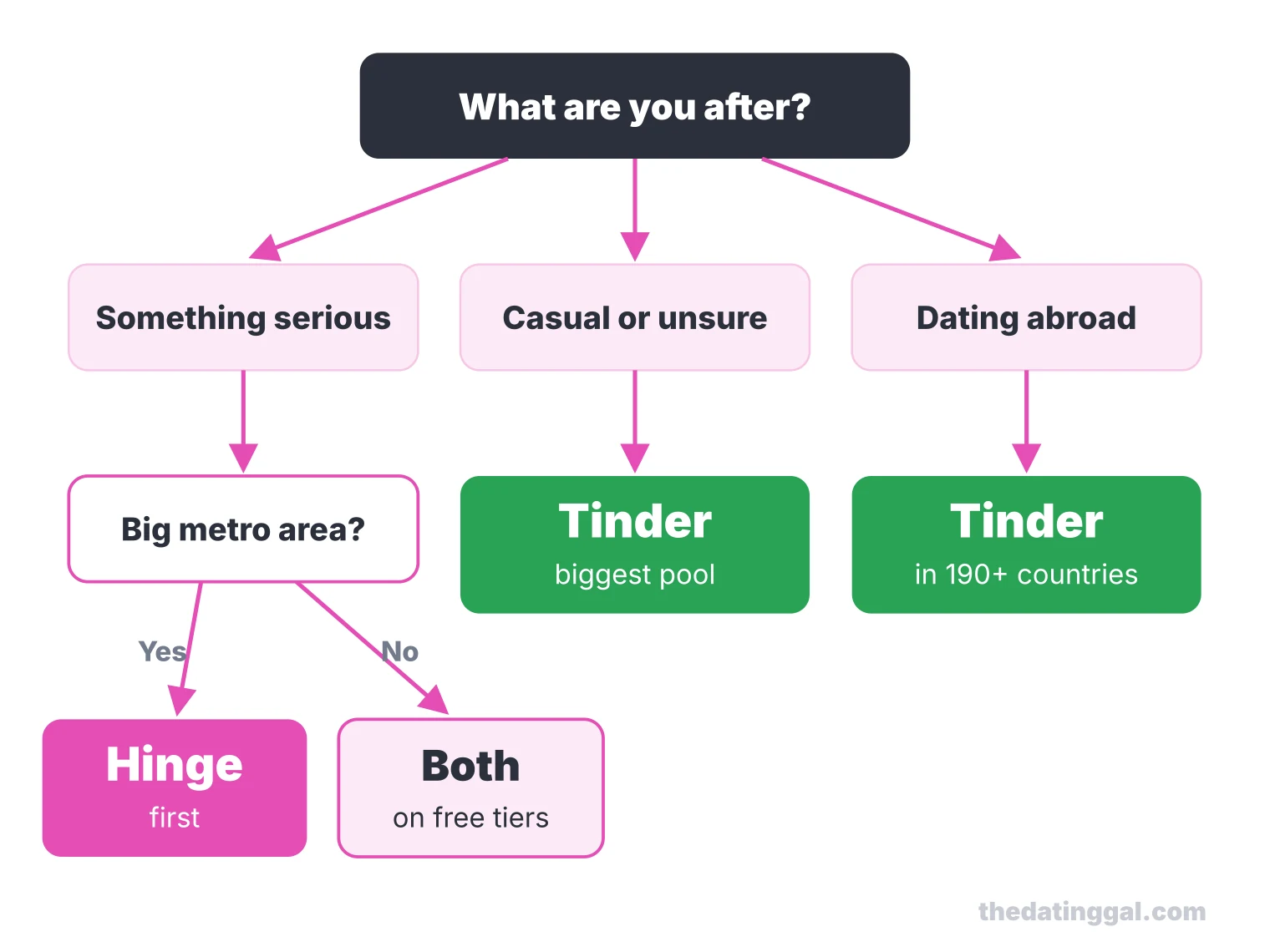
- You want a relationship and live in a big city: Hinge first.
- You want a relationship but live in a small town: run both free. Tinder will likely have more people; Hinge will tell you if your area has enough.
- You want something casual or you are not sure yet: Tinder.
- You travel or live abroad: Tinder, which works in 190+ countries. Hinge lets you change location for free, but only where it operates.
- You hate writing openers: Hinge, because you comment on something specific.
- You hate long profiles: Tinder.
- You want to pay as little as possible: free Hinge if seeing your likes matters most; Tinder Plus if more likes matter most.
- Fake profiles are your main worry: Tinder with Photo Verified Chat turned on, or Hinge while only replying to Selfie Verified profiles.
If neither fits, Bumble is the usual third option; my Hinge vs Bumble comparison covers its 2026 messaging change. For every head-to-head between the big apps, see the dating app comparisons hub.
Frequently asked questions
Is Hinge more effective than Tinder?
For people who want a relationship, usually yes: Hinge's limited likes and comment-on-a-detail format produce fewer matches that more often turn into conversations. Tinder gives more matches overall and works better in small towns. Neither company publishes success rates comparing the two.
What is the 8 rule on Hinge?
It refers to Hinge's free daily like limit, which was eight likes a day in our Hinge review. Hinge's help center only says free users get a select number of likes per day; Hinge+ and HingeX remove the cap.
Is it true that 75% of Tinder users are men?
That figure is a third-party estimate. Tinder does not publish a gender split, and estimates for both Tinder and Hinge vary from article to article. Both apps have more men than women, which is why men get far fewer matches than women on both.
How much does Hinge cost a month?
Hinge does not publish a fixed price list. Its App Store listing shows Hinge+ at $16.99 and $19.99 and other Hinge subscription price points at $14.99, $29.99 and $34.99 (October 2026), with weekly, 1, 3 and 6 month plans. The exact price depends on plan length, age and location.
Is 40 too old for Hinge?
No. Age on Hinge is a range you and other daters set in your preferences, not a cut-off, and its detailed profiles suit people who know what they want. Tinder is the app that skews young: in Pew's survey, 79% of online daters under 30 had used Tinder against 17% of those aged 50 to 64.
What are the negatives of Hinge?
A small free daily like allowance, a thinner pool outside big cities, availability in select countries only, and no in-app voice or video calls since Hinge removed them. Your Turn Limits can also pause new likes if too many matches are waiting on your reply.