
Tinder vs Bumble: Which Is Better in 2026?
Tinder vs Bumble comes down to pool size versus pace: pick Tinder if you want the biggest pool, casual dating, travel matches or an app that works almost anywhere; pick Bumble if you want a slower, more intentional feed, mandatory photo verification in the US and matches that expire if nobody makes an effort. One thing most comparisons still get wrong: since August 2026, either person can send the first message on Bumble, so it is no longer a “women message first” app.
Tinder vs Bumble at a glance
Here is how the two apps line up on the points that decide the choice, from each company’s help center and app store listings.
| Tinder | Bumble | |
|---|---|---|
| Best for | Volume, casual dating, small towns, travel | Intentional dating, people who want verified profiles |
| Who messages first | Either person, any time after a match | Either person (since August 2026), one opener each until someone replies |
| Match timer | None documented | Expires after 72 hours with no opener |
| Free version | Match, chat, limited likes, ads | Match, chat, limited likes, 1 free Extend a day |
| See who liked you | Tinder Gold and Platinum | Bumble Premium and Premium+ |
| Paid tiers | Tinder Plus, Gold, Platinum (and invite-only Select) | Bumble Boost, Premium, Premium+ |
| Cheapest listed App Store subscription | Tinder Plus $9.99 | Bumble Boost $2.99 |
| Change location | Passport: paid tiers or standalone purchase | Travel Mode: Premium and Premium+ |
| Photo verification | Optional video selfie | Mandatory in the US |
| In-app video calls | Not in the chat (Speed Date events only, select markets) | Yes, video and voice |
| Where it works | 190+ countries | Not every country |
| App Store rating | 4.2 (1.8M ratings) | 4.3 (1.8M ratings) |
| Google Play rating | 3.9 (9.25M reviews) | 3.8 (1.63M reviews) |
Ratings and prices from the Tinder App Store listing, the Bumble App Store listing, Tinder on Google Play and Bumble on Google Play. Prices checked October 2026.
The big 2026 change: anyone can message first on Bumble
For more than a decade, Bumble’s whole pitch was that in a match between a man and a woman, only the woman could open the chat. That rule is gone. On August 11, 2026, TechCrunch reported that Bumble had dropped it and stretched the response window from 24 to 72 hours. Bumble said that in its own survey, 66% of women said they prefer men to send the first message.
Bumble’s help center now describes how conversations start like this:
- After a match, you both get one opening message, and you have 72 hours from the match to send it.
- Once one of you sends an opener, the other has 72 hours to reply. The chat fully unlocks after that reply.
- If neither of you writes within 72 hours, the match expires.
- A Note sent before matching counts as your opener, and a plain “hi” or “hey” gets a nudge to write something more personal.
- Opening Moves, the canned first questions Bumble used to offer, are no longer part of the app.
Tinder works the way it always has: once you match, you can chat, either of you can write first, and Tinder documents no expiry timer.
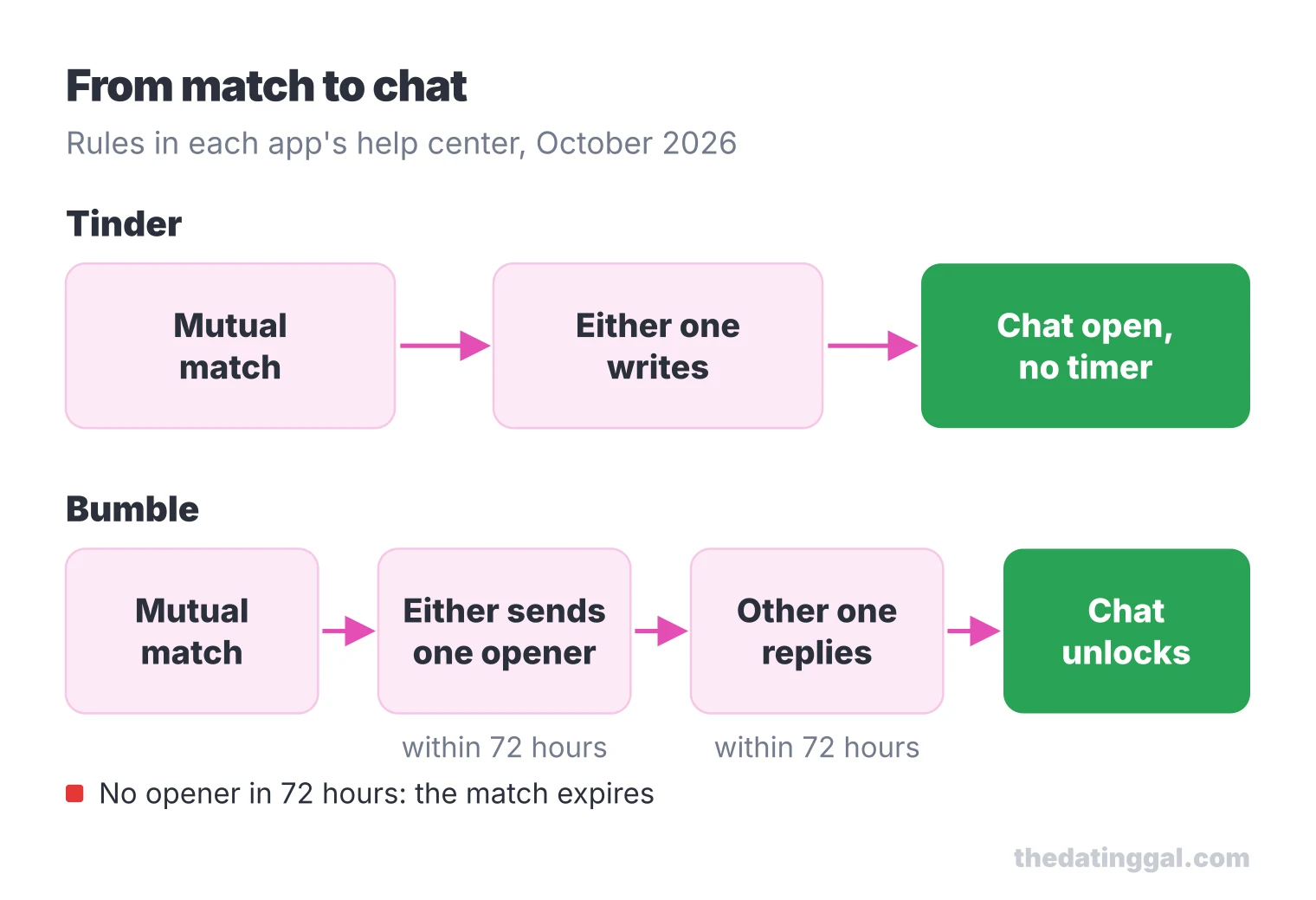
If a Bumble match is about to run out, everyone gets one free Extend a day that adds 72 hours, and paid members can extend without limit or rematch with expired connections.
What this means for the choice: the old advice “men should skip Bumble because they can’t do anything” is out of date. Men can now open the conversation on both apps. The real difference left is the clock: Bumble pushes both people to write something within three days, while Tinder lets matches sit forever, which is why Tinder chats so often die before they start.
How matching and profiles differ
Both apps use the same core mechanic: swipe right to like, left to pass, and a mutual like is a match. The differences are in what you see and how much you have to fill in.
Tinder: fast, photo-first, huge pool
Tinder launched on a college campus in 2012 and, per its overview page, now runs in 190+ countries and 40+ languages. Profiles are photo-led, with an optional bio and tags you can add, including Relationship Goals, interests, languages and pronouns. To stand out you can send a Super Like, which puts your profile first for that person, or buy a Boost to be a top profile in your area for 30 minutes.
Bumble: slower, more structured, verified
Bumble asks for more profile detail (prompts, lifestyle badges, what you are looking for), and in the US you cannot skip photo verification. Its stand-out tools are the SuperSwipe, Spotlight (shown ahead of everyone else for a set time) and Notes, formerly called Compliments: a short message about a photo or prompt that the other person sees before you match. Bumble is also piloting Dates, powered by Bee, an AI assistant that suggests matches without swiping, but only for a small group of invited members in New York City.
The practical effect: Tinder is quicker to start and gives you more profiles per minute. Bumble takes longer to set up and shows fewer people, but the profiles carry more to talk about. If you hate writing openers from nothing, a Bumble profile with prompts or a Note makes the first line easier.
What you get free on each app
Both apps are free to download and both free versions let you match and message. The caps are where they differ.
- Tinder free: you can “match, chat, and connect,” with a limited number of likes and ads. The Likes page, showing who already liked you, is reserved for Gold and Platinum.
- Bumble free: you can match and chat, use in-app video and voice calls, and get one free Extend a day. Unlimited likes start with Boost, and the full Liked You queue needs Premium.
Neither app publishes its free daily like limit. That is why the numbers you read disagree so much: Google’s AI answer says about 30 a day on Bumble and 40 on Tinder, one top-ranking comparison says around 100 on both, and another says Bumble’s free swipes are unlimited. None of those figures appears in either company’s help center, so treat them as guesses. In practice, both free tiers are enough to find out whether there are people you like near you.
What each costs in 2026
Neither app publishes a fixed US price list on the web. Prices are shown in the app and vary with plan length, location and promotions. The most reliable public numbers are the in-app purchase price points on the App Store listings.
| Tier | What it adds | App Store price points |
|---|---|---|
| Tinder Plus | Unlimited likes, Rewinds, Passport, no ads, incognito | $9.99 |
| Tinder Gold | Plus features, weekly Super Likes, 1 Boost a month, see who likes you | $13.99, $14.99, $18.99, $24.99 |
| Tinder Platinum | Gold features, Prioritized Likes | Not listed among the top App Store items |
| Bumble Boost | Unlimited likes, 5 SuperSwipes and 1 Spotlight a week, Extend, Rematch, unlimited Backtrack | $2.99, $7.99, $8.99, $9.99, $10.99, $12.99 |
| Bumble Premium | Boost features, Liked You, advanced filters, Incognito, Travel Mode | $17.99, $19.99, $32.99 |
| Bumble Premium+ | Premium features, photo insights, priority in feeds, 2 Notes, 10 SuperSwipes, 2 Spotlights a week | Not listed among the top App Store items |
Features from Tinder’s subscriptions page and Bumble’s paid features page; prices from each app’s App Store listing. Prices checked October 2026.
The listing does not say which price matches which plan length, so the spread inside each tier is mostly weekly versus monthly versus longer plans. On the chart, Bumble’s cheapest entry is lower, while its Premium tops out above Tinder Gold.
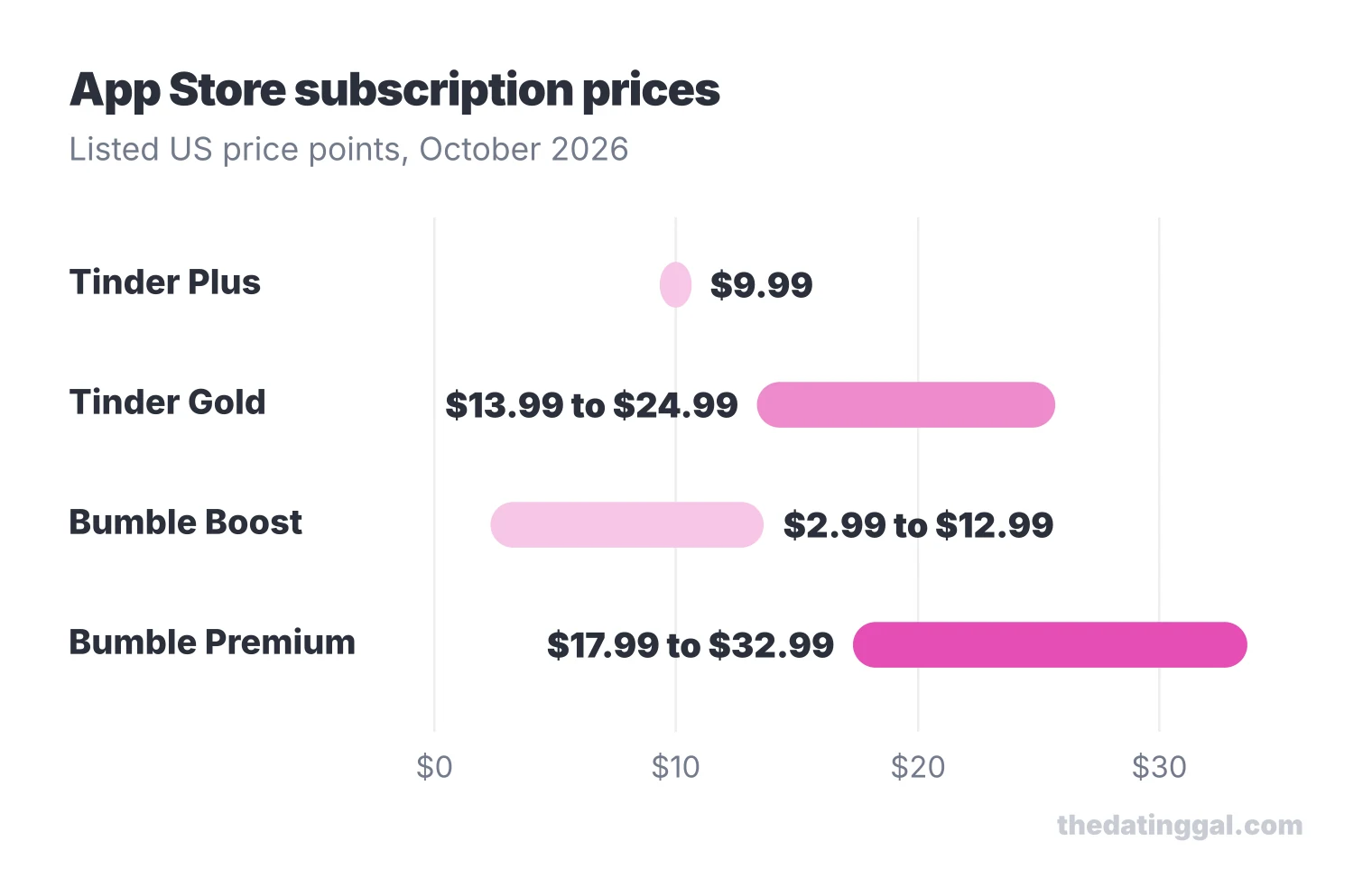
On Google Play, single items range from $0.49 to $299.99 on Tinder and from $0.49 to $259.99 on Bumble, which covers long plans and bundles of Super Likes or SuperSwipes. Extras cost money on both: on the App Store, Tinder lists a Boost at $3.99 to $7.99 and 5 Super Likes at $4.99.
Why is Tinder $500 a month?
That is Tinder Select, a separate invite-only tier. CNN reported in December 2023 that it costs $499 a month, is offered to less than 1% of users, and adds access to the “most sought after profiles” and messaging without matching first. Regular users never see it, and it is not a reason to pick or skip Tinder.
Does Tinder still charge more if you are older?
Tinder priced Plus by age for years, and some top-ranking pages still say so. In a California class action over that practice, Match Group’s quarterly filing says the parties agreed on September 10, 2025 to settle for $60.5 million. The price you see in the app is the one that counts, so compare it before you pay.
Safety and verification
Both apps have the basics (block, unmatch, report). The differences are in what is required.
- Bumble makes photo verification mandatory in the US: you cannot skip it until a selfie matches your photos. You can add ID verification with a government ID and live selfie for an extra badge. Its safety features page lists Deception Detector (AI that flags scams and fake profiles), Private Detector (blurs likely explicit images), in-app video and voice calls, and Snooze mode. Its Share Date tool for sending your date plans to a friend is currently unavailable.
- Tinder offers Photo Verification as an optional video selfie that earns a blue check, and ID + Photo Verification only in select test markets. In the US you can connect Noonlight to share where and who you are meeting and discreetly call emergency services.
On Bumble, every US profile you see has passed a selfie check; on Tinder, look for the blue check and ask for a video call before meeting anyone who has not got one. Both companies say a badge is not a guarantee. To report someone, use the report button on their profile or in the chat: Tinder explains it on its reporting page, and Bumble on its reporting page, where you can follow your report’s status in the Help Hub. Anyone who asks for money, gift cards or crypto should be reported and blocked, whatever app you met on.
Before the August change, women-message-first was itself a safety feature, since it kept unwanted openers out of women’s inboxes. In my Bumble review I found the inbox far calmer than on other apps for exactly that reason. Now that men can open too, Bumble leans on verification, Private Detector and the one-opener rule instead.
Who uses each app
Tinder is still the bigger app by a wide margin. In Pew Research Center’s survey of 6,034 US adults (July 2022), 46% of people who had used online dating had used Tinder, against 28% for Bumble. Tinder skews young: 79% of online daters under 30 had used it, compared with 17% of those aged 50 to 64. Pew does not break Bumble down by age.
The companies’ own results tell you which way each app is moving. Bumble’s second-quarter 2026 results show paying users on the Bumble app down about 17% year over year to 2.08 million, and total revenue down 15.2%. Match Group says Tinder’s year-over-year decline in daily active users narrowed to 4% in the same quarter. Neither app is collapsing, but Bumble is shrinking faster, which is part of why it rewrote its messaging rule.
What about the gender ratio? Top-ranking pages put Tinder anywhere from 60% to 75% male and Bumble from 50% to 64% male. Neither company publishes a US gender split, so I would not pick an app on those numbers. Both have more men than women, which is why men get far fewer matches than women on both.
Where you live matters more than any statistic. Tinder works in more places and has more people almost everywhere, so in a small town or a rural area it is usually the app with someone on it. Bumble is not available in every country, per its location help page, and its pool is thinner outside big cities.
Serious or casual: is Bumble a hookup app?
Bumble is a dating app, not a hookup app, and its structure (verification, more detailed profiles, a 72-hour clock) nudges people toward actual conversations. Tinder has the reputation for casual dating and it is the app most people think of for hookups, but you can set Relationship Goals on your profile, and plenty of relationships start there.
Honestly, intent depends more on the person than the logo. Say what you want in your profile on either app and you will filter faster. If you want something serious and neither feels right, Hinge is built around it: see my Tinder vs Hinge comparison and Hinge vs Bumble comparison, or the shortlist of serious dating apps. If casual is the goal, my ranking of the best dating apps for casual dating goes beyond these two.
Beyond one-on-one dating
- Bumble BFF moved out. Many comparisons sell Bumble on its BFF mode for making friends. In the US, Canada and Mexico, BFF Mode is closing and friendships move to a separate BFF app. If friends are the goal, download that instead.
- Tinder is adding group and in-person options, all in select markets for now: Double Date (you and a friend swipe on other pairs), Events for local in-person activities, Speed Date (three-minute video sessions for selfie-verified users), Astrology Mode and Tinder U for students.
- Travel: Tinder’s Passport comes with any paid tier or as a standalone purchase. Bumble’s Travel Mode needs Premium and moves you to one city for 7 days.
Why did Whitney Wolfe Herd leave Tinder?
Bumble exists because of Tinder. Whitney Wolfe Herd was one of Tinder’s co-founders. According to her Wikipedia biography, she resigned in April 2014 and sued the company for sexual harassment and discrimination, a case settled that year for just over $1 million. She launched Bumble in December 2014 with Badoo founder Andrey Andreev. The two companies met again in court: Match Group sued Bumble in March 2018 over patents and trade secrets, and the case was settled in June 2020. Wolfe Herd returned as Bumble’s CEO in 2025 and is the one who announced the end of women-first messaging.
Pros and cons
Tinder
- Pro: the biggest pool, in 190+ countries, which matters most in small towns and when traveling.
- Pro: no clock on matches, and either person can write first.
- Pro: Tinder Plus at $9.99 is a cheap way to get unlimited likes and Passport.
- Pro: Noonlight safety integration in the US.
- Con: photo verification is optional, so you have to check for the blue check yourself.
- Con: more casual reputation and more matches that never become a chat.
- Con: seeing who liked you needs Gold or Platinum, and extras like Boosts cost more.
- Con: no video call inside the chat since Tinder deprecated Face to Face video chat.
Bumble
- Pro: photo verification is mandatory in the US, with optional ID verification.
- Pro: the 72-hour, one-opener system pushes both people to say something real.
- Pro: in-app video and voice calls, so you can check someone before meeting.
- Pro: the cheapest Boost price point ($2.99 on the App Store) is a low-cost way to try paid features.
- Con: smaller pool than Tinder and thinner outside cities.
- Con: matches expire, so you have to be active to keep them.
- Con: Liked You and Travel Mode need Premium, which tops out at $32.99 on the App Store.
- Con: paying users are falling fast, and several features (BFF Mode, Share Date) have been pulled or paused.
Cancelling, refunds and deleting your account
Both apps auto-renew, and deleting the app from your phone cancels nothing. How you cancel depends on where you paid.
- Tinder: App Store purchases are cancelled in your iPhone settings under Subscriptions; Google Play purchases in the Play Store under Payments & subscriptions; card or PayPal purchases on tinder.com under Manage Payment Account, per Tinder’s cancellation page. Its refund page says most purchases are nonrefundable but it can help with direct purchases made in the last 14 days; Apple and Google decide refunds on their stores.
- Bumble: the same Apple and Google routes, or in the app under Subscription details for card, PayPal or Apple Pay, per Bumble’s cancellation page. You keep your perks until the paid period ends. For refunds, Bumble’s refund page sends store purchases to Apple or Google and asks web or card payers to contact support with the order number.
- Deleting: cancel first, then delete in Settings. Tinder keeps profile data for 90 days before purging it; Bumble lets you restore a deleted account for up to 28 days.
Which one should you pick?
- You live in a small town or rural area: Tinder. More people, more places.
- You want something serious: Bumble over Tinder, but look at Hinge too.
- You want casual dating: Tinder, and say so in your profile.
- You are a woman tired of unverified profiles and explicit photos: Bumble, for mandatory US photo verification and Private Detector.
- You are a man who used to avoid Bumble: try it again. Since August 2026 you can send the first message.
- You travel a lot: Tinder Passport costs less to unlock than Bumble’s Travel Mode, which needs Premium.
- You are over 40: both work, but the pool is younger on Tinder; my list of the best dating apps for over 40 has better-targeted options.
- You are not sure: run both free versions for two weeks and keep the one with more people you would actually meet.
Comparing other big apps? All my head-to-heads are in dating app comparisons.
Frequently asked questions
Is Bumble better than Tinder?
For intentional dating and verified profiles, usually yes: Bumble requires photo verification in the US and its 72-hour opener rule pushes both people to write. Tinder is better for volume, casual dating, small towns and travel. Neither company publishes success rates comparing the two.
Do women still have to message first on Bumble?
No. Since August 2026, both people in a match get one opening message and 72 hours to send it, and the chat unlocks once the other person replies. If nobody writes within 72 hours, the match expires.
Why is Tinder $500 a month?
That is Tinder Select, an invite-only tier reported at $499 a month and offered to less than 1% of users. It adds access to highly sought-after profiles and messaging without matching. Regular Tinder plans start at $9.99 on the App Store.
Is Bumble a dating or hookup site?
Bumble is a dating app, and its verification, detailed profiles and 72-hour message window lean toward real conversations. Some people use it for casual dating too. Tinder is the app with the stronger casual reputation.
What age group is Bumble best for?
Bumble is for adults 18 and over and does not publish an age breakdown. Pew data shows Tinder skews young, with 79% of online daters under 30 having used it, so Bumble's slower format may suit people who want something more deliberate at any age.
What is the 3-3-3 rule on Tinder?
It is not a Tinder feature or rule. It is dating advice that circulates online with different meanings, usually about pacing messages, dates or a new relationship. Tinder's help center does not mention it.