
Tinder vs Grindr: Which Is Better in 2026?
Tinder vs Grindr comes down to who you are and what you want tonight. Pick Grindr if you are a gay, bi, trans or queer man who wants to see who is close and message him right now, with no matching step. Pick Tinder if you want dates as well as hookups, a mutual match before anyone can message you, a photo verification badge, or if you date women or people of any gender. Many gay and bi men keep both: Grindr for speed, Tinder for dates.
Tinder vs Grindr at a glance
Here is how the two apps compare on the points that decide the choice, from each company’s help center and the US app store listings.
| Tinder | Grindr | |
|---|---|---|
| Best for | Dating and casual, any gender or orientation | Quick nearby meetups for gay, bi, trans and queer men |
| Launched | 2012 | March 2009 |
| Who uses it | Everyone: you set your orientation and who you see | The LGBTQ+ community, mostly men into men |
| How you browse | One profile at a time, swipe right or left | A grid of the closest profiles, sorted by distance |
| Who can message you | Only mutual matches | Anyone who sees your profile |
| Free tier | Swipe, match, chat | “Dozens” of nearby profiles, chat, photos, tags, third-party ads |
| Paid tiers | Plus, Gold, Platinum | XTRA, Unlimited |
| Incognito | From Plus, the cheapest tier | Unlimited only, the top tier |
| Photo verification badge | Yes, optional | No |
| App Store rating | 4.2 (1.8M ratings) | 4.4 (389K ratings) |
| Google Play rating | 3.9 (9.26M reviews), 500M+ downloads | 4.2 (1.69M reviews), 50M+ downloads |
Ratings from the Tinder App Store listing, the Grindr App Store listing, Tinder on Google Play and Grindr on Google Play, checked October 2026.
Who each app is for
Tinder is a general dating app. Its overview page says it started on a college campus in 2012, is for adults 18 and up, and runs in 190+ countries and 40+ languages. Straight, gay, bi and queer people all use it, and you tell it who you want to see.
Grindr launched in March 2009, three years before Tinder, as one of the first location-based apps for gay men. Its help center calls it a geolocation-based social app “for the LGBTQ+ community.” In practice the grid is mostly gay, bi and queer men, plus trans and nonbinary people.
So which gender is Grindr for? It is not limited to one, but it is built for queer people, and men looking for men are the bulk of it. A straight man has no reason to be there, and a straight woman will find almost nobody looking for her. Tinder is the app for everyone else, and a good second app for queer users.
How big is each app?
Grindr publishes its numbers: its Q2 2026 shareholder letter reports 15 million average monthly active users and 1.4 million average paying users. Match Group does not publish a Tinder monthly user count. Its Q2 2026 results only say Tinder’s daily active users fell 4% year over year, its best result in 10 quarters.
The app stores give a fairer comparison: Tinder has 500M+ Google Play downloads to Grindr’s 50M+, and more than five times as many Google Play reviews. Pew Research’s survey of 6,034 US adults (July 2022) found 46% of online daters had used Tinder and 6% Grindr, with Grindr used more by LGB adults than straight ones. Tinder is far bigger overall. Grindr is bigger where it counts for many gay men: everyone on it is there for men like them.
How matching and messaging work
Tinder: swipe, match, then chat
Tinder shows one profile at a time. Swipe right to like, left to pass, and if both of you like each other, it is a match. Tinder’s help center is clear that you can only chat after you match. That filter is why many people find Tinder calmer: nobody can message you unless you said yes first. The flip side is that a match is not a conversation, and plenty of matches never reply.
Grindr: the grid, and message anyone
Grindr opens on the Grid, the profiles closest to you plus anyone paying for a Boost. Tap a profile, then send a message or a Tap. There is no matching step, so you can talk to anyone you see, and anyone can talk to you. Grindr adds:
- Right Now, a one-hour post saying you are available, whether you can host, with an optional photo. Free sessions reset every Friday at 5 PM local time.
- For You, six curated profiles a day, which only Unlimited subscribers can message.
- Tags and filters to narrow the grid, and chat with photos, video and voice messages.
This is the core difference in one line: Tinder asks “do you both like each other?”, Grindr asks “who is closest right now?”
What people use them for: is Tinder mostly a hookup app?
Grindr is built around hookups, and its features say so: distance on every profile, Right Now, a grid that refreshes as people come and go. Plenty of men use it to chat, make friends or meet locals while traveling, but most expect speed. The flip side, raised by student reporters and in Grindr’s Wikipedia entry, is a blunt culture: rejections based on looks, unsolicited sexual pictures before a face pic, and racist “preferences,” enough that Grindr removed its ethnicity filter in 2020 after complaints.
Tinder is not mostly a hookup app, and it is not a relationship app either. It is a mix: some people want a relationship, some want something casual, and the profile is where they say so. A research paper among the top results reports that gay men see Tinder as the more “romantic” of the two, mostly because you need a mutual match and profiles are built around photos and bio rather than stats. If you want something serious, see my Tinder vs Hinge comparison for the more relationship-minded option.
Is Tinder good for gay men?
Yes, with a smaller pool. Tinder lets you describe yourself and choose who you see, and none of the top-ranking pages explain how:
- In Discovery Settings you set sexual orientation, age and distance for who you see.
- Its gender and orientation settings offer Man, Woman and Beyond Binary, more than one gender if you like, and an optional orientation you can show or hide on your profile. Tinder says it suppresses them where LGBTQIA+ identities are criminalized.
- Traveler Alert automatically hides your profile when you open Tinder in a country where being LGBTQIA+ is criminalized, until you choose to show it.
What Tinder cannot fix is numbers. In a town where Grindr shows a few dozen men nearby, Tinder might show a handful who match your settings, and the queer columnists in the top results describe running out of profiles fast. That is why so many gay men use both. For more queer-first options, my LGBTQ+ dating sites guide covers apps built for dating rather than the grid.
Free vs paid: what each costs
Both apps are free to download and use. Tinder’s free version lets you swipe, match and chat. Grindr’s free version shows “dozens” of nearby profiles, chat, private albums, tags, block and report, with third-party ads. The biggest free limit on Grindr is how many men you see; on Tinder it is how many likes you get.
| Tier | What it adds | Prices listed on the US App Store |
|---|---|---|
| Tinder Plus | Unlimited likes, Rewinds, Passport (swipe in another city), no ads, incognito | $9.99 |
| Tinder Gold | Everything in Plus, plus weekly Super Likes, 1 Boost a month (30 minutes), See who Likes You | $13.99, $14.99, $18.99, $24.99 |
| Tinder Platinum | Everything in Gold, plus Prioritized Likes (seen sooner) | Shown in the app only |
| Tinder extras | Boosts, Super Likes | Boost $3.99 to $7.99; 5 Super Likes $4.99; 3 Super Likes $9.99 |
| Grindr XTRA | No third-party ads, up to 500 nearest profiles, 5 global chats a day via Explore, read receipts, 5 expiring photos a day, Grindr Web | $14.99, $22.99 |
| Grindr Unlimited | Everything in XTRA, plus every profile on the grid, Viewed Me, typing status, Incognito, unsend, chat translation, messaging For You picks | $27.99, $44.99; Unlimited Day Pass $9.99 |
| Grindr extras | Boost, extra Right Now sessions | Boost $11.99 |
Prices checked October 2026. Tiers from Tinder subscriptions, Grindr XTRA and Grindr Unlimited; prices from the App Store listings linked above, which do not say which amount matches which plan length. On Google Play, Tinder lists in-app items from $0.49 to $299.99 and Grindr from $0.99 to $999.99. The price on your subscribe screen is the one that counts.
The cheapest useful upgrade is Tinder Plus. On Grindr, XTRA fixes the small grid and the ads; Unlimited is for seeing everyone and browsing invisibly. In my Tinder review I found Tinder Plus was enough; Gold and Platinum only make sense if you swipe heavily.
Why the numbers you read about Tinder and Grindr disagree
- “75 million Tinder users.” Google’s AI answer and several pages repeat it, but Match Group’s latest results publish no Tinder monthly figure. Treat it as an old estimate. Grindr’s 15 million is a reported number.
- Prices. One comparison in the results lists Grindr XTRA at $19.99, Unlimited at $39.99 and Tinder Gold at $29.99. None of those match the App Store items above. Prices vary by plan length and over time, so check the app.
- How many profiles XTRA shows. Grindr’s help center says 500; its App Store listing says up to 600. Plan on 500.
- Messaging before a match on Tinder. Some pages say Platinum lets you message before matching. Tinder’s current subscription page lists Prioritized Likes as Platinum’s only extra, not messaging before a match.
Safety and verification
This is the clearest gap between the two, and none of the top results cover it. Tinder offers optional Photo Verification: a short video selfie compared with your photos, which earns a blue check other people can see. Tinder says the check is “not a guarantee” of who someone is. In the US, it also links to Noonlight, which lets you log who you are meeting and where, and discreetly call emergency services.
Grindr has no member-facing verification badge. It requires SMS verification for accounts made with an email, asks for an identity selfie only when a profile is reported for impersonation, and runs a video-selfie age check where the law requires it or an account looks underage.
Neither app runs criminal background checks on its users. Both say so on their Colorado safety pages (Tinder, Grindr); Tinder adds that it may check sex offender registries when it has enough information.
Red flags on both apps
Grindr’s scam awareness guide lists the patterns, and they apply on Tinder too:
- Anyone asking for money, gift cards, crypto or an “investment,” or asking you to pay before you meet.
- A “sugar daddy” offering to pay you, or asking you to create app accounts for him.
- A request for a verification code sent to your phone: that is an account takeover.
- Links to other apps or sites, or a message claiming to be support.
- Sextortion: explicit photos traded early, then a demand for money. Do not pay, save the messages, block and report.
Fake profiles are also used to lure LGBTQ people into robberies and assaults, in the US and abroad. Before meeting anyone: video call first, meet in a public place, tell a friend where you are going, and get yourself home. To report on Tinder, tap the three dots on a profile or chat, then Report. On Grindr, tap the block icon on a profile, then Report; Grindr’s reporting guide notes that reporting does not block, so block too. My guide to online dating scams covers the warning signs in more depth.
Privacy and location
Grindr shows distance on profiles by default. Its help center says it collects your location within a 100 m radius, and you can turn Show Distance off, though the grid is still sorted by distance. Grindr’s privacy record is the weaker of the two: as its Wikipedia entry documents, Norway’s data protection authority fined it €10 million for sharing user data with advertisers, and its App Store privacy label lists location, identifiers and usage data as used to track you. Since 2019 it has disabled distance automatically in countries where users are at risk.
For discretion, the price difference matters. Tinder puts incognito in Plus, its cheapest tier, and lets anyone hide their profile by turning Discovery off. Grindr puts Incognito in Unlimited, its most expensive tier. If you are not out and want to browse without being seen, Tinder is the cheaper way to do it.
Canceling and refunds
Both apps renew automatically, and on both, deleting the app or your account does not stop billing.
- Tinder: cancel where you paid: Apple, Google Play or tinder.com, per its cancellation guide. Its refund page says it can help with card or PayPal purchases made in the last 14 days; Apple and Google handle their own.
- Grindr: cancel in your App Store or Google Play subscriptions, per its cancellation guide. Its refund policy says all purchases are final; iPhone refunds go through Apple at reportaproblem.apple.com.
Deleting a Tinder account keeps your data for 90 days before it is purged, per its deletion page.
Tinder or Grindr: pick by what you want
If you are still undecided, start from what matters most to you this month.
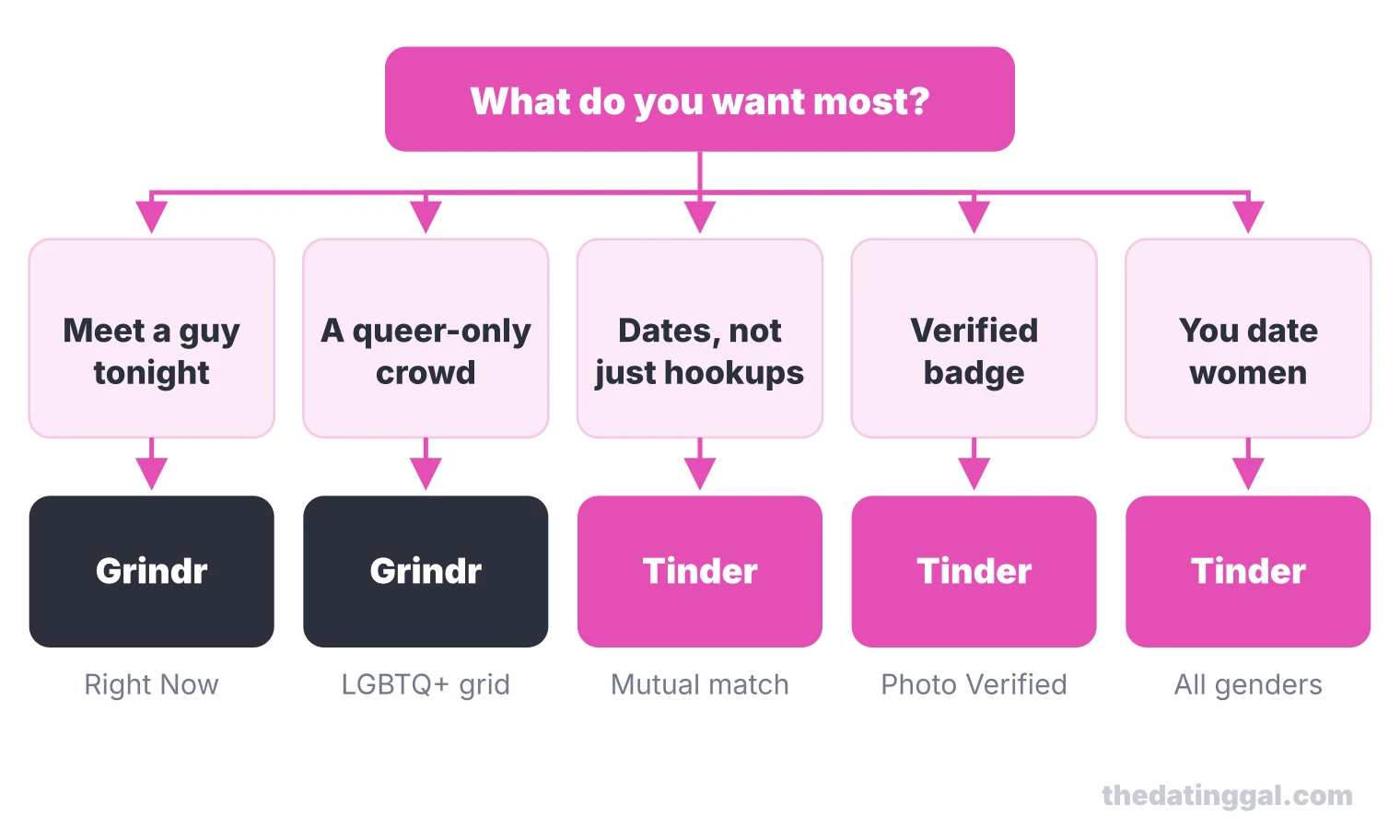
- You want to meet a guy tonight: Grindr, and its Right Now feed.
- You want an app where everyone is queer: Grindr. No guessing, no straight profiles.
- You want dates, not just hookups: Tinder, where only mutual matches can message you.
- You want to know he looks like his photos: Tinder, and favor profiles with the Photo Verified check.
- You date women, or people of any gender: Tinder. Grindr is not built for you.
- You want to browse unseen on a budget: Tinder Plus, not Grindr Unlimited.
- You are tired of Grindr but want the same idea: my Grindr alternatives guide sorts the options, and Grindr vs SCRUFF compares the closest rival. For hookup apps ranked, see the best gay hookup apps.
For other head-to-heads, like Tinder vs Bumble, see all my dating app comparisons.
How I compared them
This comparison is based on public information, not on hands-on use of Grindr: Tinder’s and Grindr’s help centers, Grindr’s SEC filing, Match Group’s results, Pew Research, and both apps’ App Store and Google Play listings, all checked in October 2026, plus my original Tinder review. I weighed who each app serves, how matching and messaging work, what the free tier allows, what each paid tier costs, safety and verification tools, privacy, and how clearly each company explains renewals and refunds.
Frequently asked questions
Is Tinder better than Grindr?
It depends on what you want. Grindr is faster for meeting gay, bi and queer men nearby because you can message anyone on the grid, while Tinder suits dates, needs a mutual match before chatting and offers a photo verification badge. Many gay men use both.
What gender is Grindr for?
Grindr describes itself as an app for the LGBTQ+ community. In practice most users are gay, bi and queer men looking for men, along with trans and nonbinary people. It is not built for straight users.
Can a straight guy use Grindr?
Grindr's help center describes it as an app for the LGBTQ+ community, and the grid is mostly men looking for men. A straight man looking for women will find almost no one there and is better off on Tinder or another general dating app.
Is Tinder good for gay men?
Yes, with a smaller pool. Tinder lets you set your orientation and who you see in Discovery Settings, hide your orientation on your profile, and auto-hides LGBTQIA+ profiles in countries where they are criminalized. In small towns you may run out of profiles quickly.
Which came first, Grindr or Tinder?
Grindr came first. It launched in March 2009, and Tinder launched in 2012. They are separate companies: Tinder belongs to Match Group, Grindr to Grindr Inc.
Is Tinder mostly a hookup app?
No. Tinder is a mix of people looking for relationships, dates and casual sex, and profiles are where they say which. Grindr is the one built around quick hookups, with distance on every profile and a one-hour Right Now feed.