
Best Sober Dating Apps in 2026 (Honest Picks)
Yes, there are sober dating apps, and the one I’d try first is Loosid: it is the largest app built only for sober and sober-curious singles, and you can match and chat free. If you live outside a big city, pair it with Hinge, where you can say you don’t drink on your profile and, on a paid plan, filter matches by drinking and drug use. Sober Love is a small newcomer worth a $1 trial, and The 13th-Step is a tiny iPhone-only option.
Below: the ranking, what each one really costs (App Store and official prices, checked October 2026), two apps the other lists still recommend that have gone quiet, how sober filters work on mainstream apps, and how to date sober without putting your recovery at risk.
The best sober dating apps at a glance
| Rank | App | Best for | Cheapest paid option | What free gets you | Rating |
|---|---|---|---|---|---|
| 1 | Loosid | A pool where everyone is sober | $9.99 for a week of Dating Pro | Profile, likes and passes (capped daily), matching, chat | 2.5/5 |
| 2 | Hinge | Big pool with drinking and drug filters | Subscriptions from $14.99 | Profile, limited daily likes, chat with matches | 4.5/5 |
| 3 | Bumble | Big pool, simple app, lifestyle filters on Premium | Premium from $17.99 | Swiping, matching, chat with matches | 4/5 |
| 4 | Sober Love | Activity-minded sober singles in the US and UK | $1 for the first month of Premium | Profile, 10 photos, search, likes (no messaging) | 2.5/5 |
| 5 | The 13th-Step | iPhone users who want a free, no-paywall try | No in-app purchases listed | Everything listed | 2/5 |
Prices checked October 2026 on each app’s US App Store listing or official pricing page (linked in each section). Where Apple does not say how long a plan lasts, I give the lowest listed price rather than guess a monthly cost.
How I ranked them
I ranked these on public information, not on hands-on use: each app’s App Store and Google Play listing (rating, number of ratings and last update, checked October 2026), its pricing and help pages, its terms, and what it actually does to keep the pool sober and safe. The rank answers “where is a sober person most likely to meet someone”, so a dedicated app with a real community beats a better-built app with no one on it. The ratings out of 5 are each app’s overall score (value, safety and verification, signs of an active user base, features for its audience, transparency); for Loosid, Hinge and Bumble they are the scores from my full reviews.
1. Loosid: best sober-only dating app
Loosid is the name every result for this search comes back to, and for good reason: nobody on it will ask why you’re not drinking. It started in 2018 as a sober social network and now runs two apps, a community app (sobriety tracker, groups, hotlines, an AI recovery mentor called SAM) and a separate dating app. The Loosid dating app on Google Play lists matching with local sober singles, chat, Flirt and SuperLike, “secret admirers”, bookmarks and Sober Questions such as “My favorite mocktail is?”. Loosid’s sober dating page claims 400,000+ members, a company number that counts every sign-up, not people near you.
The reputation is mixed. The App Store listing shows 4.4 out of 5 from 3.9K ratings; on Google Play the dating app has 3.7 stars from 542 reviews and 100K+ downloads (October 2026). The community app does better, 4.7 from 7.2K ratings, which tells you people like the sober community more than the dating product. In my Loosid review I go through the recurring complaints: bots and scam profiles, thin pools outside big metros, and daily caps on likes.
- Who it suits: you want sobriety settled before the first message, you live in or near a large US city, and you’d use the community side for friends too.
- The catch: Loosid’s terms and conditions say “We do not, and have no obligation to, verify the identity of or otherwise screen our users for any reason.” Nothing checks that a member is actually sober. Stay on the free tier until you’ve seen who lives near you.
Get it from Loosid’s website or the official stores, not an APK site.
2. Hinge: best mainstream app for sober singles
Hinge is the practical backup when the sober-only pool runs dry, and for many people it is the main app. Your profile shows your stance on drinking, smoking, marijuana and drugs, so a match can see “I don’t drink” before they like you. In my Hinge review I found its prompt-based profiles pull out real personality, which helps when you want to explain sobriety on your own terms rather than across a bar table.
The detail most lists skip: filtering people by those answers is not free. Hinge’s Subscription and Purchase Benefits page lists Drinking, Smoking, Marijuana Use and Drug Use among the advanced Dating Preferences for Hinge+ and HingeX subscribers. Free members can see the answers on each profile but can’t hide people by them. On the App Store, Hinge has 4.4 out of 5 from 1.1M ratings, and its subscriptions are listed from $14.99 to $34.99 (Hinge+ items at $16.99 and $19.99), October 2026.
- Who it suits: sober, alcohol-free or sober-curious daters who want a large pool and a relationship-minded crowd.
- The catch: plenty of people on Hinge drink. A match who answered “Sometimes” may still be a great fit, or may not get it. You have the conversation yourself.
3. Bumble: big pool, filters on Premium
Bumble is the other big app worth pairing with a sober one. Its help page on filters says Advanced Filters are part of Bumble Premium, and that you can only use a filter on something you have added to your own profile: its example is that if you haven’t shown your stance on smoking, you can’t filter for non-smokers. The same logic applies to lifestyle answers, so fill yours in. On the App Store, Bumble has 4.3 out of 5 from 1.8M ratings, with Premium listed at $17.99, $19.99 and $32.99 (October 2026). My Bumble review covers its verification and safety tools.
- Who it suits: people who want volume and are happy to state sobriety in their bio.
- The catch: filters only catch people who answered the question; a blank field slips through either way.
4. Sober Love: a small newcomer with a $1 trial
Sober Love is a sober dating and community site open to people in the US and UK, started by a founder who entered rehab in 2024 and built it after struggling to date sober, according to its homepage. It matches around activities (hikes, cooking classes, meditation) rather than drinks, welcomes anyone “walking the sober path” whether through rehab, a 12-step program or simply exploring sobriety, and says it runs on verified profiles only and zero tolerance for harassment. It runs in the browser at app.soberlove.app; I found no Sober Love listing from this company on the App Store or Google Play.
Its Features & Pricing page splits it in two. Basic Access is free: a profile, up to 10 photos, search by interests and lifestyle, and likes. Premium adds unlimited messaging, reading messages, seeing who viewed you and who liked you, for $1 (or £1) for one month. It renews automatically and you can turn renewal off online; the page does not publish what renewal costs after that first month, so check the price at checkout before you pay.
- Who it suits: sober singles who like the idea of meeting through activities and want a cheap look.
- The catch: no public member numbers and no app store ratings to judge activity by. Expect a very small pool, especially outside big cities.
Not to be confused with an older iPhone app also called Sober Love, which has 3.0 stars from 6 ratings and was last updated in February 2021.
5. The 13th-Step: free, iPhone-only and tiny
The 13th-Step: Sober Dating is an iPhone app from an independent developer with three sections: sober dating, making sober friends, and alcohol-free events and meetups. The listing shows it as free with no in-app purchases, rated 18+, and still updated (version 1.0.15 in August 2026). It also has just 3 ratings (3.7 out of 5) on the US App Store, so the user base is likely tiny, and there is no Android version.
- Who it suits: iPhone users who want a second sober app that costs nothing.
- The catch: beyond the size, the name. In recovery circles, “13th stepping” is slang for someone with sober time pursuing a newcomer. The app means it as “the step after the twelve”, but some people in recovery will read it the other way.
What sober dating apps cost
None of the sober apps publish a simple monthly price, so here is what each one lists, side by side.
| App | Free tier | Paid options listed | Cheapest way in |
|---|---|---|---|
| Loosid (dating) | Match and chat, daily caps | Dating Pro Weekly $9.99; 1 Month $23.99 or $29.99; 3 Months $49.99; 1 Year $119.99; Premium items $19.99 to $79.99 | $9.99 for one week |
| Hinge | Limited likes, chat with matches | Subscriptions $14.99 to $34.99; Hinge+ $16.99, $19.99 | $14.99 (length not shown) |
| Bumble | Swipe, match, chat | Premium $17.99, $19.99, $32.99; Boost $2.99 to $12.99 | $2.99 Boost item; Premium from $17.99 |
| Sober Love | Profile, search, likes, no messages | Premium $1 for the first month, renews automatically | $1 |
| The 13th-Step | Everything listed | None listed | Free |
Prices checked October 2026 on the US App Store listings for Loosid, Hinge and Bumble, and on Sober Love’s pricing page (all linked above). Loosid’s weekly plan is the most expensive per month (about $43), so use it as a one-week test and cancel before it renews. If you subscribe through Apple or Google, cancel in your phone’s subscription settings: deleting the app does not stop the billing.
Apps other lists still recommend (and why I don’t)
Two names keep showing up in older sober dating lists, including ones that rank on the first page today. I checked both in October 2026.
- Sober Grid. Long described as a social network for finding sober people nearby. Today sobergrid.com shows a parked-domain page, and I could not find a Sober Grid app on the US App Store or Google Play. Treat it as gone unless it comes back.
- Clean and Sober Love (CASL). The App Store listing is still up, with 3.0 stars from 91 ratings, but its last update is version 1.38 from July 2022 and its website returned an error when I checked. An app untouched for four years is a poor bet for an active pool or a working report button.
Sober filters on mainstream apps
Most sober people end up on a mainstream app at some point, because that’s where the numbers are. What actually works:
- Answer the lifestyle questions honestly. On Hinge and Bumble, your own answer is what lets others find you, and on Bumble it is also what unlocks your filter.
- Filtering is a paid feature on both. Hinge puts drinking and drug-use filters behind Hinge+ or HingeX; Bumble puts Advanced Filters behind Premium. Free, you still see each person’s answers on their profile.
- Say it in words too. A one-line “Sober, and happy about it: coffee or a hike for a first date?” in a prompt or bio does more than a field. My guide to good dating app bios has a simple formula.
- “Sometimes” is not a red flag by itself. Plenty of social drinkers are glad to date someone sober. What matters is how they react when you tell them.
What about eHarmony and Match?
Both come up in this search as big pools of relationship-minded people, and both let you write about your lifestyle in your profile. Neither is built for sober dating, so the conversation is still yours to start. If you want a long-term partner and a larger pool than any sober app has, see my eHarmony review and Match review, or the wider list of serious dating apps.
How to choose a sober dating app
The choice comes down to two questions: does every match have to be sober, and how many sober people live near you?
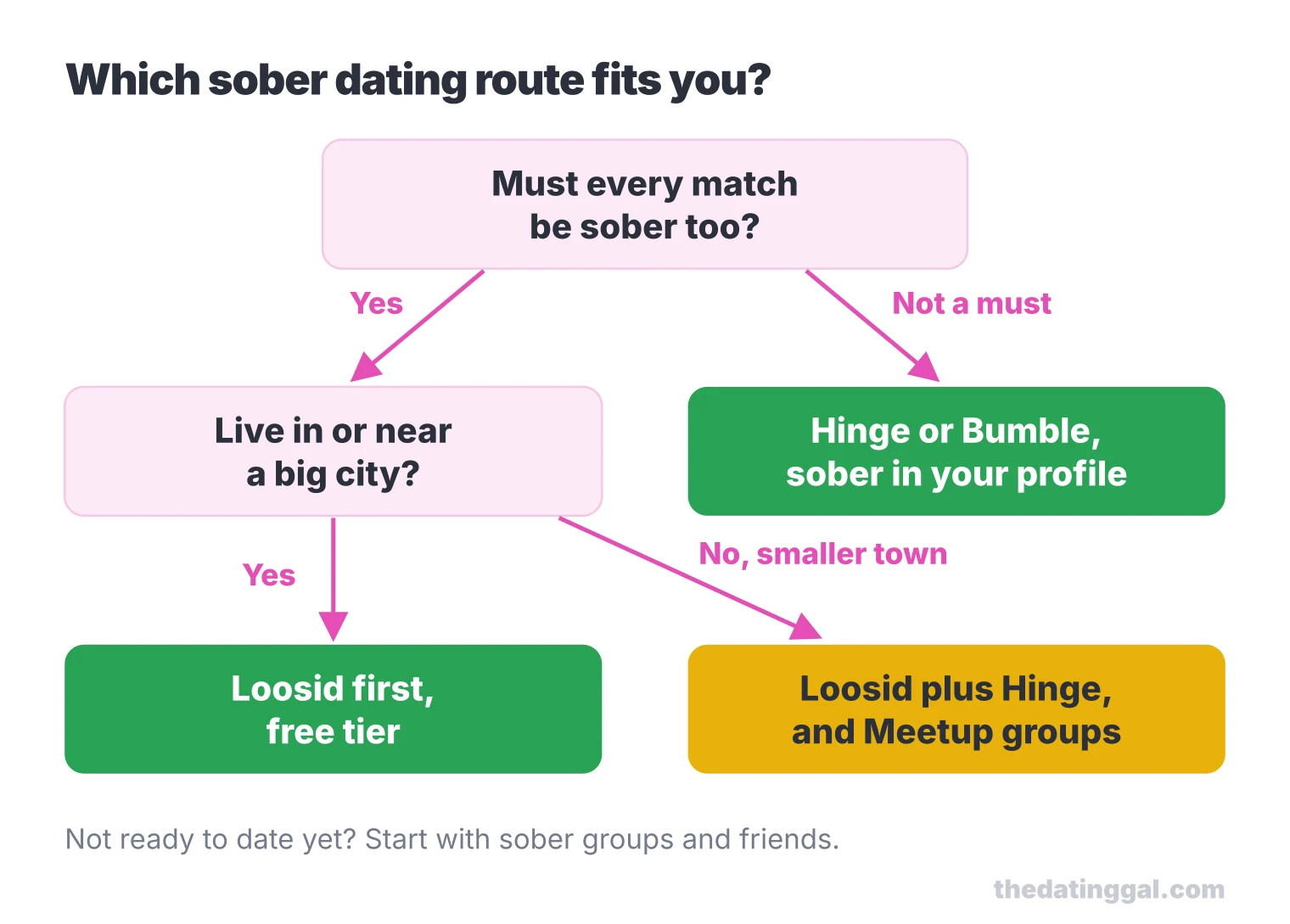
- Sobriety is a dealbreaker and you live in a big metro: start with Loosid’s free tier, add Sober Love for $1 if you want a second sober pool.
- Sobriety is a dealbreaker but you live in a smaller town: keep Loosid, add Hinge with your answers filled in, and look for local sober groups (below).
- You want a sober-friendly partner, not necessarily a sober one: Hinge or Bumble, sober in your profile from day one.
- You’re in early recovery: many people wait before dating. Talk it through with your sponsor, counselor or therapist, and use the community side of Loosid for friends first.
For more apps built around a shared lifestyle or identity, browse the niche dating sites hub.
Beyond the apps: where else sober singles meet
Some of the best options are not dating apps at all. On Meetup (4.7 out of 5 from 273K App Store ratings), searching “sober” in your city can bring up alcohol-free hangouts, hikes, yoga, game nights and Dry January groups. The App Store lists optional Meetup subscriptions from $3.99 (October 2026). Private Facebook groups for sober singles, alumni groups run by treatment centers, and interest groups tied to what helped your recovery (running clubs, yoga, volunteering) all put you next to people who already share something real with you. Meeting through a group first also gives you a built-in safety net: people who know you both.
Dating sober safely
Sober apps attract the same scammers as every other app, and a few risks are specific to recovery.
- Don’t assume “sober” is verified. No app on this list proves a member is sober, and Loosid’s terms say it doesn’t screen users at all. Take it as a stated value, and listen to how they talk about it.
- Know the scam script. The FTC’s romance scam guide lists the signs: someone who wants to move off the app fast, professes strong feelings quickly, can’t meet in person, then asks for money, gift cards, wire transfers or crypto, or offers to help you invest. Never send money to someone you haven’t met. On a recovery app, add anyone who uses your story to pressure you.
- Watch for 13th stepping. Someone with years of sobriety targeting people in their first months is a known pattern in recovery communities. If a match pushes intensity early, especially when you are newly sober, step back.
- Choose dates that protect you. Public, daytime and alcohol-free: coffee, a walk, a museum. Decide your boundaries (no bars, no late nights) before you go, not in the moment.
- Keep support one call away. Tell a friend or your sponsor where you’ll be. If a date shakes your sobriety, SAMHSA’s National Helpline at 1-800-662-4357 is free, confidential and open 24 hours a day, 365 days a year, for referrals to local treatment and support groups.
- Report and block. Use the in-app report button, then report money scams at ReportFraud.ftc.gov. My guide to online dating scams covers the patterns in detail.
What “sober” means on a dating app
On a profile, “sober” can mean several things: in recovery from alcohol or drugs, alcohol-free for health or personal reasons, or sober-curious and cutting back. Loosid and Sober Love welcome all three. On mainstream apps, a “Never” under drinking may just mean someone doesn’t like the taste, so ask what it means for them. If being in recovery matters to you, say so; it filters faster than any setting.
Frequently asked questions
Is there a dating site for sober people?
Yes. Loosid is the largest dating app built only for sober and sober-curious singles, and Sober Love and The 13th-Step are smaller options. Mainstream apps like Hinge and Bumble also let you state your stance on drinking and, on paid plans, filter by it.
Are sober dating apps free?
Mostly, at the start. Loosid lets you match and chat free with daily caps, Sober Love's free tier lets you like but not message, and The 13th-Step lists no in-app purchases. Paid options start at $1 for Sober Love's first month and $9.99 for a week of Loosid Dating Pro (October 2026).
What is the best way to meet sober singles?
Combine a sober-only app like Loosid with a mainstream app where your profile says you are sober, then add offline groups: sober Meetup events, Facebook groups for sober singles and treatment center alumni groups. In a smaller town, the groups often matter more than the apps.
What does sober mean on dating apps?
It can mean in recovery from alcohol or drugs, alcohol-free for health or personal reasons, or sober-curious. On mainstream apps a Never under drinking may simply mean someone does not drink, so ask what it means for them.
What is rule 62 in sobriety?
Rule 62 comes from the Alcoholics Anonymous book Twelve Steps and Twelve Traditions, in the chapter on Tradition Four. It is a single sentence printed on a card by an early group: Don't take yourself too damn seriously.
What is the 333 rule in dating apps?
There is no official 333 rule. It is informal dating advice that circulates online in different versions, so ask whoever mentioned it what they mean. For sober dating, the rule that matters more is deciding your boundaries, like no bars and daytime first dates, before you meet.