
Keeper Review 2026: Legit or Waste of Money?
The Keeper dating app (keeper.ai) is a legit AI-assisted matchmaking service for people who want to get married, not a swipe app and not a scam. Joining the free pool costs nothing and is worth a try if you are marriage-minded and live in the US, Canada or the UK. The paid “Marriage Bounty” is another story: the price is set person by person, the founder has described the average contract as about $50,000, and the terms say fees already paid are non-refundable, so only sign if you get the full number in writing.
What Keeper is, and who runs it
Keeper describes itself as “an AI-assisted matchmaking service” and says plainly in its FAQ that it is not a dating app. There is no feed, no swiping and no browsing: you fill in a long profile, its AI ranks candidates, a human matchmaker reviews the best one, and you get one introduction at a time. The Keeper homepage pitches it as “the world’s most accurate matchmaker, powered by AI” and says over 1.6 million people have joined.
The company behind it is Keeper Dating Inc., a Delaware corporation with a Dover, Delaware address in its terms and conditions. The FAQ says it was founded in May 2022 and is venture-backed by Champion Hill Ventures, Lightbank and Lakehouse Ventures. Founder and CEO Jake Kozloski told AlleyWatch in December 2025 that the company raised a $4M pre-seed round and that the AI handles about 95% of the sorting and filtering, with humans as the final check.
Who Keeper is for
Keeper is built for one goal: marriage and family. Its homepage says every member is “screened for long-term intent” and that casual daters are banned, and the FAQ says it removes anyone found to have short-term intentions. If you want something casual, it is the wrong place, and the FAQ says so itself.
- Where: mainly the United States, Canada and the United Kingdom. You can sign up from elsewhere, but coverage is limited. English only.
- Age: 18 and over.
- Gender mix: an Institute for Family Studies article based on data Keeper supplied says women outnumber men by roughly 5 to 1 among people who complete onboarding, and the median woman is about 21 to 22 at signup. That is Keeper’s own data, not an independent audit.
- Same-sex matching: the homepage and FAQ only talk about men and women, but Keeper’s product changelog shows same-sex matching was added in Settings on June 2, 2026. Expect a much smaller pool, since nothing on the site says how many people use it.
If you want a mainstream option with a bigger pool for a serious relationship, my serious dating apps page compares the usual suspects.
How matching works on Keeper
The homepage and FAQ describe the same five steps. You answer a long questionnaire in your own words (AlleyWatch quotes the founder at “over 100 questions”), covering who you are and what you want, from kids and religion to appearance and bedtime. The AI, which the FAQ says mixes Keeper’s own models with third-party ones including OpenAI’s GPT API, reads your answers, checks photos against your appearance criteria and ranks the pool. A matchmaker then reviews the match by hand. Keeper says it only introduces people who meet each other’s preferences, with “a small margin of flexibility” that it discusses with both of you first.
The order of introductions is the unusual part. The woman sees the match’s profile first. If she is interested, the man sees hers. If she passes, he never sees her profile and gets anonymous feedback instead. Contact details are only exchanged after both say yes, and by default your profile shows your first name and education, with other details shared only when Keeper thinks they help.
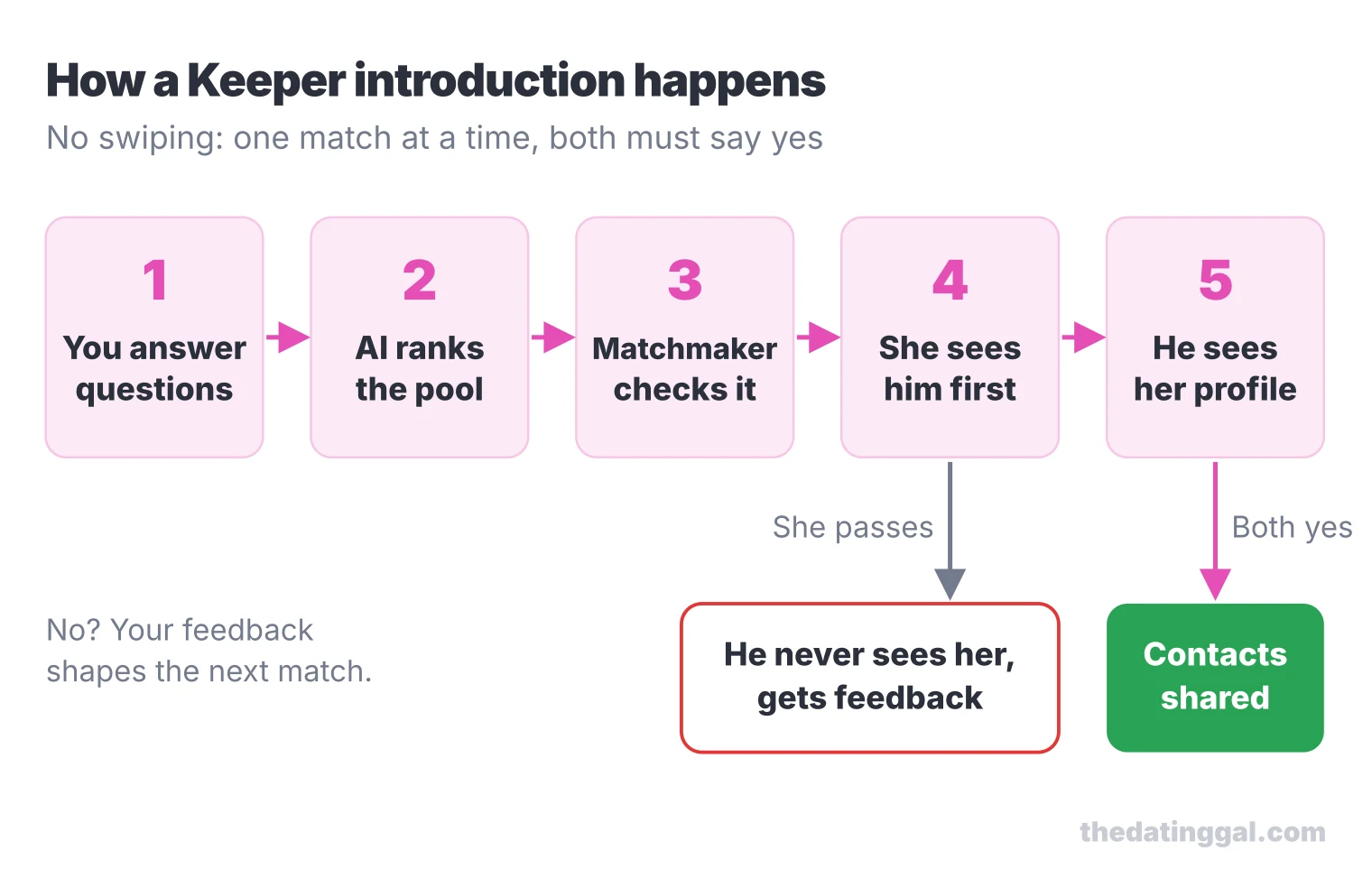
Speed depends on what you pay. The FAQ says most paying members match “within a few weeks to a few months” and free members sometimes wait longer. Since August 31, 2026, the changelog says Keeper can also text you a question about a specific promising match before deciding whether to introduce you.
Keeper dating app price: what it really costs
Keeper has two plans, and the FAQ explains them in more detail than any of the coverage around it. Here is what it publishes, with the dollar figure that comes from the founder’s interview rather than from Keeper’s own pages.
| Plan | Who you can match with | What you pay |
|---|---|---|
| Free | Paying members only | Nothing. Matching may take longer. |
| Marriage Bounty | Paying and free members, with priority | No sign-up fee. A fee per match once both agree to meet, then a one-time success fee at a relationship milestone. Price set individually, not published. Founder’s stated average: about $50,000 (AlleyWatch). |
Prices checked October 2026 on Keeper’s FAQ. There is no pricing page: keeper.ai/pricing returned a 404 when checked.
How the Marriage Bounty is billed
The FAQ lays out the mechanics, which none of the articles ranking for this app explain:
- Per-match fee: charged only after both of you have reviewed profiles and agreed to meet. Each new match fee is 20% lower than the previous one, and match fees stop once half your bounty has been deducted.
- Success fee: charged once, at the first milestone you reach, minus the match fees you already paid. You never pay more than your total bounty.
- Milestones that trigger it: a civil or religious marriage, having a child together, legally adopting your match’s child, living together at the same legal address for a year or more, or still being together 18 months after the introduction.
So “you only pay if you get married” is not accurate: 18 months together, or a year at the same address, triggers the full fee too, and the per-match fees can add up to half the bounty even if nothing works out. If you take the paid plan, ask for the bounty, the first match fee and the plan terms in writing before you sign.
Pricing has changed over time. Older forum threads that rank for this search quote other numbers, and a 2024 Trustpilot reviewer mentions paying a deposit. Neither matches the current FAQ, which says there is no sign-up fee, so treat older numbers as outdated. Kozloski also told AlleyWatch he expected to remove human matchmakers around Q3 2026 and “cut prices substantially”. As of October 2026, the FAQ still describes matchmakers reviewing every introduction and publishes no lower price.
Is there a Keeper app to download?
No. The FAQ says Keeper is a browser-based web app: you sign up, answer questions, get matches and pause from app.keeper.ai on your phone or computer. A search of the US App Store in October 2026 found no app from Keeper Dating Inc. The apps called “Keeper” there are unrelated, for example a tax filing app from Keeper Tax Inc. If an app store listing claims to be Keeper the matchmaker, it is not the real one.
Safety and verification
Keeper’s matchmakers look at every introduction, which is more than any swipe app does. But the terms are clear about what that review is not. They say Keeper does not run a criminal background check, a government ID check or an independent age check on every member, may use third-party screening and public records in some cases, and does not guarantee anyone’s identity or background.
Its Safety and Acceptable Use Policy (updated August 12, 2026) fills in the rest:
- When it verifies: it may ask for a government ID, selfie, video or phone confirmation when it suspects a minor, impersonation, fraud or another safety threat. It is targeted, not routine.
- Who is barred: people required to register as sex offenders, people with qualifying violent or sexual convictions, and anyone previously banned for safety reasons.
- Banned behavior: impersonation, lying about identity or intentions, asking for money, gift cards or crypto, harassment, stalking, sextortion and solicitation of paid sex, among others.
- How to report: email support@keeper.ai with names, dates and screenshots. No police report is needed, and in an emergency the policy says to call 911 first. Keeper may restrict a profile right away during a review, and appeals are read by a human.
Practical rules still apply because the screening is not a background check: meet in public, tell a friend where you are, video chat before you meet, and never send money to a match, whatever the story.
Privacy: what you hand over
Keeper asks for a lot. The Trustpilot complaints mention it, and the privacy policy (updated October 2, 2026) confirms the scope: profile and photos, plus optional sensitive data such as ethnicity, religion, political opinions, sexual orientation and psychometric results. The FAQ says Keeper never sells your data and only shares it with your match. The privacy policy is more nuanced: Keeper does not sell to data brokers, but it may share trait data, psychometric scores and outcome labels with AI and research partners, in pseudonymous form. Skip the optional sensitive questions you are not comfortable answering.
Does it work? The “1 in 10” claim
Keeper’s headline claim is that 1 in 10 first dates lead to marriage. The FAQ adds that 37% of matches lead to a first date, that women accept 53% of offered matches and men 65%, and compares that to 1 in 1,000 on top dating apps. Two things to keep in mind:
- These are Keeper’s own figures, with no published method or independent audit.
- The sources disagree on the comparison: Keeper’s FAQ and dating app comparison page say 1 in 1,000 on the apps, while the AlleyWatch interview says 1 in 10,000. I cannot settle that at the source, which says something about how loosely the number is used.
The signup figure needs the same care. “1.6 million people have joined” is signups, and the FAQ does not say how many of those are active members. The FAQ also says plainly that Keeper will not necessarily find your spouse on the first try.
Complaints and reviews
Keeper has no app store rating to check, since it has no app. On Trustpilot it has a TrustScore of 3.4 from 29 reviews (October 2026), 90% of them five stars, but only 3 posted in the last 12 months. The praise focuses on the detailed intake, photo and profile advice, and a responsive team. The complaints are about slow or missing matches, the amount of personal data asked for, and one reviewer who paid a deposit, got no matches and had $100 refunded after posting. Trustpilot shows Keeper replied to all of its negative reviews. With so few recent reviews, there is too little public evidence to judge the paid plan’s results either way.
Keeper’s free side tools
A lot of searches for Keeper are really about its calculator. The Standards Calculator estimates what share of the US population of the sex you choose meets your filters: age range, height, income, education, religion, smoking and more. Keeper says it uses US Census Bureau and CDC data, is free with no sign-up, does not store your inputs, and does not tell you your personal odds. That is the tool behind “what percent of men meet my standards?” and “how rare is my type?”. Keeper also runs a free photo test, where people in your age range rate your dating photos anonymously. Neither tool is matchmaking.
Pros and cons
Pros
- Free plan is genuinely free, with no subscription.
- One vetted match at a time, no swiping, and a human check on every introduction.
- Women approve first, and contact details are only shared after a mutual yes.
- Paid members are charged mainly when a relationship lasts, and never more than the bounty.
- Pause any time without penalty.
Cons
- No published price for the paid plan, and the founder’s stated average is about $50,000.
- Terms say fees already paid are non-refundable, with binding individual arbitration under Delaware law.
- No routine ID or background checks.
- Free members only see paying members and can wait months.
- Web app only, English only, and mainly US, Canada and UK.
- Success figures are Keeper’s own and unaudited.
How to cancel or delete your Keeper account
The FAQ says there is no subscription or long-term contract and you can cancel any time. If you only need a break, you can pause matchmaking and pick up where you left off. To delete your data, the privacy policy says you can often do it in your account settings, or email support@keeper.ai to request deletion. Keeper keeps some records after closure, such as safety reports and backups. On the Marriage Bounty, read your plan terms before cancelling: the general terms say fees already paid are final.
Alternatives to Keeper
- eHarmony: the long-running compatibility-questionnaire option, if you like Keeper’s depth but want a mainstream site.
- Hinge: a relationship-focused app built around prompts, for people who want to pick their own matches.
- Match: the classic paid dating site, if you prefer browsing and searching yourself.
- Coffee Meets Bagel: a small daily batch of curated profiles, closer to Keeper’s slower pace.
- Known: another newer app that uses AI to cut out swiping.
For more options, browse the full list of dating site reviews.
How I rate it
I rate Keeper 3 out of 5. The rating is based on public pricing, features, safety tools, reputation and value, from Keeper’s FAQ, terms, privacy and safety policies, changelog and Trustpilot page as of October 2026, not on hands-on use. It scores well for features for its audience (4/5: deep intake, human vetting, women-first approvals). It scores lower on value (3/5: the free plan is good, but the paid plan’s average is very high), safety and verification (2.5/5: human review, but no routine ID or background checks), evidence of an active user base (2.5/5: 1.6 million signups but no active count and only 29 Trustpilot reviews) and transparency (2/5: no public price, non-refundable fees and arbitration).
Frequently asked questions
Is Keeper a good dating app?
Keeper is not a swipe app but an AI-assisted matchmaker for people who want marriage, and it is a legitimate company. It suits marriage-minded singles in the US, Canada or the UK who are fine with a long questionnaire and one match at a time. It is a poor fit for casual dating, and its paid plan is expensive and has no published price.
How much does Keeper dating cost?
The free plan costs nothing but only matches you with paying members. The paid Marriage Bounty has no sign-up fee, a declining fee per match and a success fee at a relationship milestone, with the price set individually. Keeper's founder told AlleyWatch the average contract is about $50,000.
Is Keeper free?
Yes, there is a free plan. Free members pay nothing, but they can only be matched with paying members and may wait longer for a match, according to Keeper's FAQ.
Why is Keeper restricted?
Keeper is limited to adults 18 and over looking for a serious relationship, mainly in the US, Canada and the UK, and in English only. It removes people with short-term intentions and bars registered sex offenders and people previously banned for safety reasons.
What percent of men meet my standards?
That is what Keeper's free Standards Calculator estimates. You set filters like age, height, income and education, and it estimates the share of the US population that fits, using Census and CDC data. It does not store your inputs or predict your personal chances.
Is there a Keeper app on iPhone or Android?
No. Keeper is a browser-based web app that you use at app.keeper.ai on your phone or computer. Apps named Keeper in the App Store are unrelated products, such as a tax filing app.